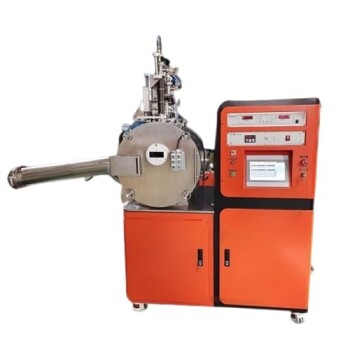
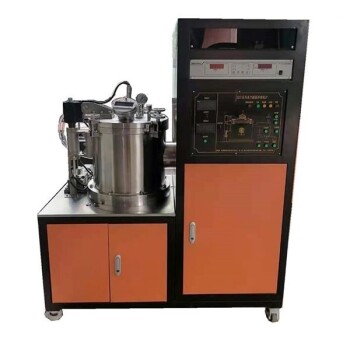
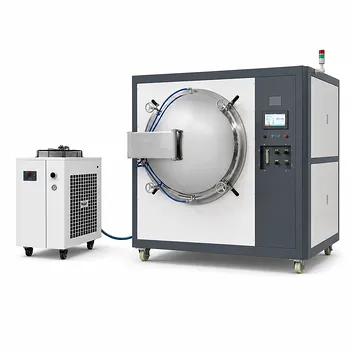
The vacuum arc melting furnace serves as the critical synthesis environment for AlCrFeCoNi high-entropy alloys, providing the extreme temperatures and atmospheric purity required to fuse disparate metallic elements. This equipment utilizes a high-energy electric arc to achieve complete atomic-level mixing of elements with significantly different melting points, such as aluminum and chromium, while operating under a protective argon shield to prevent oxidation.
Core Takeaway: The vacuum arc melting furnace is indispensable for HEA production because it enables the creation of a chemically homogenous, high-purity solid solution by combining localized extreme heat with a controlled, non-reactive environment.
Achieving Atomic-Level Mixing and Homogeneity
Overcoming Melting Point Disparities
AlCrFeCoNi alloys consist of elements with widely varying thermal properties, ranging from the low melting point of aluminum (660°C) to the high melting point of chromium (1907°C).
The high-energy electric arc generates intense localized heat that ensures all components, regardless of their individual melting points, reach a fully liquid phase simultaneously.
This rapid transition to a liquid state allows the metallic atoms to diffuse freely, facilitating the formation of the intended single-phase FCC or BCC solid solution structures.
The Importance of the Flip-Remelting Cycle
To ensure the final alloy does not suffer from component segregation, the furnace allows for multiple repeated melting cycles.
Operators typically use a non-consumable tungsten electrode to melt the ingot, then flip it over and remelt it several times within a water-cooled copper crucible.
This iterative process is essential for achieving chemical homogeneity, ensuring that the concentration of aluminum, chromium, iron, cobalt, and nickel is uniform throughout the entire ingot.
Ensuring Material Purity and Compositional Accuracy
Prevention of Oxidative Loss
Active metals like aluminum and chromium are highly susceptible to oxidation when heated to melting temperatures in the presence of oxygen.
The vacuum arc furnace eliminates this risk by evacuating the chamber and backfilling it with high-purity argon gas, creating an inert protective atmosphere.
By preventing the formation of oxides, the furnace ensures that the final "as-cast" alloy maintains the precise stoichiometric ratios required for high-entropy alloy research.
Removing Impurities and Contaminants
The high-vacuum environment effectively removes volatile impurities and dissolved gases from the raw metal powders during the initial heating phase.
Using a non-consumable tungsten electrode ensures that no foreign metallic elements are introduced into the melt, maintaining the high purity of the AlCrFeCoNi matrix.
This purity is vital for subsequent testing, such as molten salt corrosion research or mechanical deformation studies, where minor impurities could skew results.
Understanding the Trade-offs and Limitations
Rapid Solidification and Micro-segregation
While the water-cooled copper crucible prevents the melt from reacting with the container, it also causes rapid solidification.
This fast cooling can sometimes lead to micro-segregation or "coring" within the grain structure, which may require subsequent homogenization heat treatments to fully resolve.
Scale and Geometry Constraints
Laboratory-scale vacuum arc furnaces are typically limited to producing small, button-shaped ingots, which may not be suitable for large-scale industrial applications.
The process is also highly energy-intensive and requires meticulous preparation of raw materials to ensure the arc remains stable throughout the synthesis.
How to Apply This to Your Project
Making the Right Choice for Your Goal
- If your primary focus is experimental purity: Prioritize a furnace equipped with a high-vacuum pump and use high-purity (99.9%+) raw metal shards rather than fine powders to minimize surface oxides.
- If your primary focus is chemical homogeneity: Implement a minimum of five to seven "flip-and-remelt" cycles to ensure the aluminum is thoroughly dispersed within the transition metal matrix.
- If your primary focus is subsequent mechanical testing: Be prepared to follow the arc melting process with vacuum annealing to relieve internal stresses caused by the rapid cooling of the copper crucible.
The vacuum arc melting furnace remains the gold standard for HEA synthesis, providing the thermal power and environmental control necessary to transform raw elements into advanced, high-performance alloys.
Summary Table:
| Feature | Function in HEA Synthesis | Primary Benefit |
|---|---|---|
| High-Energy Arc | Generates localized extreme heat | Fuses elements with disparate melting points (e.g., Al vs. Cr) |
| Inert Argon Shield | Creates a non-reactive atmosphere | Prevents oxidative loss of active metals like Aluminum |
| Water-Cooled Crucible | Facilitates rapid solidification | Minimizes contamination from the container material |
| Flip-Remelt Cycle | Enables repeated melting iterations | Ensures absolute chemical homogeneity and atomic-level mixing |
| High-Vacuum System | Removes volatile impurities/gases | Produces high-purity ingots for accurate material testing |
Elevate Your HEA Research with KINTEK Precision
Achieving perfect homogeneity in AlCrFeCoNi high-entropy alloys requires equipment that refuses to compromise on purity or thermal control. KINTEK specializes in high-performance laboratory solutions tailored for advanced material science. Our state-of-the-art vacuum arc melting furnaces are engineered to provide the atmospheric integrity and high-energy stability essential for complex alloy synthesis.
Beyond synthesis, KINTEK offers a comprehensive ecosystem for your lab, including:
- Thermal Processing: Muffle, tube, vacuum, and atmosphere furnaces for crucial post-melt homogenization.
- Material Preparation: Precision crushing, milling systems, and hydraulic pellet presses.
- Specialized Research Tools: High-pressure reactors, electrolytic cells, and high-purity ceramic crucibles.
Whether you are a researcher focused on mechanical deformation or a developer of corrosion-resistant materials, KINTEK provides the reliability and expertise you need to drive innovation.
Ready to optimize your synthesis process? Contact KINTEK today for a tailored equipment consultation!
References
- Dávid Csík, Karel Saksl. High-Entropy Composite Coating Based on AlCrFeCoNi as an Anode Material for Li-Ion Batteries. DOI: 10.3390/coatings13071219
This article is also based on technical information from Kintek Solution Knowledge Base .
Related Products
- Vacuum Arc Induction Melting Furnace
- Vacuum Induction Melting Spinning System Arc Melting Furnace
- Non Consumable Vacuum Arc Induction Melting Furnace
- Vacuum Heat Treat Furnace and Levitation Induction Melting Furnace
- Lab-Scale Vacuum Induction Melting Furnace
People Also Ask
- How do vacuum induction or arc melting furnaces facilitate the synthesis of U-Al-C MAX phases? Precision Heat & Purity
- What core role does a Vacuum Induction Melting furnace play in nickel-free steel production? Achieve High-Purity Alloys
- What is the function of a vacuum arc melting furnace? Master Homogeneity for Amorphous Alloy Ribbons
- What is the function of a vacuum arc melting furnace? Prepare High-Purity Alx(CrFeNi)1-x High-Entropy Alloys
- What is the primary function of a vacuum arc melting furnace in RHEA preparation? Achieving Extreme Thermal Fusion