Knowledge What is the temperature of a carbon regeneration kiln? Mastering the 750-800°C Reactivation Process
Author avatar

Tech Team · Kintek Solution

Updated 6 days ago

What is the temperature of a carbon regeneration kiln? Mastering the 750-800°C Reactivation Process


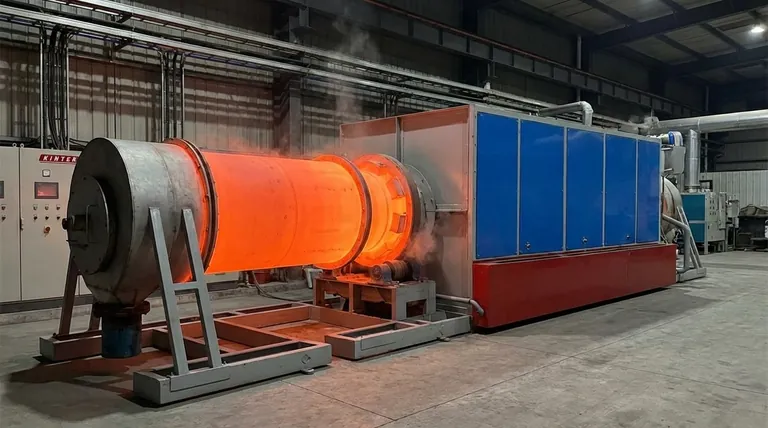
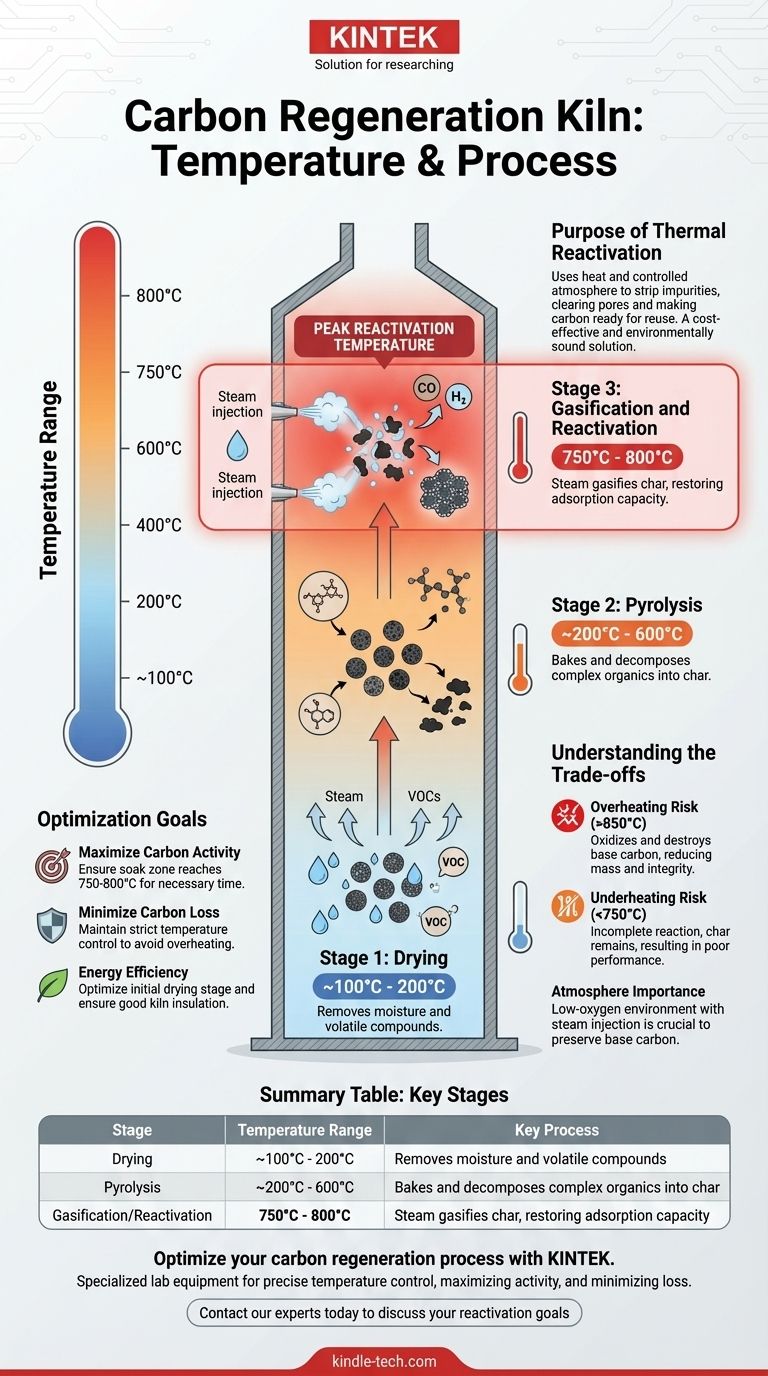
In practice, a carbon regeneration kiln operates across a range of temperatures, typically reaching a peak reactivation temperature between 750°C and 800°C (1382°F to 1472°F). This is not a single setting, but a carefully controlled thermal process with distinct stages designed to remove adsorbed impurities without destroying the carbon itself.

The core principle of carbon regeneration is not simply heating, but using a precise temperature profile to drive a sequence of reactions. The final, highest temperature stage uses steam to gasify and remove stubborn residues, which is what restores the carbon's valuable adsorptive capacity.
What is the temperature of a carbon regeneration kiln? Mastering the 750-800°C Reactivation Process

The Purpose of Thermal Reactivation

Activated carbon works by adsorbing impurities onto its vast internal pore structure. Over time, these pores become saturated, and the carbon loses its effectiveness.

The goal of a regeneration kiln is to use heat and a controlled atmosphere to strip these impurities away, clearing the pores and making the carbon ready for reuse. This is a far more cost-effective and environmentally sound solution than discarding and replacing the saturated carbon.

The Key Stages Inside the Kiln

The journey of carbon through a regeneration kiln is a multi-step process, with each temperature zone serving a specific purpose. The process generally moves from lower to higher temperatures.

Stage 1: Drying (~100°C - 200°C)

The first step is to remove water and moisture that the carbon has absorbed. This low-temperature heating also drives off the most volatile organic compounds that were adsorbed during service.

Stage 2: Pyrolysis (~200°C - 600°C)

As the temperature rises further, the more complex organic compounds that are strongly adsorbed onto the carbon begin to decompose. This process, known as pyrolysis or baking, breaks them down into a residual char of elemental carbon that remains within the pore structure.

Stage 3: Gasification and Reactivation (750°C - 800°C)

This is the most critical and highest-temperature phase. In this "soak zone," steam (water vapor) is injected into the kiln. At these elevated temperatures, the steam triggers a controlled chemical reaction with the char residue left behind from pyrolysis.

This reaction gasifies the unwanted char, converting it into carbon monoxide and hydrogen gas, which then exit the kiln. This step effectively cleans out the micropores, restoring the carbon's original adsorptive properties.

Understanding the Trade-offs

Achieving effective regeneration requires a delicate balance. The success of the entire process hinges on precise control over temperature and atmosphere.

The Risk of Overheating

If the temperature exceeds the optimal range (e.g., above 850°C), the steam and heat will begin to react with the activated carbon structure itself, not just the adsorbed residue. This oxidizes and destroys the base carbon, reducing its mass and structural integrity, leading to significant carbon loss and higher operational costs.

The Problem of Underheating

If the kiln does not reach the necessary gasification temperature (around 750°C), the reaction with steam will be incomplete. The pyrolytic char will remain in the pores, blocking active sites. The carbon will not be fully regenerated, resulting in poor performance when it is put back into service.

The Importance of the Atmosphere

Simply heating the carbon in the presence of air (oxygen) would cause it to burn away completely. The process relies on a low-oxygen environment and the controlled injection of steam to ensure only the unwanted residue is gasified while the valuable activated carbon structure is preserved.

Making the Right Choice for Your Goal

To optimize your regeneration process, you must align your operating parameters with your primary objective.

  • If your primary focus is maximizing carbon activity: Ensure the soak zone consistently reaches the target gasification temperature (750°C - 800°C) for the necessary residence time.
  • If your primary focus is minimizing carbon loss: Maintain strict temperature control to avoid overheating, as even small excursions above the target can significantly increase the oxidation of the base carbon.
  • If your primary focus is energy efficiency: Optimize the initial drying stage, as removing water is the most energy-intensive part of the process, and ensure the kiln is well-insulated to maintain thermal stability.

Mastering the distinct temperature stages of regeneration is the key to restoring carbon performance while maximizing its operational lifespan.

Summary Table:

Stage Temperature Range Key Process
Drying ~100°C - 200°C Removes moisture and volatile compounds
Pyrolysis ~200°C - 600°C Bakes and decomposes complex organics into char
Gasification/Reactivation 750°C - 800°C Steam gasifies char, restoring adsorption capacity

Optimize your carbon regeneration process with KINTEK.

Our specialized lab equipment and consumables are designed to help you achieve precise temperature control, maximize carbon activity, and minimize loss. Whether you're focused on performance, efficiency, or extending carbon lifespan, KINTEK has the solutions for your laboratory's needs.

Contact our experts today to discuss how we can support your reactivation goals.

Visual Guide
What is the temperature of a carbon regeneration kiln? Mastering the 750-800°C Reactivation Process Visual Guide

Related Products

People Also Ask

Related Products

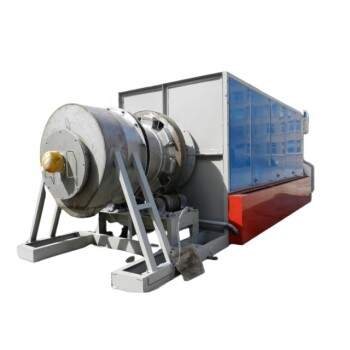
Electric Rotary Kiln Small Rotary Furnace for Activated Carbon Regeneration

Electric Rotary Kiln Small Rotary Furnace for Activated Carbon Regeneration

Revitalize your activated carbon with KinTek's Electric Regeneration Furnace. Achieve efficient and cost-effective regeneration with our highly automated rotary kiln and intelligent thermal controller.

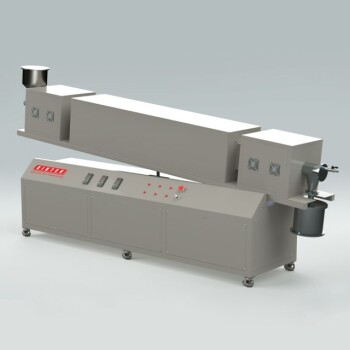
Vacuum Sealed Continuous Working Rotary Tube Furnace Rotating Tube Furnace

Vacuum Sealed Continuous Working Rotary Tube Furnace Rotating Tube Furnace

Experience efficient material processing with our vacuum-sealed rotary tube furnace. Perfect for experiments or industrial production, equipped with optional features for controlled feeding and optimized results. Order now.

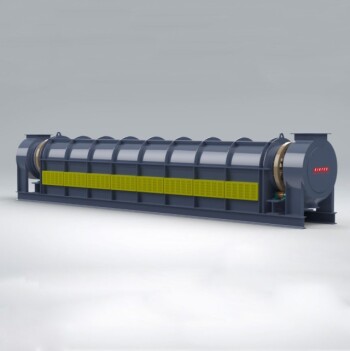
Electric Rotary Kiln Pyrolysis Furnace Plant Machine Calciner Small Rotary Kiln Rotating Furnace

Electric Rotary Kiln Pyrolysis Furnace Plant Machine Calciner Small Rotary Kiln Rotating Furnace

Electric rotary kiln - precisely controlled, it's ideal for calcination and drying of materials like lithium cobalate, rare earths, and non-ferrous metals.

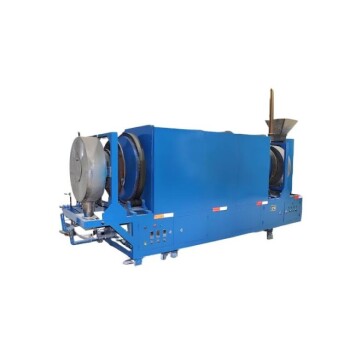
Electric Rotary Kiln Continuous Working Small Rotary Furnace Heating Pyrolysis Plant

Electric Rotary Kiln Continuous Working Small Rotary Furnace Heating Pyrolysis Plant

Efficiently calcine and dry bulk powder and lump fluid materials with an electric heating rotary furnace. Ideal for processing lithium ion battery materials and more.

Mesh belt controlled atmosphere furnace

Mesh belt controlled atmosphere furnace

Discover our KT-MB mesh belt sintering furnace - perfect for high-temperature sintering of electronic components & glass insulators. Available for open air or controlled atmosphere environments.

1200℃ Split Tube Furnace with Quartz Tube Laboratory Tubular Furnace

1200℃ Split Tube Furnace with Quartz Tube Laboratory Tubular Furnace

KT-TF12 split tube furnace: high-purity insulation, embedded heating wire coils, and max. 1200C. Widely used for new materials and chemical vapour deposition.

Laboratory Muffle Oven Furnace Bottom Lifting Muffle Furnace

Laboratory Muffle Oven Furnace Bottom Lifting Muffle Furnace

Efficiently produce batches with excellent temperature uniformity using our Bottom Lifting Furnace. Features two electric lifting stages and advanced temperature control up to 1600℃.

Graphite Vacuum Continuous Graphitization Furnace

Graphite Vacuum Continuous Graphitization Furnace

High-temperature graphitization furnace is a professional equipment for graphitization treatment of carbon materials. It is a key equipment for the production of high-quality graphite products. It has high temperature, high efficiency and uniform heating. It is suitable for various high-temperature treatments and graphitization treatments. It is widely used in metallurgy, electronics, aerospace, etc. industry.

Ultra-High Temperature Graphite Vacuum Graphitization Furnace

Ultra-High Temperature Graphite Vacuum Graphitization Furnace

The ultra-high temperature graphitization furnace utilizes medium frequency induction heating in a vacuum or inert gas environment. The induction coil generates an alternating magnetic field, inducing eddy currents in the graphite crucible, which heats up and radiates heat to the workpiece, bringing it to the desired temperature. This furnace is primarily used for graphitization and sintering of carbon materials, carbon fiber materials, and other composite materials.

Vertical High Temperature Graphite Vacuum Graphitization Furnace

Vertical High Temperature Graphite Vacuum Graphitization Furnace

Vertical high temperature graphitization furnace for carbonization and graphitization of carbon materials up to 3100℃.Suitable for shaped graphitization of carbon fiber filaments and other materials sintered in a carbon environment.Applications in metallurgy, electronics, and aerospace for producing high-quality graphite products like electrodes and crucibles.

Small Vacuum Heat Treat and Tungsten Wire Sintering Furnace

Small Vacuum Heat Treat and Tungsten Wire Sintering Furnace

The small vacuum tungsten wire sintering furnace is a compact experimental vacuum furnace specially designed for universities and scientific research institutes. The furnace features a CNC welded shell and vacuum piping to ensure leak-free operation. Quick-connect electrical connections facilitate relocation and debugging, and the standard electrical control cabinet is safe and convenient to operate.

Customizable PEM Electrolysis Cells for Diverse Research Applications

Customizable PEM Electrolysis Cells for Diverse Research Applications

Custom PEM test cell for electrochemical research. Durable, versatile, for fuel cells & CO2 reduction. Fully customizable. Get a quote!

Vacuum Hot Press Furnace Machine for Lamination and Heating

Vacuum Hot Press Furnace Machine for Lamination and Heating

Experience clean and precise lamination with Vacuum Lamination Press. Perfect for wafer bonding, thin-film transformations, and LCP lamination. Order now!

Glassy Carbon Sheet RVC for Electrochemical Experiments

Glassy Carbon Sheet RVC for Electrochemical Experiments

Discover our Glassy Carbon Sheet - RVC. Perfect for your experiments, this high-quality material will elevate your research to the next level.

Platinum Sheet Electrode for Laboratory and Industrial Applications

Platinum Sheet Electrode for Laboratory and Industrial Applications

Elevate your experiments with our Platinum Sheet Electrode. Crafted with quality materials, our safe and durable models can be tailored to fit your needs.

Platinum Auxiliary Electrode for Laboratory Use

Platinum Auxiliary Electrode for Laboratory Use

Optimize your electrochemical experiments with our Platinum Auxiliary Electrode. Our high-quality, customizable models are safe and durable. Upgrade today!

Automatic Laboratory Heat Press Machine

Automatic Laboratory Heat Press Machine

Precision automatic heat press machines for labs—ideal for material testing, composites, and R&D. Customizable, safe, and efficient. Contact KINTEK today!

FS Electrochemical Hydrogen Fuel Cells for Diverse Applications

FS Electrochemical Hydrogen Fuel Cells for Diverse Applications

KINTEK's FS Electrochemical Cell: Modular PEM fuel cell stack for R&D and training. Acid-resistant, scalable, and customizable for reliable performance.

Automatic Lab Cold Isostatic Press CIP Machine Cold Isostatic Pressing

Automatic Lab Cold Isostatic Press CIP Machine Cold Isostatic Pressing

Efficiently prepare samples with our Automatic Lab Cold Isostatic Press. Widely used in material research, pharmacy, and electronic industries. Provides greater flexibility and control compared to electric CIPs.

High Temperature Constant Temperature Heating Circulator Water Bath Chiller Circulator for Reaction Bath

High Temperature Constant Temperature Heating Circulator Water Bath Chiller Circulator for Reaction Bath

Efficient and reliable, KinTek KHB Heating Circulator is perfect for your lab needs. With a max. heating temperature of up to 300℃, it features accurate temperature control and fast heating.


Leave Your Message