Knowledge Resources What maintenance should I do on my furnace? A Proactive Guide to Safety and Reliability
Author avatar

Tech Team · Kintek Solution

Updated 3 months ago

What maintenance should I do on my furnace? A Proactive Guide to Safety and Reliability


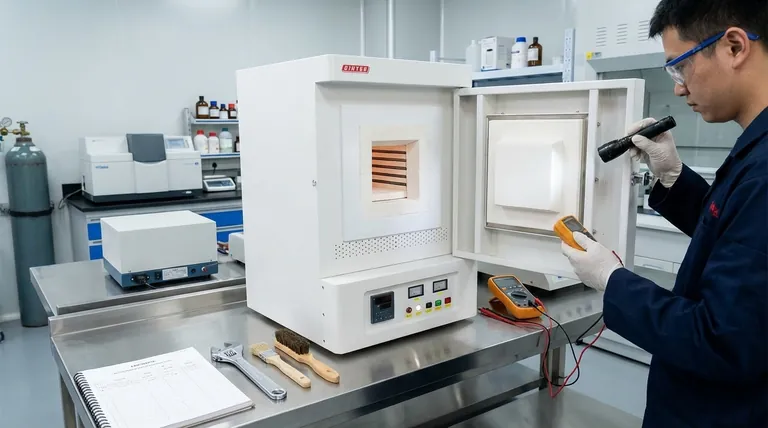
Effective furnace maintenance is a disciplined routine of inspection and cleaning, crucial for preventing accidents and ensuring the long-term reliability of your equipment. At its core, this involves regularly cleaning the furnace chamber, meticulously inspecting all electrical connections and heating elements, and verifying the integrity of auxiliary systems like cooling circuits and vacuum pumps.

The goal of furnace maintenance is to shift from reactive repair to proactive system management. Consistent checks on electrical integrity, contamination levels, and system performance are what separate a reliable workhorse from a source of constant downtime and operational risk.
What maintenance should I do on my furnace? A Proactive Guide to Safety and Reliability

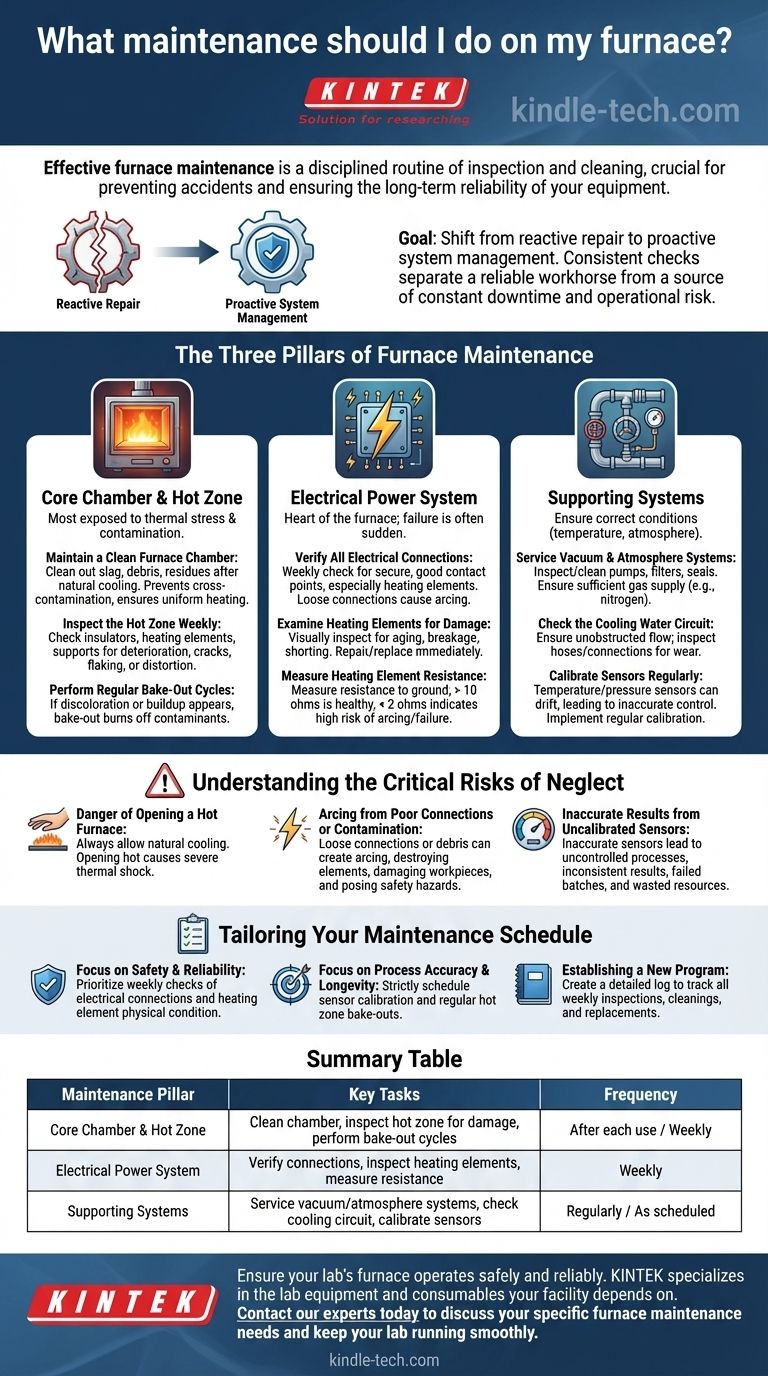
The Three Pillars of Furnace Maintenance

Proper maintenance can be organized into three key areas: the core heating chamber, the electrical power system, and the essential supporting systems. Neglecting any one of these can compromise the entire operation.

Pillar 1: The Core Chamber and Hot Zone

This is where the work happens, and it's the area most exposed to thermal stress and contamination.

Maintain a Clean Furnace Chamber

After the furnace has cooled naturally, always clean out any slag, debris, or process residues. A clean chamber prevents cross-contamination and ensures more uniform heating.

Inspect the Hot Zone Weekly

The hot zone—including insulators, heating elements, and work supports—should be examined weekly. Look for signs of deterioration like cracks, flaking insulation, or physical distortion.

Perform Regular Bake-Out Cycles

If you notice discoloration on insulators or buildup in gas nozzles, a bake-out cycle can help clean the hot zone. This process burns off contaminants that accumulate over time.

Pillar 2: The Electrical Power System

The electrical system is the furnace's heart. Its failure is often sudden and can be catastrophic, making regular inspection a non-negotiable task.

Verify All Electrical Connections

At least once a week, check that all electrical connections are secure and in good contact. Pay special attention to the connection points for the heating elements, as loose connections here can cause arcing and failure.

Examine Heating Elements for Damage

Visually inspect the heating elements for signs of aging, breakage, or short-circuiting. Any compromised element should be repaired or replaced immediately to prevent uneven heating or complete failure.

Measure Heating Element Resistance

For a more technical check, measure the heating element's resistance to ground. A healthy reading should be greater than 10 ohms; a reading below 2 ohms indicates a high risk of arcing and imminent failure.

Pillar 3: Supporting Systems

These systems ensure the furnace can operate under the correct conditions, from temperature to atmosphere.

Service Vacuum and Atmosphere Systems

If you use a vacuum furnace, this includes inspecting and cleaning the vacuum pump and replacing filters and seals. For atmosphere furnaces, ensure your supply of process gas, such as high-purity nitrogen, is sufficient.

Check the Cooling Water Circuit

Ensure the cooling water circuit is unobstructed and flowing smoothly. Inspect hoses and connections for wear or damage and replace them proactively.

Calibrate Sensors Regularly

Temperature and pressure sensors can drift over time, leading to inaccurate process control. Implement a regular calibration schedule to ensure your furnace is operating at the specified parameters.

Understanding the Critical Risks of Neglect

Skipping maintenance isn't a trade-off; it's an acceptance of risk. Understanding these risks reinforces the importance of a consistent maintenance routine.

The Danger of Opening a Hot Furnace

After a cycle, always cut the power and allow the furnace to cool down naturally. Opening the furnace door while it is still hot can cause severe thermal shock to the chamber and heating elements, drastically reducing their lifespan.

Arcing from Poor Connections or Contamination

A loose electrical connection or conductive debris in the chamber can create an electrical arc. This can destroy a heating element, damage the workpiece, and pose a significant safety hazard.

Inaccurate Results from Uncalibrated Sensors

If your temperature or pressure sensors are not accurate, your process is not controlled. This leads to inconsistent results, failed batches, and wasted resources, directly impacting quality and efficiency.

Tailoring Your Maintenance Schedule

Use these guidelines to build a routine that matches your operational priorities.

  • If your primary focus is safety and reliability: Prioritize weekly checks of all electrical connections and the physical condition of the heating elements.
  • If your primary focus is process accuracy and longevity: Implement a strict schedule for sensor calibration and regular hot zone bake-outs to prevent contamination.
  • If you are establishing a new maintenance program: Start by creating a detailed log to track all weekly inspections, cleanings, and any component replacements.

A well-maintained furnace is a predictable asset, not an unpredictable liability.

Summary Table:

Maintenance Pillar Key Tasks Frequency
Core Chamber & Hot Zone Clean chamber, inspect hot zone for damage, perform bake-out cycles After each use / Weekly
Electrical Power System Verify connections, inspect heating elements, measure resistance Weekly
Supporting Systems Service vacuum/atmosphere systems, check cooling circuit, calibrate sensors Regularly / As scheduled

Ensure your lab's furnace operates safely and reliably. KINTEK specializes in the lab equipment and consumables your facility depends on. From replacement heating elements and thermocouples to expert advice on maintenance schedules, we provide the support you need to minimize downtime and maximize productivity. Contact our experts today to discuss your specific furnace maintenance needs and keep your lab running smoothly.

Visual Guide
What maintenance should I do on my furnace? A Proactive Guide to Safety and Reliability Visual Guide

Related Products

People Also Ask

Related Products

Graphite Vacuum Furnace High Thermal Conductivity Film Graphitization Furnace

Graphite Vacuum Furnace High Thermal Conductivity Film Graphitization Furnace

The high thermal conductivity film graphitization furnace has uniform temperature, low energy consumption and can operate continuously.

High Temperature Muffle Oven Furnace for Laboratory Debinding and Pre Sintering

High Temperature Muffle Oven Furnace for Laboratory Debinding and Pre Sintering

KT-MD High temperature debinding and pre-sintering furnace for ceramic materials with various molding processes. Ideal for electronic components such as MLCC and NFC.

1700℃ Controlled Atmosphere Furnace Nitrogen Inert Atmosphere Furnace

1700℃ Controlled Atmosphere Furnace Nitrogen Inert Atmosphere Furnace

KT-17A Controlled atmosphere furnace: 1700℃ heating, vacuum sealing technology, PID temperature control, and versatile TFT smart touch screen controller for laboratory and industrial use.

Vertical High Temperature Graphite Vacuum Graphitization Furnace

Vertical High Temperature Graphite Vacuum Graphitization Furnace

Vertical high temperature graphitization furnace for carbonization and graphitization of carbon materials up to 3100℃.Suitable for shaped graphitization of carbon fiber filaments and other materials sintered in a carbon environment.Applications in metallurgy, electronics, and aerospace for producing high-quality graphite products like electrodes and crucibles.

1700℃ Muffle Oven Furnace for Laboratory

1700℃ Muffle Oven Furnace for Laboratory

Get superior heat control with our 1700℃ Muffle Furnace. Equipped with intelligent temperature microprocessor, TFT touch screen controller & advanced insulation materials for precise heating up to 1700C. Order now!

1200℃ Split Tube Furnace with Quartz Tube Laboratory Tubular Furnace

1200℃ Split Tube Furnace with Quartz Tube Laboratory Tubular Furnace

KT-TF12 split tube furnace: high-purity insulation, embedded heating wire coils, and max. 1200C. Widely used for new materials and chemical vapour deposition.

Ultra-High Temperature Graphite Vacuum Graphitization Furnace

Ultra-High Temperature Graphite Vacuum Graphitization Furnace

The ultra-high temperature graphitization furnace utilizes medium frequency induction heating in a vacuum or inert gas environment. The induction coil generates an alternating magnetic field, inducing eddy currents in the graphite crucible, which heats up and radiates heat to the workpiece, bringing it to the desired temperature. This furnace is primarily used for graphitization and sintering of carbon materials, carbon fiber materials, and other composite materials.

Graphite Vacuum Furnace Bottom Discharge Graphitization Furnace for Carbon Materials

Graphite Vacuum Furnace Bottom Discharge Graphitization Furnace for Carbon Materials

Bottom-out graphitization furnace for carbon materials, ultra-high temperature furnace up to 3100°C, suitable for graphitization and sintering of carbon rods and carbon blocks. Vertical design, bottom discharging, convenient feeding and discharging, high temperature uniformity, low energy consumption, good stability, hydraulic lifting system, convenient loading and unloading.

Controlled Nitrogen Inert Hydrogen Atmosphere Furnace

Controlled Nitrogen Inert Hydrogen Atmosphere Furnace

KT-AH Hydrogen atmosphere furnace - induction gas furnace for sintering/annealing with built-in safety features, dual housing design, and energy-saving efficiency. Ideal for lab and industrial use.

Large Vertical Graphite Vacuum Graphitization Furnace

Large Vertical Graphite Vacuum Graphitization Furnace

A large vertical high-temperature graphitization furnace is a type of industrial furnace used for the graphitization of carbon materials, such as carbon fiber and carbon black. It is a high-temperature furnace that can reach temperatures of up to 3100°C.

600T Vacuum Induction Hot Press Furnace for Heat Treat and Sintering

600T Vacuum Induction Hot Press Furnace for Heat Treat and Sintering

Discover the 600T Vacuum Induction Hot Press Furnace, designed for high-temperature sintering experiments in vacuum or protected atmospheres. Its precise temperature and pressure control, adjustable working pressure, and advanced safety features make it ideal for nonmetal materials, carbon composites, ceramics, and metal powders.

Laboratory Muffle Oven Furnace Bottom Lifting Muffle Furnace

Laboratory Muffle Oven Furnace Bottom Lifting Muffle Furnace

Efficiently produce batches with excellent temperature uniformity using our Bottom Lifting Furnace. Features two electric lifting stages and advanced temperature control up to 1600℃.

Vacuum Hot Press Furnace Machine Heated Vacuum Press

Vacuum Hot Press Furnace Machine Heated Vacuum Press

Discover the advantages of Vacuum Hot Press Furnace! Manufacture dense refractory metals & compounds, ceramics, and composites under high temp and pressure.

Vacuum Sealed Continuous Working Rotary Tube Furnace Rotating Tube Furnace

Vacuum Sealed Continuous Working Rotary Tube Furnace Rotating Tube Furnace

Experience efficient material processing with our vacuum-sealed rotary tube furnace. Perfect for experiments or industrial production, equipped with optional features for controlled feeding and optimized results. Order now.

Vacuum Heat Treat and Molybdenum Wire Sintering Furnace for Vacuum Sintering

Vacuum Heat Treat and Molybdenum Wire Sintering Furnace for Vacuum Sintering

A vacuum molybdenum wire sintering furnace is a vertical or bedroom structure, which is suitable for withdrawal, brazing, sintering and degassing of metal materials under high vacuum and high temperature conditions. It is also suitable for dehydroxylation treatment of quartz materials.

Electric Rotary Kiln Pyrolysis Furnace Plant Machine Calciner Small Rotary Kiln Rotating Furnace

Electric Rotary Kiln Pyrolysis Furnace Plant Machine Calciner Small Rotary Kiln Rotating Furnace

Electric rotary kiln - precisely controlled, it's ideal for calcination and drying of materials like lithium cobalate, rare earths, and non-ferrous metals.

2200 ℃ Graphite Vacuum Heat Treat Furnace

2200 ℃ Graphite Vacuum Heat Treat Furnace

Discover the power of the KT-VG Graphite Vacuum Furnace - with a maximum working temperature of 2200℃, it's perfect for vacuum sintering of various materials. Learn more now.

Dental Porcelain Zirconia Sintering Ceramic Furnace Chairside with Transformer

Dental Porcelain Zirconia Sintering Ceramic Furnace Chairside with Transformer

Experience top-notch sintering with Chairside Sintering Furnace with Transformer. Easy to operate, noise-free pallet, and automatic temperature calibration. Order now!

Horizontal High Temperature Graphite Vacuum Graphitization Furnace

Horizontal High Temperature Graphite Vacuum Graphitization Furnace

Horizontal Graphitization Furnace: This type of furnace is designed with the heating elements placed horizontally, allowing for uniform heating of the sample. It's well-suited for graphitizing large or bulky samples that require precise temperature control and uniformity.

Vacuum Heat Treat and Pressure Sintering Furnace for High Temperature Applications

Vacuum Heat Treat and Pressure Sintering Furnace for High Temperature Applications

Vacuum pressure sintering furnaces are designed for high temperature hot pressing applications in metal and ceramic sintering. Its advanced features ensure precise temperature control, reliable pressure maintenance, and a robust design for seamless operation.


Leave Your Message