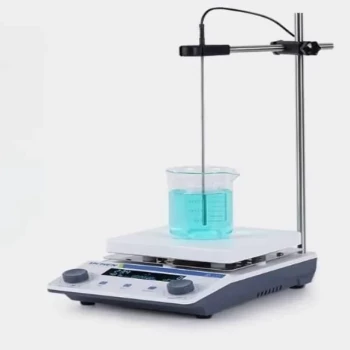
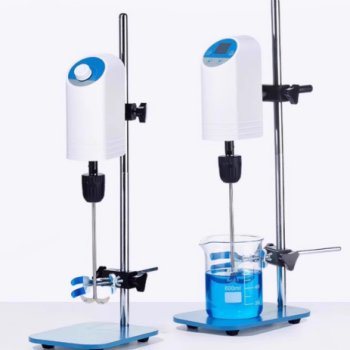
The magnetic stirrer and stirring bar act as the critical stabilization mechanism for your reaction environment. By driving the stirring bar at high speeds, the device forces aluminum core-shell particles into a uniform suspension within distilled water, ensuring constant and even physical distribution.
Reliable kinetic data requires the elimination of physical variables. The magnetic stirrer ensures that the measured hydrogen production represents the material's inherent chemical reactivity, rather than artifacts caused by particle settling or stagnant water.
Achieving a Uniform Reaction Environment
Combatting Particle Settling
The primary physical challenge in these reactions is gravity. Without active intervention, aluminum core-shell particles will naturally settle to the bottom of the reactor.
High-Speed Mechanical Agitation
The stirrer drives the bar at high speeds to counteract this settling. This continuous energy input maintains the particles in a dynamic, suspended state throughout the experiment.
Ensuring Data Accuracy
Eliminating Local Gradients
Static reactions create local concentration gradients where reagents are depleted near the particle surface. The stirrer's agitation constantly refreshes the distilled water in contact with the particles.
Measuring True Kinetics
To generate accurate hydrogen production curves, every particle surface must be equally exposed to the reactant. This setup ensures the data reflects the inherent reaction kinetic characteristics of the aluminum, not the diffusion rate of water.
Common Pitfalls to Avoid
The Risk of Inadequate Mixing
If the stirring speed is insufficient, particles may clump or settle. This leads to reduced surface area exposure and artificially low reaction rates.
Misinterpreting Diffusion as Kinetics
Without vigorous agitation, you risk measuring the speed of diffusion rather than the chemical reaction itself. The stirrer is the safeguard that separates physical transport limitations from true chemical kinetics.
Maximizing Experimental Reliability
To ensure your kinetic evaluation is valid, you must isolate the chemical reaction from physical constraints.
- If your primary focus is establishing baseline kinetics: Maintain high rotational speeds to ensure the reaction is chemically controlled rather than diffusion controlled.
- If your primary focus is comparing material variants: Use consistent stirring parameters to ensure differences in hydrogen production curves are due to material properties, not suspension quality.
Consistency in agitation is the key to reproducible kinetic data.
Summary Table:
| Feature | Role in Reaction Kinetics | Impact on Data Accuracy |
|---|---|---|
| High-Speed Agitation | Counteracts particle settling/gravity | Maintains uniform particle suspension |
| Mechanical Energy | Eliminates local concentration gradients | Ensures reaction is chemically controlled |
| Stirring Bar Motion | Constant refreshing of reactant surface | Provides reproducible hydrogen curves |
| Diffusion Control | Minimizes physical transport limitations | Measures inherent material reactivity |
Elevate Your Material Research with KINTEK
Precision in kinetic evaluation starts with reliable laboratory equipment. At KINTEK, we specialize in high-performance laboratory solutions tailored for advanced material science and battery research. Whether you are analyzing hydrogen production with our magnetic stirrers, utilizing high-temperature high-pressure reactors and autoclaves, or preparing samples with our crushing and milling systems, we provide the tools necessary to eliminate variables and achieve reproducible results.
From PTFE consumables and ceramics to sophisticated electrolytic cells, KINTEK is committed to supporting your lab’s efficiency and accuracy. Contact us today to find the perfect equipment for your research and experience the KINTEK advantage in precision engineering.
References
- Olesya A. Buryakovskaya, Anatoly V. Grigorenko. Effect of Thermal Treatment of Aluminum Core-Shell Particles on Their Oxidation Kinetics in Water for Hydrogen Production. DOI: 10.3390/ma14216493
This article is also based on technical information from Kintek Solution Knowledge Base .
Related Products
- Laboratory Small Constant Temperature Heated Magnetic Stirrer Heater and Stirrer
- Custom PTFE Teflon Parts Manufacturer for Magnetic Stirring Bar
- High Performance Laboratory Stirrers for Diverse Applications
- Three-dimensional electromagnetic sieving instrument
- Custom PTFE Teflon Parts Manufacturer for PTFE Stirring Bar Recovery Rod
People Also Ask
- What role does a magnetic stirrer with heating play in ZnO nanoparticle synthesis? Precision Control for Quality Results
- What role does a constant temperature heating magnetic stirrer play in MFC-HAp synthesis? Achieve Material Homogeneity
- What is the function of a laboratory magnetic stirrer in Ni–Cr–P electrodeposition? Optimize Ion Transport & Coating
- Why is a laboratory magnetic stirrer required for benzoic acid esters? Boost Reaction Speed & Yield with High RPM
- What role does a laboratory magnetic stirrer play in TiO2 and TiO2-Ag sol preparation? Master Chemical Kinetics