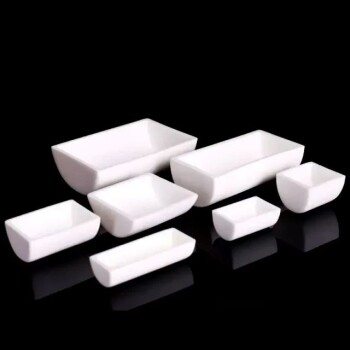
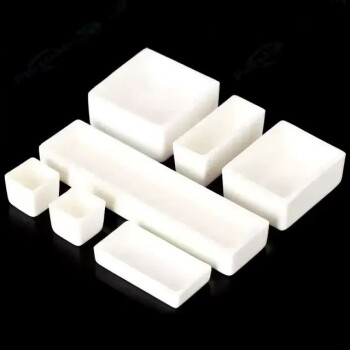
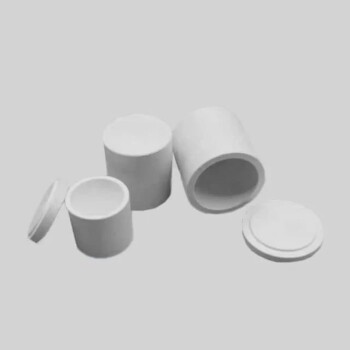
Alumina crucibles serve as the essential, chemically inert containment vessels required for synthesizing lithium salt precursors. Specifically, they withstand the corrosive nature of strong alkaline mixtures—such as lithium hydroxide (LiOH) and boric acid (H3BO3)—while maintaining structural integrity during high-temperature sintering.
Core Takeaway The success of synthesizing Li3BO3 relies on the crucible’s ability to resist chemical attack from molten alkalis while maintaining thermal stability. Alumina provides a neutral environment that prevents container-sample reactions, ensuring the final product maintains its intended purity and stoichiometric ratio.
The Chemical Challenge of Lithium Synthesis
Handling Corrosive Precursors
Synthesizing lithium borate (Li3BO3) typically involves reacting lithium hydroxide (LiOH) with boric acid.
Lithium hydroxide is a strong alkali, which can be highly corrosive to standard laboratory glassware or weaker ceramics when heated.
Withstanding Sintering Temperatures
The synthesis process requires distinct thermal phases.
The mixture is typically sintered at temperatures between 500°C and 600°C to drive the reaction.
Supplemental processing, such as preparing glass precursors, may require even higher temperatures, necessitating resistance up to 900°C.
Why Alumina is the Material of Choice
Superior Chemical Inertness
The primary role of the alumina crucible is to act as a non-reactive barrier.
During the heating process, the alumina does not react with the alkaline lithium mixture.
This inertness is critical because any reaction between the vessel and the precursors would introduce impurities into the final Li3BO3 product.
Preserving Stoichiometry
Precise chemical composition is vital for material science applications.
By resisting corrosion, alumina crucibles ensure that the stoichiometric ratio of the reactants remains unchanged throughout the experiment.
This guarantees that the calculated amount of lithium and boron input results in the exact desired output without loss to the container walls.
Stability in Furnace Environments
Alumina crucibles are mechanically robust enough to function within vertical electric furnaces.
They provide a stable container for the raw materials to fully melt, a necessary condition for achieving a homogenous mixture.
This stability prepares the material for subsequent processing steps, such as rapid quenching.
Operational Considerations and Trade-offs
Temperature Limits and Melting
While alumina is stable at the 500°C–600°C range used for sintering, operators must be mindful of the material's upper limits.
Alumina performs exceptionally well up to 900°C for molten salts, but extreme temperatures combined with specific corrosive fluxes can eventually degrade the ceramic over repeated cycles.
Thermal Shock Sensitivity
Alumina is a ceramic and acts as a thermal insulator, but it can be susceptible to thermal shock.
While the material is excellent for the heating phase of synthesis, rapid temperature changes (such as immediate quenching of the crucible itself) can cause cracking.
The "rapid quenching" mentioned in processing usually refers to quenching the molten contents, not necessarily plunging the hot crucible itself into coolant.
Making the Right Choice for Your Project
When selecting containment for lithium precursor synthesis, align your choice with your specific experimental requirements.
- If your primary focus is Chemical Purity: Rely on alumina to prevent alkaline corrosion from altering your Li3BO3 stoichiometry.
- If your primary focus is High-Temperature Processing: utilize alumina for its stability in electric furnaces at temperatures ranging from 500°C up to 900°C.
Alumina provides the necessary balance of thermal resilience and chemical resistance to turn volatile precursors into stable, high-quality salts.
Summary Table:
| Feature | Benefit in Li3BO3 Synthesis |
|---|---|
| Chemical Inertness | Prevents reactions with corrosive lithium hydroxide (LiOH) |
| Thermal Stability | Maintains integrity during sintering phases (500°C - 900°C) |
| Stoichiometry Control | Ensures precise reactant ratios by preventing container-sample loss |
| Durability | High resistance to strong alkaline fluxes in furnace environments |
Elevate Your Material Research with KINTEK Precision
Maximize the purity and consistency of your lithium salt precursors with KINTEK’s high-performance laboratory solutions. From premium alumina and ceramic crucibles designed to withstand corrosive alkaline environments to our advanced high-temperature muffle and tube furnaces, we provide the tools necessary for precision sintering and synthesis.
Whether you are developing battery research materials or specialized chemical precursors, our experts are ready to equip your lab with the industry's most reliable high-temperature furnaces, crushing systems, and essential consumables.
Ready to optimize your synthesis workflow? Contact KINTEK today for a consultation and quote!
Related Products
- Arc-Shaped Alumina Ceramic Crucible High Temperature Resistant for Engineering Advanced Fine Ceramics
- Alumina Al2O3 Ceramic Crucible Semicircle Boat with Lid for Engineering Advanced Fine Ceramics
- Engineering Advanced Fine Ceramics Alumina Al2O3 Crucible With Lid Cylindrical Laboratory Crucible
- Engineering Advanced Fine Ceramics Alumina Crucibles (Al2O3) for Thermal Analysis TGA DTA
- Engineering Advanced Fine Alumina Al2O3 Ceramic Crucible for Laboratory Muffle Furnace
People Also Ask
- Why Use Alumina Crucibles & Powder Burial for NaSICON? Ensure Phase Purity and Prevent Elemental Volatilization
- What is the primary purpose of using alumina crucibles for LLTO ceramics? Optimize Your High-Temperature Sintering
- Why are alumina crucibles and mother powder essential for LATP sintering? Optimize Your Solid Electrolyte Performance
- Why are high-purity alumina crucibles used for liquid lead corrosion experiments? Ensure Data Accuracy at 550°C
- Primary considerations for choosing alumina crucibles and quartz tubes in indium intercalation: Ensure Material Purity