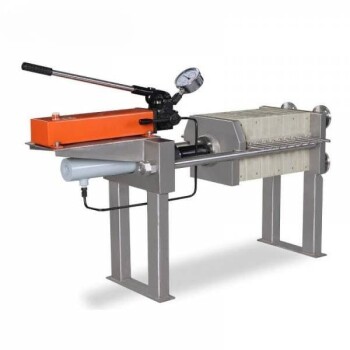
The fundamental scientific principle governing the operation of a hydraulic press is Pascal’s Law (also known as Pascal's Principle). This law states that when pressure is applied to a confined fluid, that pressure is transmitted undiminished and equally in all directions throughout the fluid. By utilizing this constant pressure across two areas of different sizes, a hydraulic press can transform a small mechanical force into a significantly larger compressive force.
Core Takeaway A hydraulic press does not create energy; it acts as a force multiplier based on fluid mechanics. By applying Pascal's Law, the system leverages a constant pressure to generate a massive output force on a large surface area using only a modest input force on a small surface area.
The Mechanics of Force Multiplication
To understand how a hydraulic press crushes resistant materials with ease, you must look past the heavy machinery and focus on the fluid dynamics inside.
The Constant Pressure Rule
According to Pascal's Law, fluid in a closed system acts as a perfect transmission medium.
If you apply pressure to one part of the liquid, that exact same pressure intensity appears instantly at every other point in the container. The pressure does not diminish as it travels.
The Two-Piston Setup
A standard hydraulic press consists of two cylinders connected by a pipe containing fluid (usually oil).
One cylinder has a small diameter (often called the Plunger), and the other has a large diameter (the Ram). The fluid connects them, ensuring they share the same internal pressure environment.
Force vs. Area
The magic happens because of the relationship between Force, Pressure, and Area ($P = F/A$).
Because the pressure ($P$) remains constant throughout the system, the force ($F$) must change if the surface area ($A$) changes. A larger surface area translates that constant pressure into a much larger total force.
The Mathematical Relationship
The primary reference provides the formula that engineers use to calculate exactly how much "strength" a press has.
The Equation
The output force ($F2$) is determined by the input force ($F1$) multiplied by the ratio of the two areas. $F2 = F1 \times (A2 / A1)$
How to Interpret the Formula
$A1$ is the area of the small input piston, and $A2$ is the area of the large output piston.
If the output area ($A2$) is 10 times larger than the input area ($A1$), the output force ($F2$) will be 10 times greater than the input force ($F1$).
The Role of the Pump
In practical terms, the smaller piston acts as a pump.
It delivers a modest mechanical force to the fluid. The fluid then transmits this pressure to the larger piston, effectively magnifying the force to perform heavy work, such as crushing or molding.
Understanding the Trade-offs
While Pascal’s Law allows for immense force multiplication, it is subject to the conservation of energy. You do not get "something for nothing."
The Sacrifice of Distance
To gain force, you must sacrifice movement distance.
If you magnify the force by a factor of 10, the input piston must move 10 times further to move the output piston just one unit of distance.
Speed vs. Power
Because of the distance requirement, hydraulic presses are generally slower than mechanical presses.
The small piston (Plunger) often has to pump rapidly or move a long distance to generate a small amount of movement in the large ram.
Making the Right Choice for Your Goal
Understanding Pascal's Law helps you manipulate the variables of a hydraulic system to suit your specific needs.
- If your primary focus is Maximizing Force: Decrease the diameter of the input piston (Plunger) or increase the diameter of the output piston (Ram) to increase the area ratio.
- If your primary focus is Speed of Operation: Increase the size of the input piston, acknowledging that you will require more input force to achieve the same pressure.
- If your primary focus is System Integrity: Ensure the fluid remains completely confined, as any leak breaks the "closed system" requirement of Pascal's Law and drops pressure instantly.
Mastering a hydraulic press is simply a matter of managing the ratio between your input area and your output area.
Summary Table:
| Feature | Small Piston (Plunger) | Large Piston (Ram) |
|---|---|---|
| Surface Area | Small ($A_1$) | Large ($A_2$) |
| Applied Force | Modest Input ($F_1$) | Magnified Output ($F_2$) |
| Pressure | Constant ($P$) | Constant ($P$) |
| Movement Distance | Long | Short |
| Function | Force Input/Pump | Work Execution/Crushing |
Elevate Your Lab's Precision with KINTEK
Maximize your material processing efficiency with KINTEK’s advanced hydraulic systems. Whether you need pellet, hot, or isostatic hydraulic presses, our equipment is engineered to leverage Pascal's Law for maximum consistency and power.
Beyond pressing, KINTEK offers a full suite of laboratory solutions—from high-temperature furnaces and crushing systems to high-pressure reactors and battery research tools.
Ready to optimize your workflow? Contact our experts today to find the perfect equipment tailored to your research or production needs!
Related Products
- Heated Hydraulic Press Machine with Heated Plates for Vacuum Box Laboratory Hot Press
- Automatic High Temperature Heated Hydraulic Press Machine with Heated Plates for Lab
- Manual High Temperature Heated Hydraulic Press Machine with Heated Plates for Lab
- Heated Hydraulic Press Machine with Integrated Manual Heated Plates for Lab Use
- 24T 30T 60T Heated Hydraulic Press Machine with Heated Plates for Laboratory Hot Press
People Also Ask
- Why is a heated laboratory hydraulic press necessary for composite laminates? Achieve Void-Free Structural Integrity
- What technical conditions does a heated hydraulic press provide for PEO batteries? Optimize Solid-State Interfaces
- What is the core function of a laboratory heated hydraulic press in CSP? Revolutionize Low-Temp Ceramic Sintering
- How is a heated hydraulic press used for Li-LLZO batteries? Optimize Interfacial Bonding with Thermal-Pressure
- What are heated hydraulic presses used for? Molding Composites, Vulcanizing Rubber, and More