Knowledge Which method of heat transfer occur in a vacuum? Unlocking the Power of Thermal Radiation
Author avatar

Tech Team · Kintek Solution

Updated 1 week ago

Which method of heat transfer occur in a vacuum? Unlocking the Power of Thermal Radiation


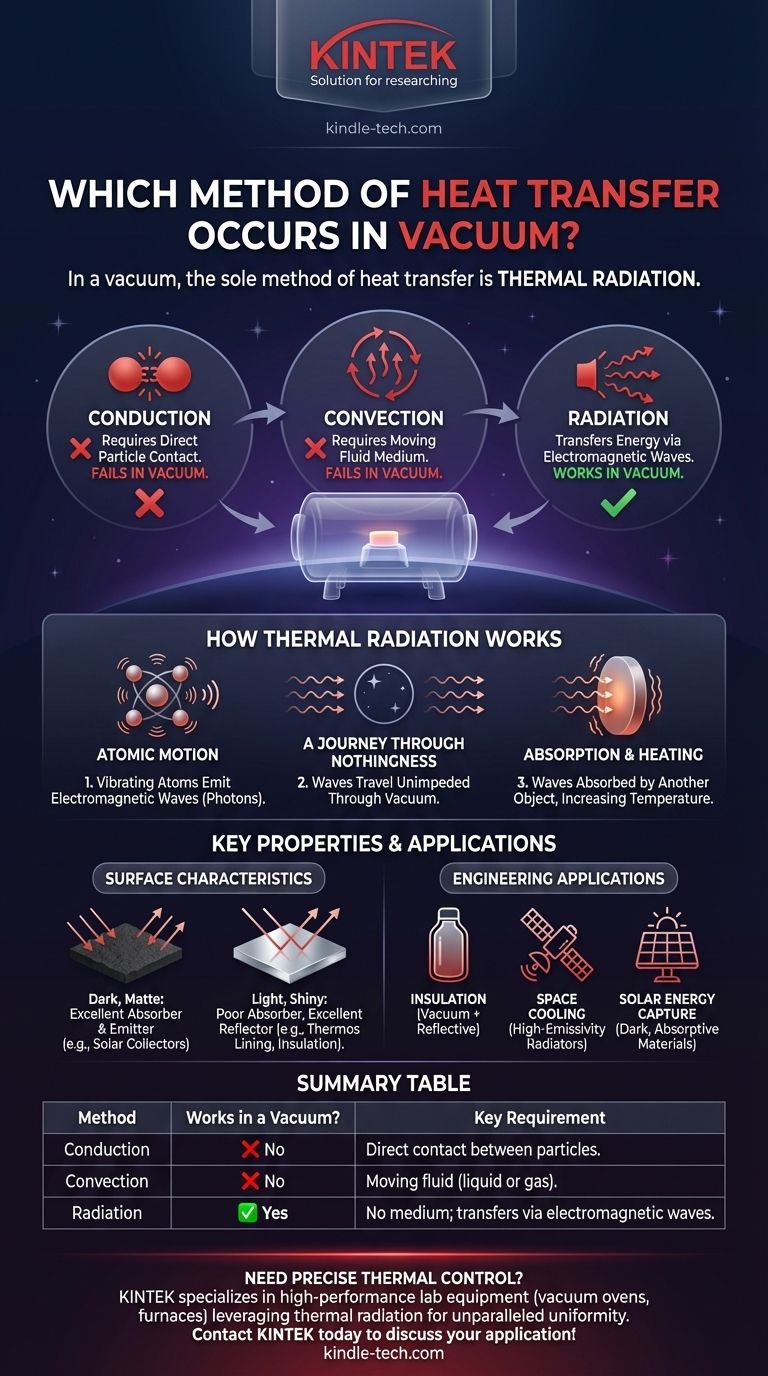
In a vacuum, the sole method of heat transfer is thermal radiation. This is because the other two primary methods of heat transfer—conduction and convection—require a medium of particles (atoms or molecules) to carry the thermal energy. Since a vacuum is, by definition, a space devoid of matter, radiation is the only process that can move heat across it.

While conduction and convection rely on particle interactions to transfer heat, thermal radiation moves energy via electromagnetic waves. This fundamental difference is why radiation is the only way heat can travel through the empty expanse of space or a man-made vacuum.
Which method of heat transfer occur in a vacuum? Unlocking the Power of Thermal Radiation

The Three Modes of Heat Transfer: A Quick Review

To understand why radiation is unique, it's helpful to quickly review all three mechanisms of heat transfer.

Conduction: The Molecular Chain Reaction

Conduction is heat transfer through direct contact. When a hot object touches a colder one, the faster-vibrating atoms in the hot object collide with the slower-vibrating atoms in the cold object, transferring kinetic energy. This is why a metal spoon heats up when left in a hot cup of coffee.

Convection: The Moving Fluid

Convection occurs when a fluid (a liquid or gas) moves, carrying thermal energy with it. Warmer, less dense fluid rises, and cooler, denser fluid sinks, creating a convection current. This is the principle behind boiling water or a room heater warming the air.

Why Conduction and Convection Fail in a Vacuum

Both conduction and convection depend entirely on the presence of atoms or molecules. Without a medium, there are no particles to collide (for conduction) or flow (for convection). A vacuum creates a physical barrier that stops these two processes completely.

How Thermal Radiation Works

Thermal radiation is fundamentally different. It does not rely on matter to propagate; it is a form of pure energy transport.

From Atomic Motion to Light Waves

Every object with a temperature above absolute zero (-273.15°C or 0 Kelvin) has atoms in constant motion. This vibration causes the charged particles within those atoms to accelerate, which in turn emits electromagnetic waves, also known as photons.

These waves carry energy away from the object. This is not just a process for extremely hot objects; everything radiates energy, including ice cubes, planets, and the human body.

A Journey Through Nothingness

Once emitted, these electromagnetic waves travel outwards at the speed of light. They can pass through a vacuum unimpeded, just as starlight travels across the vast emptiness of space to reach our eyes.

Absorption and Heating

When these electromagnetic waves strike another object, their energy can be absorbed. This absorbed energy increases the kinetic energy of the receiving object's atoms, causing them to vibrate faster. We perceive this increase in atomic vibration as a rise in temperature. This is how the Earth is warmed by the Sun, despite the vacuum of space between them.

Key Properties of Thermal Radiation

Understanding radiation involves more than just knowing it works in a vacuum. Its behavior is governed by specific properties.

Surface Characteristics are Critical

The effectiveness of radiation depends heavily on an object's surface.

  • Dark, matte surfaces are excellent absorbers and emitters of thermal radiation.
  • Light, shiny surfaces are poor absorbers and emitters; they reflect most radiation instead. This is why a thermos has a silvered inner lining—to reflect heat back to the hot liquid (or away from the cold liquid), minimizing radiative heat transfer.

Temperature Dictates Intensity and Wavelength

The hotter an object is, the more thermal energy it radiates. Furthermore, the type of radiation changes with temperature. A lukewarm object primarily emits low-energy infrared waves (invisible to us), while a red-hot piece of iron emits higher-energy visible light.

Making the Right Choice for Your Goal

Controlling heat transfer is a core engineering challenge. Understanding radiation is key to designing effective systems.

  • If your primary focus is insulation: Use a vacuum to eliminate conduction and convection, and a reflective surface to minimize heat transfer by radiation, as seen in a Dewar flask (thermos).
  • If your primary focus is cooling an object in space: Design it with high-emissivity surfaces (like black radiator panels) that can efficiently radiate excess heat away into space.
  • If your primary focus is capturing solar energy: Use dark, highly absorptive materials to maximize the amount of energy absorbed from the sun's radiation.

By understanding how energy moves through nothingness, you can engineer solutions that function effectively in any environment, from your daily coffee to deep space exploration.

Summary Table:

Heat Transfer Method Works in a Vacuum? Key Requirement
Conduction ❌ No Requires direct contact between particles.
Convection ❌ No Requires a moving fluid (liquid or gas).
Radiation Yes Requires no medium; transfers energy via electromagnetic waves.

Need precise thermal control for your laboratory processes?

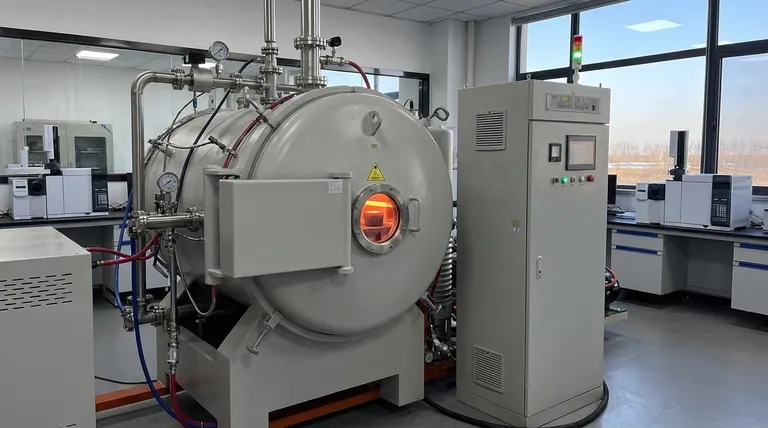
Understanding heat transfer is fundamental to applications like vacuum drying, heat treatment, and materials research. KINTEK specializes in high-performance lab equipment, including vacuum ovens and furnaces, designed to leverage thermal radiation for unparalleled temperature uniformity and process control.

Let our experts help you select the perfect equipment for your specific needs. Contact KINTEK today to discuss your application!

Visual Guide
Which method of heat transfer occur in a vacuum? Unlocking the Power of Thermal Radiation Visual Guide

Related Products

People Also Ask

Related Products

Molybdenum Vacuum Heat Treat Furnace

Molybdenum Vacuum Heat Treat Furnace

Discover the benefits of a high-configuration molybdenum vacuum furnace with heat shield insulation. Ideal for high-purity, vacuum environments like sapphire crystal growth and heat treatment.

Vacuum Heat Treat Furnace with Ceramic Fiber Liner

Vacuum Heat Treat Furnace with Ceramic Fiber Liner

Vacuum furnace with polycrystalline ceramic fiber insulation liner for excellent heat insulation and uniform temperature field. Choose from 1200℃ or 1700℃ max. working temperature with high vacuum performance and precise temperature control.

2200 ℃ Graphite Vacuum Heat Treat Furnace

2200 ℃ Graphite Vacuum Heat Treat Furnace

Discover the power of the KT-VG Graphite Vacuum Furnace - with a maximum working temperature of 2200℃, it's perfect for vacuum sintering of various materials. Learn more now.

2200 ℃ Tungsten Vacuum Heat Treat and Sintering Furnace

2200 ℃ Tungsten Vacuum Heat Treat and Sintering Furnace

Experience the ultimate refractory metal furnace with our Tungsten vacuum furnace. Capable of reaching 2200℃, perfect for sintering advanced ceramics and refractory metals. Order now for high-quality results.

1700℃ Laboratory Quartz Tube Furnace with Alumina Tube Tubular Furnace

1700℃ Laboratory Quartz Tube Furnace with Alumina Tube Tubular Furnace

Looking for a high-temperature tube furnace? Check out our 1700℃ Tube Furnace with Alumina Tube. Perfect for research and industrial applications up to 1700C.

Vacuum Heat Treat Sintering Brazing Furnace

Vacuum Heat Treat Sintering Brazing Furnace

A vacuum brazing furnace is a type of industrial furnace used for brazing, a metalworking process that joins two pieces of metal using a filler metal that melts at a lower temperature than the base metals. Vacuum brazing furnaces are typically used for high-quality applications where a strong, clean joint is required.

Graphite Vacuum Furnace High Thermal Conductivity Film Graphitization Furnace

Graphite Vacuum Furnace High Thermal Conductivity Film Graphitization Furnace

The high thermal conductivity film graphitization furnace has uniform temperature, low energy consumption and can operate continuously.

1700℃ Muffle Oven Furnace for Laboratory

1700℃ Muffle Oven Furnace for Laboratory

Get superior heat control with our 1700℃ Muffle Furnace. Equipped with intelligent temperature microprocessor, TFT touch screen controller & advanced insulation materials for precise heating up to 1700C. Order now!

Vacuum Heat Treat and Molybdenum Wire Sintering Furnace for Vacuum Sintering

Vacuum Heat Treat and Molybdenum Wire Sintering Furnace for Vacuum Sintering

A vacuum molybdenum wire sintering furnace is a vertical or bedroom structure, which is suitable for withdrawal, brazing, sintering and degassing of metal materials under high vacuum and high temperature conditions. It is also suitable for dehydroxylation treatment of quartz materials.

Ultra-High Temperature Graphite Vacuum Graphitization Furnace

Ultra-High Temperature Graphite Vacuum Graphitization Furnace

The ultra-high temperature graphitization furnace utilizes medium frequency induction heating in a vacuum or inert gas environment. The induction coil generates an alternating magnetic field, inducing eddy currents in the graphite crucible, which heats up and radiates heat to the workpiece, bringing it to the desired temperature. This furnace is primarily used for graphitization and sintering of carbon materials, carbon fiber materials, and other composite materials.

Graphite Vacuum Furnace IGBT Experimental Graphitization Furnace

Graphite Vacuum Furnace IGBT Experimental Graphitization Furnace

IGBT experimental graphitization furnace, a tailored solution for universities and research institutions, with high heating efficiency, user-friendliness, and precise temperature control.

600T Vacuum Induction Hot Press Furnace for Heat Treat and Sintering

600T Vacuum Induction Hot Press Furnace for Heat Treat and Sintering

Discover the 600T Vacuum Induction Hot Press Furnace, designed for high-temperature sintering experiments in vacuum or protected atmospheres. Its precise temperature and pressure control, adjustable working pressure, and advanced safety features make it ideal for nonmetal materials, carbon composites, ceramics, and metal powders.

Vacuum Dental Porcelain Sintering Furnace

Vacuum Dental Porcelain Sintering Furnace

Get precise and reliable results with KinTek's Vacuum Porcelain Furnace. Suitable for all porcelain powders, it features hyperbolic ceramic furnace function, voice prompt, and automatic temperature calibration.

Small Vacuum Heat Treat and Tungsten Wire Sintering Furnace

Small Vacuum Heat Treat and Tungsten Wire Sintering Furnace

The small vacuum tungsten wire sintering furnace is a compact experimental vacuum furnace specially designed for universities and scientific research institutes. The furnace features a CNC welded shell and vacuum piping to ensure leak-free operation. Quick-connect electrical connections facilitate relocation and debugging, and the standard electrical control cabinet is safe and convenient to operate.

Vacuum Hot Press Furnace Machine for Lamination and Heating

Vacuum Hot Press Furnace Machine for Lamination and Heating

Experience clean and precise lamination with Vacuum Lamination Press. Perfect for wafer bonding, thin-film transformations, and LCP lamination. Order now!

Laboratory Sterilizer Lab Autoclave Pulse Vacuum Lifting Sterilizer

Laboratory Sterilizer Lab Autoclave Pulse Vacuum Lifting Sterilizer

The pulse vacuum lifting sterilizer is a state-of-the-art equipment for efficient and precise sterilization. It uses pulsating vacuum technology, customizable cycles, and a user-friendly design for easy operation and safety.

Benchtop Laboratory Vacuum Freeze Dryer

Benchtop Laboratory Vacuum Freeze Dryer

Benchtop laboratory freeze dryer for efficient lyophilization of biological, pharmaceutical, and food samples. Features intuitive touchscreen, high-performance refrigeration, and durable design. Preserve sample integrity—consult now!

HFCVD Machine System Equipment for Drawing Die Nano-Diamond Coating

HFCVD Machine System Equipment for Drawing Die Nano-Diamond Coating

The nano-diamond composite coating drawing die uses cemented carbide (WC-Co) as the substrate, and uses the chemical vapor phase method ( CVD method for short ) to coat the conventional diamond and nano-diamond composite coating on the surface of the inner hole of the mold.

Engineering Advanced Fine Ceramics Aluminum Oxide Al2O3 Heat Sink for Insulation

Engineering Advanced Fine Ceramics Aluminum Oxide Al2O3 Heat Sink for Insulation

The hole structure of the ceramic heat sink increases the heat dissipation area in contact with the air, which greatly enhances the heat dissipation effect, and the heat dissipation effect is better than that of super copper and aluminum.

Laboratory Test Sieves and Sieving Machines

Laboratory Test Sieves and Sieving Machines

Precision lab test sieves & sieving machines for accurate particle analysis. Stainless steel, ISO-compliant, 20μm-125mm range. Request specs now!


Leave Your Message