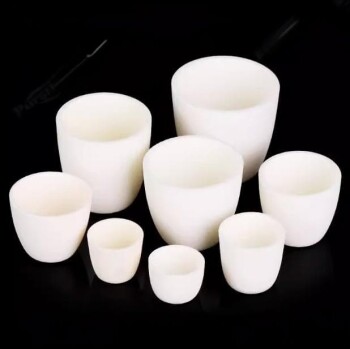
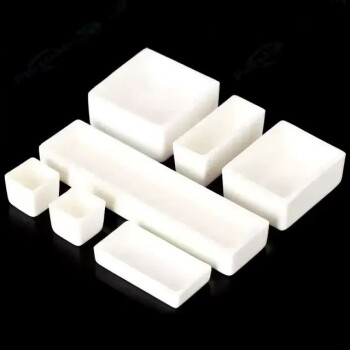
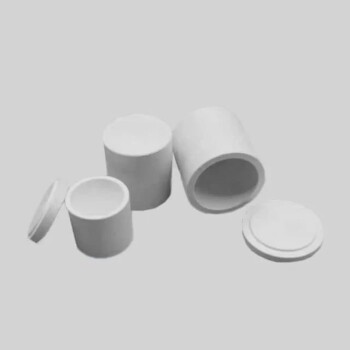
Alumina (corundum) crucibles are the preferred containment vessels for static corrosion tests primarily due to their exceptional thermal resistance and chemical stability. They are capable of holding aggressive media, such as borosilicate glass melts, at elevated temperatures while ensuring the chemical interaction between the crucible and the melt remains minimal.
Core Takeaway: The value of alumina lies in its ability to preserve the integrity of the reaction environment. While slight erosion of the crucible may occur, the trace amount of material released has a negligible effect on corrosion kinetics, ensuring the test results accurately reflect the refractory's performance, not contamination artifacts.
The Foundation: Stability Under Stress
Withstanding Extreme Temperatures
Static corrosion tests require maintaining materials at high heat for extended periods. Alumina crucibles are selected because they possess excellent high-temperature resistance.
They maintain structural integrity when holding molten substances, such as borosilicate glass, which would compromise lesser materials.
Chemical Inertness
Beyond heat, the containment vessel must resist chemical attack. Alumina offers high chemical stability, preventing catastrophic failure of the vessel during the test.
This stability is crucial for safety and for ensuring the test runs for its full intended duration without leaks or breaches.
Preserving Data Integrity
Minimizing Contamination
The primary goal of a corrosion test is to isolate the interaction between the chromium refractory sample and the melt. High-purity alumina (often >99%) is used to prevent container components from leaching into the melt.
This ensures that the chemical composition of the melt remains stable throughout the experiment.
Negligible Kinetic Impact
While no material is perfectly inert, the interaction between alumina and borosilicate glass melts is well understood. The trace amount of alumina that may enter the melt does not significantly alter the overall corrosion kinetics.
This allows researchers to attribute observed degradation solely to the reaction between the refractory sample and the glass, maintaining a "pure" reaction environment.
Understanding the Trade-offs
The Reality of Slight Erosion
It is important to acknowledge that alumina is not immune to attack. The melt may slightly erode the crucible walls over the course of the experiment.
However, this erosion is generally superficial and, as noted above, does not skew the reaction rate data for the refractory being tested.
The Importance of Purity
Not all alumina crucibles are equal. To ensure the accuracy of experimental data—particularly for trace element comparisons or oxide film formation—high-purity alumina is essential.
Using lower-grade crucibles introduces a risk of contaminating the metal or glass melt, which could invalidate sensitive measurements.
Making the Right Choice for Your Goal
When designing your corrosion experiments, consider the sensitivity of your data requirements.
- If your primary focus is standard corrosion kinetics: Rely on alumina crucibles, as the minor erosion will not statistically affect the reaction rates of your chromium refractory.
- If your primary focus is ultra-trace element analysis: Ensure you utilize alumina with a purity greater than 99% to strictly prevent container leaching from contaminating the melt.
Ultimately, alumina provides the critical balance of durability and inertness required to validate your refractory's performance with confidence.
Summary Table:
| Feature | Benefit for Corrosion Testing |
|---|---|
| High Thermal Resistance | Withstands long-duration heat for molten borosilicate glass. |
| Chemical Inertness | Prevents vessel failure and leakage during aggressive chemical contact. |
| Minimal Leaching | High purity (>99%) prevents contamination of the reaction melt. |
| Stable Kinetics | Trace material release has a negligible effect on refractory test data. |
Elevate Your Laboratory Precision with KINTEK
Ensure the integrity of your research with KINTEK’s premium high-purity alumina crucibles and ceramics. Designed for extreme thermal environments, our containment solutions prevent contamination and provide the chemical stability required for accurate corrosion kinetics analysis.
Beyond specialized crucibles, KINTEK offers a comprehensive suite of laboratory solutions, including:
- High-Temperature Furnaces: Muffle, vacuum, and CVD systems for precise heat treatment.
- Sample Preparation: Advanced crushing, milling, and hydraulic pellet presses.
- Fluid Control: High-temperature high-pressure reactors and autoclaves.
- Specialized Consumables: PTFE products, ceramics, and high-performance electrodes.
Ready to optimize your testing environment? Contact KINTEK today to discuss your specific application and discover how our high-performance laboratory equipment and consumables can drive your research success.
References
- S. M. Shaydullin, Sergey A. Lukin. Corrosion testing of prospective chrome refractory materials in borosilicate glass melts. DOI: 10.15826/elmattech.2024.3.031
This article is also based on technical information from Kintek Solution Knowledge Base .
Related Products
- Arc-Shaped Alumina Ceramic Crucible High Temperature Resistant for Engineering Advanced Fine Ceramics
- Alumina Al2O3 Ceramic Crucible Semicircle Boat with Lid for Engineering Advanced Fine Ceramics
- Engineering Advanced Fine Ceramics Alumina Al2O3 Crucible With Lid Cylindrical Laboratory Crucible
- Engineering Advanced Fine Ceramics Alumina Crucibles (Al2O3) for Thermal Analysis TGA DTA
- Engineering Advanced Fine Alumina Al2O3 Ceramic Crucible for Laboratory Muffle Furnace
People Also Ask
- Why Use Alumina Crucibles & Powder Burial for NaSICON? Ensure Phase Purity and Prevent Elemental Volatilization
- What is the primary purpose of using alumina crucibles for LLTO ceramics? Optimize Your High-Temperature Sintering
- Why are alumina crucibles and mother powder essential for LATP sintering? Optimize Your Solid Electrolyte Performance
- Why are high-purity alumina crucibles used for liquid lead corrosion experiments? Ensure Data Accuracy at 550°C
- Primary considerations for choosing alumina crucibles and quartz tubes in indium intercalation: Ensure Material Purity