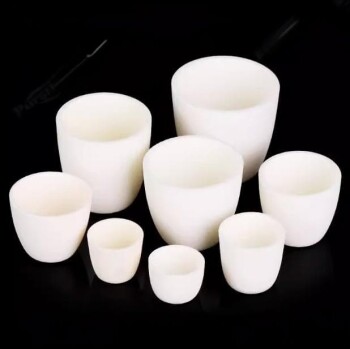
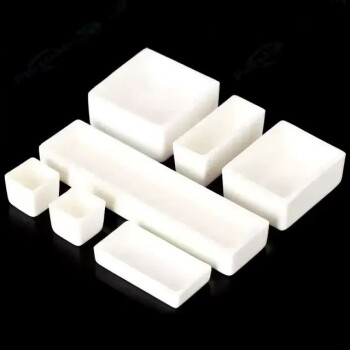
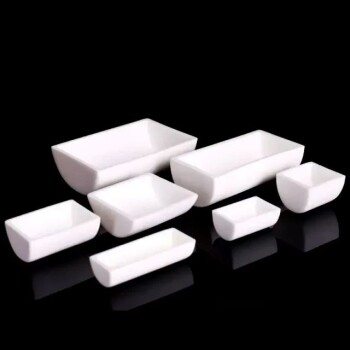
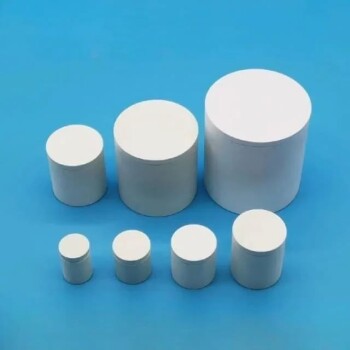
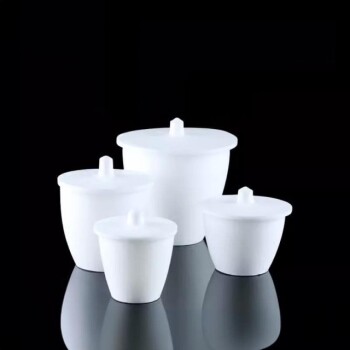
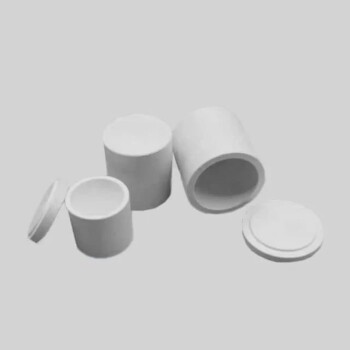
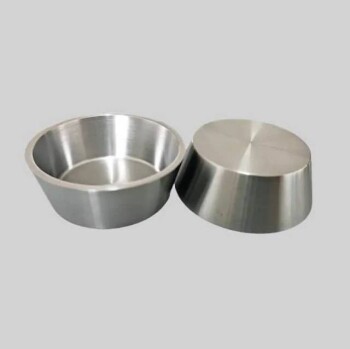
High-purity ceramic crucibles are non-negotiable for preparing intermetallic interface materials like Al/Al2Cu because they serve as chemically inert containers during the melting process. Their primary function is to prevent the leaching of contaminants, specifically silicon or carbon, which can fundamentally alter the alloy's composition. Without this inert barrier, the resulting data regarding the material's properties would be compromised by foreign elements.
The use of high-purity ceramics is the only way to guarantee that observed material behaviors are intrinsic to the alloy rather than artifacts of contamination. Without them, impurities can skew microstructural evolution and compromise the accuracy of mechanical property data.
The Role of Purity in Material Science
Eliminating Chemical Contamination
When melting reactive materials such as Aluminum (Al) and Copper (Cu) alloys, standard containers often degrade. This degradation releases trace elements into the melt.
High-purity ceramic crucibles possess superior chemical stability. This prevents the introduction of impurities like silicon and carbon during the alloying process. Maintaining this purity is the only way to ensure the final composition matches your theoretical calculations.
Ensuring Accurate Microstructural Evolution
The way an intermetallic interface forms is highly sensitive to chemical composition. Even trace impurities can alter how grains grow and how phases separate.
By acting as a non-reactive container, high-purity ceramics allow you to study the intrinsic microstructural evolution of the Al/Al2Cu interface. This ensures that the grain boundaries and phase interactions you observe are natural properties of the alloy, not reactions to contaminants.
Withstanding Thermal Stress
The preparation of intermetallics involves significant thermal fluctuations. A failure in the container can lead to sample loss or immediate contamination.
These crucibles are engineered for exceptional thermal shock resistance. They maintain their structural integrity throughout the heating and cooling cycles required for melting, ensuring the melt remains isolated and pure.
The Risks of Compromised Containment
The Hidden Cost of Impurities
It is a common pitfall to assume that minor contamination is negligible. In intermetallic studies, this is incorrect.
If a crucible releases elements like carbon, it can change the intrinsic mechanical properties of the interface. You may record strength or ductility data that is actually a result of impurity hardening or embrittlement, leading to scientifically invalid conclusions.
False Negatives in Experimentation
Using lower-grade crucibles introduces variables that are difficult to control.
If your experimental results show unexpected behaviors, you cannot distinguish between a novel material property and a container artifact. High-purity ceramics eliminate this variable, providing a baseline of experimental accuracy that acts as a control for your research.
Ensuring Data Integrity in Your Research
If your primary focus is determining Intrinsic Mechanical Properties:
- You must use high-purity ceramics to prevent foreign elements from artificially strengthening or weakening the material interface.
If your primary focus is studying Microstructural Evolution:
- You must rely on chemically stable containers to ensure that phase formation and boundary definitions are driven solely by the alloy's thermodynamics, not by nucleation on contaminants.
True scientific insight requires removing the container from the equation entirely.
Summary Table:
| Feature | High-Purity Ceramic Crucible | Impact on Al/Al2Cu Research |
|---|---|---|
| Chemical Stability | Chemically inert; zero leaching | Prevents Si/C contamination; maintains alloy purity |
| Thermal Resistance | High thermal shock resistance | Ensures structural integrity during rapid heating/cooling |
| Interaction Level | Non-reactive container | Allows study of intrinsic microstructural evolution |
| Data Reliability | Eliminates impurity variables | Guarantees accuracy of mechanical property measurements |
Elevate Your Material Research with KINTEK Precision
Don't let crucible contamination compromise your scientific breakthroughs. KINTEK specializes in high-performance laboratory equipment and consumables designed for the most demanding applications. Whether you are preparing intermetallic interfaces like Al/Al2Cu or exploring advanced material science, our high-purity ceramic crucibles provide the inert environment necessary for valid, reproducible results.
From high-temperature furnaces and vacuum systems to specialized PTFE and ceramic consumables, KINTEK delivers the tools you need to ensure microstructural integrity.
Ready to secure your research data? Contact KINTEK today for a consultation and custom quote!
References
- Saryu Fensin, Jian Luo. Deformation and Transitions at Interfaces and Grain Boundaries. DOI: 10.1007/s11837-019-03390-2
This article is also based on technical information from Kintek Solution Knowledge Base .
Related Products
- Arc-Shaped Alumina Ceramic Crucible High Temperature Resistant for Engineering Advanced Fine Ceramics
- Engineering Advanced Fine Alumina Al2O3 Ceramic Crucible for Laboratory Muffle Furnace
- High Purity Pure Graphite Crucible for Evaporation
- Alumina Al2O3 Ceramic Crucible Semicircle Boat with Lid for Engineering Advanced Fine Ceramics
- Engineering Advanced Fine Ceramics Alumina Al2O3 Crucible With Lid Cylindrical Laboratory Crucible
People Also Ask
- Why Use Alumina Crucibles & Powder Burial for NaSICON? Ensure Phase Purity and Prevent Elemental Volatilization
- What is the primary purpose of using alumina crucibles for LLTO ceramics? Optimize Your High-Temperature Sintering
- Why are alumina crucibles and mother powder essential for LATP sintering? Optimize Your Solid Electrolyte Performance
- Why are high-purity alumina crucibles used for liquid lead corrosion experiments? Ensure Data Accuracy at 550°C
- Primary considerations for choosing alumina crucibles and quartz tubes in indium intercalation: Ensure Material Purity