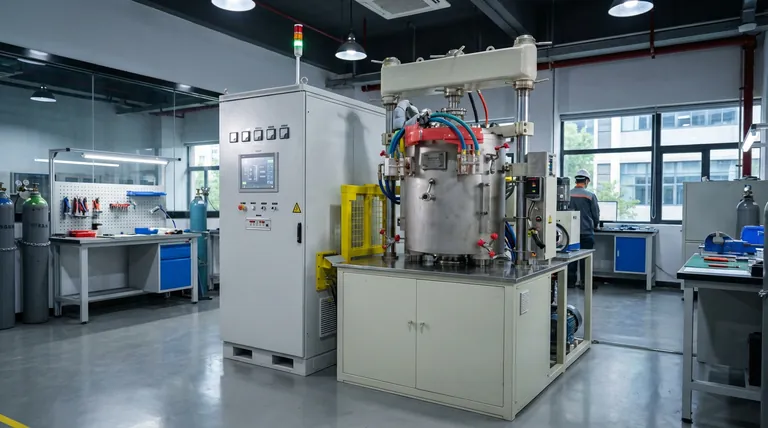
The Engineer's Dilemma: When Strong Isn't Strong Enough
Imagine designing a component for a satellite thruster or a deep-sea submersible. You've chosen an advanced powdered alloy, theoretically perfect for the job. You press it, you sinter it, and yet, under extreme stress, it fails.
The material itself isn't the problem. The problem is invisible: microscopic voids, the tiny pockets of empty space left between particles after a conventional manufacturing process. These voids are the origin points of catastrophic failure.
This is a common frustration in materials science. The challenge isn't just about what a material is made of, but how densely its atoms are packed. To solve this, we must move beyond sequential processes and into the world of simultaneous force.
Redefining Density: The Physics of Simultaneous Force
Most manufacturing involves separate steps: first, you press a powder into a shape (compaction), and then you bake it in a furnace to fuse the particles (sintering).
Hot pressing rejects this separation. It is a process of unity, applying intense heat and immense pressure at the same time.
This isn't just a scheduling change; it fundamentally alters the physics of material formation. It creates an environment where particles have no choice but to surrender their individuality and merge into a nearly perfect, monolithic whole.
Heat and Pressure as a Single Tool
This combined assault is known as "activated sintering." Heat energizes the particles, making them malleable and eager to bond. Simultaneously, pressure physically forces them together, collapsing the voids that would otherwise become weak points.
The result is an accelerated, aggressive densification. Material transformations, phase changes, and alloy formations that would take hours in a traditional furnace happen far more efficiently. The material doesn't just get hard; it achieves a new level of internal integrity.
The Strategic Trade-Off: Choosing Performance Over Pace
Hot pressing is not a universal solution. It's a specialist's tool. Choosing it is a conscious decision to prioritize absolute material performance over the economics of mass production.
The decision hinges on a simple question: Is "good enough" acceptable, or is peak performance non-negotiable?
The Pursuit of Perfection: Where Hot Pressing Excels
When the application demands the absolute best, the advantages of hot pressing are clear:
- Unrivaled Density: The primary benefit is achieving near-theoretical density. This directly translates to superior mechanical properties—greater strength, hardness, and wear resistance. The final product is simply tougher.
- Architectural Freedom: Because the process is so efficient, it can operate at lower pressures than cold pressing. This allows engineers to create large, geometrically complex components without introducing the internal stresses that cause warping or cracking.
- Specialized Missions: It is the go-to method for prototypes, small-batch production of high-performance parts (like cemented carbides), and R&D where material properties must be pushed to their absolute limits.
The Inherent Costs of a Flawless Structure
This level of performance comes with inescapable trade-offs:
- A Deliberate Pace: The process is slow. Molds produce one or a few items at a time. It is the opposite of a high-speed assembly line, making it unsuitable for high-volume manufacturing.
- A Significant Investment: Hot press machines are sophisticated, and the molds—typically graphite—must endure punishing conditions, giving them a high cost and a short lifespan.
- The Artisan's Touch: This is not a "press-and-play" operation. Success requires a skilled operator who can masterfully balance temperature, pressure, heating rates, and material science. It's a craft that blends engineering with intuition.
A Practical Decision Framework
Choosing between hot pressing and traditional sintering is a matter of balancing ambition with practicality. The right choice depends entirely on your project's goal.
| Aspect | Hot Pressing | Traditional Sintering |
|---|---|---|
| Process | Simultaneous heat and pressure | Separate cold pressing and sintering steps |
| Key Advantage | Superior final density and strength | Higher production speed and lower cost |
| Best For | Large, complex shapes; high-performance parts | Mass production of simpler components |
| Production Speed | Low (single-piece or small batches) | High (suitable for mass production) |
| Cost | Higher operational and equipment costs | More economical for high volumes |
Ultimately, hot pressing is the answer when you encounter a material challenge that cannot be solved by conventional means. It's a tool for creating components that perform at the very edge of what's possible.
Achieving this level of material perfection in a laboratory or R&D setting requires equipment that is just as precise and reliable as the process itself. As a specialist in advanced lab equipment, KINTEK provides the foundational tools necessary to explore and perfect these demanding applications. If your work demands materials without compromise, we can help you build the capability to create them.
Ready to push the boundaries of material performance? Contact Our Experts
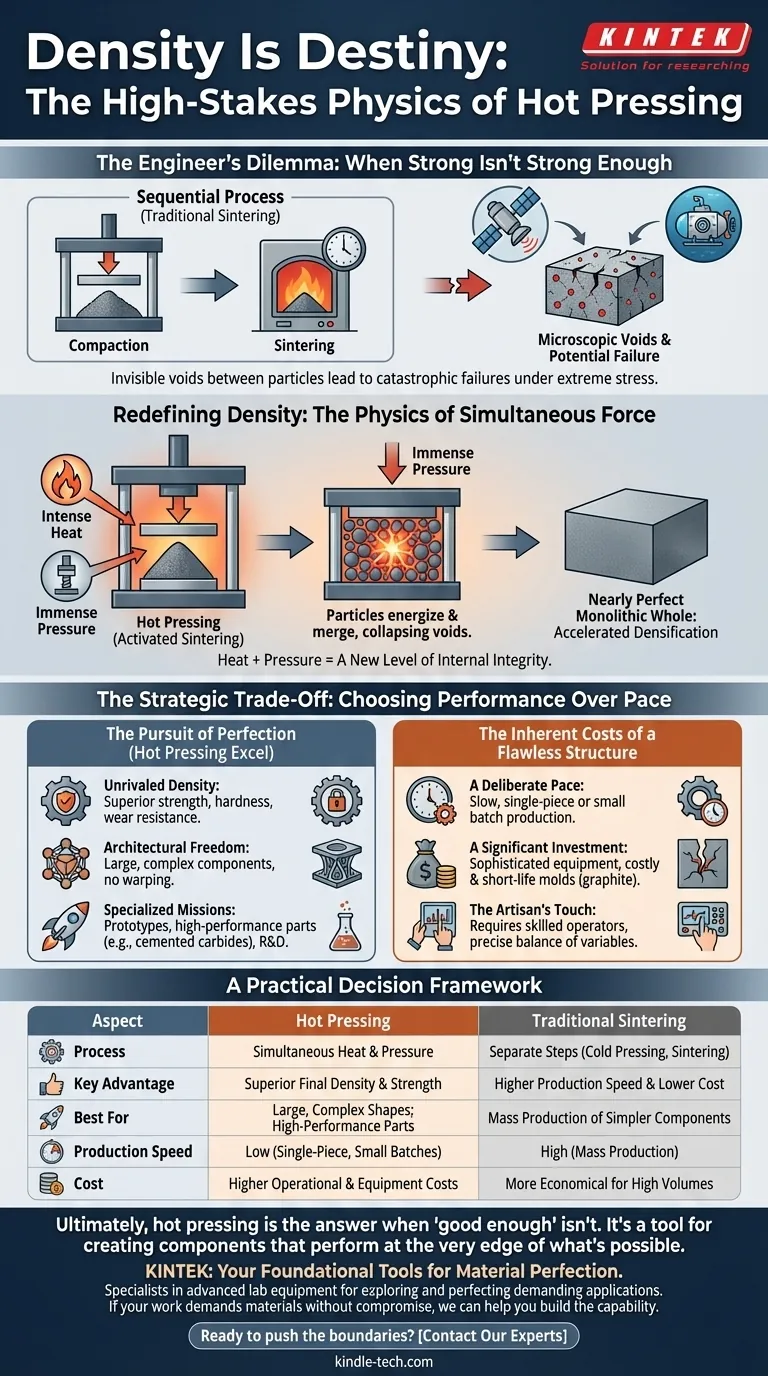
Visual Guide
Related Products
- Automatic Heated Hydraulic Press Machine with Heated Plates for Laboratory Hot Press 25T 30T 50T
- Manual High Temperature Heated Hydraulic Press Machine with Heated Plates for Lab
- Touchscreen Automatic Vacuum Heat Press
- 30T 40T Split Automatic Heated Hydraulic Press Machine with Heated Plates for Laboratory Hot Press
- Vacuum Hot Press Furnace Machine Heated Vacuum Press
Related Articles
- Why Your Composite and Polymer Parts Keep Failing: The Secret Is Simultaneous Heat and Pressure
- The Physics of Flawless Materials: Deconstructing the Hydraulic Hot Press
- Precision Under Pressure: The Physics and Psychology of the Hydraulic Hot Press
- Hydraulic Hot Press: Principles, Components, Features, Advantages, and Applications
- Comprehensive Guide to Hydraulic Hot Press: Function, Features and Applications