You’ve spent hours meticulously preparing your samples. The materials are perfectly aligned, the adhesive is applied just right, and everything is ready for the final, critical step. You place your assembly in the hot press, run the cycle, and wait. But when you retrieve the part, you find a weak bond, a warped component, or an inconsistent finish. Frustrated, you’re back at square one, wondering what went wrong this time.
The All-Too-Familiar Cycle of Trial and Error
If this scenario sounds familiar, you're not alone. In labs and on production lines across numerous industries—from advanced materials research to precision electronics assembly—teams constantly battle the unpredictable nature of their bonding processes.
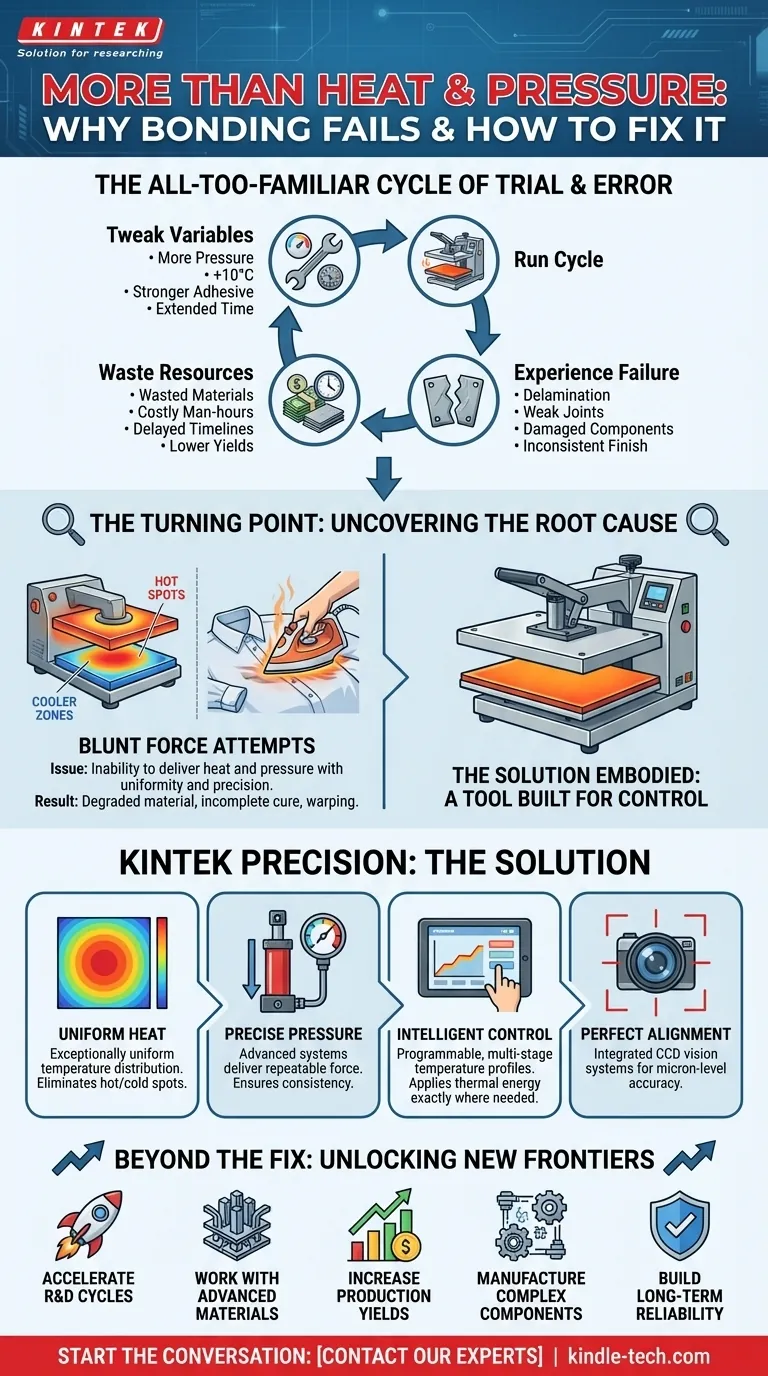
When faced with failures like delamination, weak joints, or damaged components, the typical response is to start tweaking variables:
- "Maybe we need more pressure."
- "Let's increase the temperature by 10 degrees."
- "Perhaps a different, stronger adhesive will work."
- "Let's extend the press time by another minute."
While these adjustments might occasionally produce a successful part, they rarely lead to a repeatable, reliable process. This guesswork isn't just a technical headache; it has significant business consequences. Every failed cycle translates to wasted high-value materials, costly man-hours, and delayed project timelines. For manufacturers, it can mean lower production yields and a higher risk of product failures in the field, potentially damaging your brand's reputation for quality.
The Turning Point: Uncovering the Root Cause
The constant struggle to find the "magic formula" of heat, pressure, and time stems from a fundamental misunderstanding of the problem. We become so focused on the inputs (our process parameters) that we overlook the real culprit: the method of delivery (the tool itself).
Why "More Heat" Is a Losing Strategy
The core issue isn't that you need more heat or pressure. The issue is that your equipment may be incapable of delivering that heat and pressure with perfect uniformity and absolute precision, every single time.
Think of it like trying to iron a delicate silk shirt with a cheap, old iron. The iron technically gets hot, but it has scorching hot spots and cooler areas. No matter how you adjust the temperature dial, you'll either fail to remove the wrinkles or you'll burn the fabric. The problem isn't your ironing technique; it's the tool's inability to provide even, controlled heat.
A basic hot press operates on the same principle. It may reach the target temperature on average, but "hot spots" can degrade your material, while cooler zones prevent the adhesive from curing properly. Similarly, uneven pressure application can lead to warping or inconsistent bond strength across the part. The "solutions" of adding more heat or pressure are blunt-force attempts to compensate for a tool that lacks finesse, often making the problem worse.
The Solution Embodied: A Tool Built for Control
To permanently solve the problem of inconsistent bonding, you don't need to be a master of guesswork. You need to eliminate the variables that cause it. This requires moving away from a simple "hot and heavy" machine to an instrument designed for precision control.
This is where a KINTEK precision hot press changes the game. It is not just another machine that applies heat and pressure; it is the embodiment of the solution, engineered from the ground up to address the root cause of failure.
- To combat uneven heat: KINTEK presses are designed with platens that ensure exceptionally uniform temperature distribution, eliminating the hot and cold spots that ruin your work.
- To fix inconsistent pressure: Our advanced hydraulic or pneumatic systems deliver precise, repeatable force across the entire surface, ensuring every part is treated exactly the same.
- To prevent damage to sensitive components: Features like programmable, multi-stage temperature profiles and rapid pulse heating apply thermal energy exactly when and where it's needed, protecting delicate materials.
- To guarantee perfect alignment: For complex electronics, integrated CCD vision systems ensure micron-level accuracy before the press cycle even begins.
A KINTEK hot press isn't just a "better" tool; it's the right tool because it gives you direct control over the very factors that cause inconsistency.
Beyond the Fix: Unlocking New Frontiers in Production and Research
When you no longer have to worry about the reliability of your bonding process, you stop spending your time troubleshooting and start focusing on innovation. Resolving this fundamental issue unlocks a new level of potential.
With the confidence that your results are repeatable and reliable, you can now:
- Accelerate R&D cycles by getting dependable data from the very first test.
- Work with more advanced and sensitive materials that were previously too challenging to process.
- Increase production yields and reduce material waste, directly improving your bottom line.
- Manufacture smaller, more complex, and higher-performance components with the assurance of quality.
- Build products with superior long-term reliability, enhancing your reputation as an industry leader.
Ultimately, a reliable process is the foundation of innovation. At KINTEK, we believe that providing you with a tool you can trust is the first step in helping you achieve your next major breakthrough. Your projects face unique challenges, and a one-size-fits-all approach is not the answer. Let's discuss how the right equipment can provide the stable foundation necessary to accelerate your goals. Contact Our Experts to start the conversation.
Visual Guide
Related Products
- Automatic Heated Hydraulic Press Machine with Heated Plates for Laboratory Hot Press 25T 30T 50T
- Manual High Temperature Heated Hydraulic Press Machine with Heated Plates for Lab
- Touchscreen Automatic Vacuum Heat Press
- 30T 40T Split Automatic Heated Hydraulic Press Machine with Heated Plates for Laboratory Hot Press
- Vacuum Hot Press Furnace Machine Heated Vacuum Press
Related Articles
- Why Your Composite and Polymer Parts Keep Failing: The Secret Is Simultaneous Heat and Pressure
- The Physics of Flawless Materials: Deconstructing the Hydraulic Hot Press
- Precision Under Pressure: The Physics and Psychology of the Hydraulic Hot Press
- Hydraulic Hot Press: Principles, Components, Features, Advantages, and Applications
- Comprehensive Guide to Hydraulic Hot Press: Function, Features and Applications