The Hidden Enemy Within
In the world of high-performance engineering, failure often begins not with a bang, but with a whisper. An invisible, microscopic void trapped deep inside a cast turbine blade. A subtle lack of fusion in a 3D-printed medical implant.
These are not flaws of design, but of density. They are tiny pockets of nothing that, under stress, become the origin points of catastrophic failure.
Controlling this risk comes down to the deliberate application of two fundamental forces: heat and pressure. Yet, how they are applied creates two entirely different philosophies of material science, often confused under the single term "hot press."
The Architect’s Touch: Precision Bonding with Directional Force
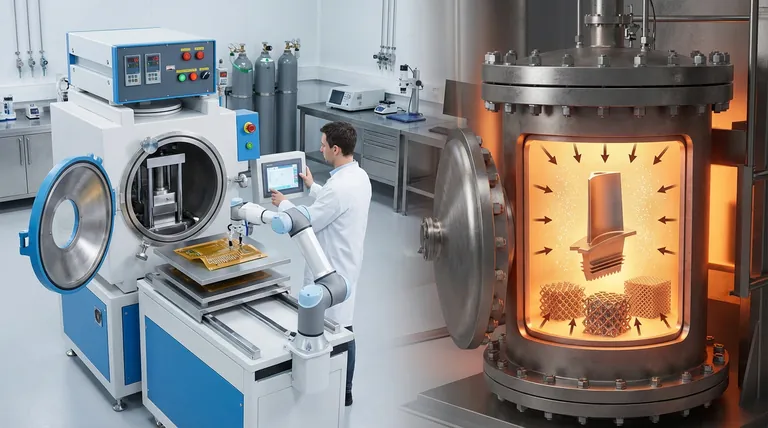
One philosophy is about construction. It’s about joining, laminating, and creating perfect interfaces between distinct materials. This is the world of the traditional hot press machine.
Its power lies in absolute control over a directional force. Think of a precision stamp, applying heat and pressure exactly where needed.
-
Unwavering Precision: Modern systems use pulse heating for rapid, targeted temperature spikes, while rigid press structures ensure that force is distributed with perfect uniformity. This is about repeatable accuracy on a microscopic scale.
-
The Certainty of Connection: The goal isn't to change the materials themselves, but to create an unbreakable, permanent bond between them. For a flexible circuit bonded to a rigid PCB, this bond is the entire foundation of its function.
-
Automated Versatility: With features like CCD vision for alignment and programmable process cycles, these machines become the reliable workhorses of high-volume electronics and composites manufacturing. They build things up, layer by layer, with guaranteed consistency.
This approach is for when the challenge is at the surface—creating a flawless connection between two parts.
The Alchemist’s Pursuit: Forging Integrity with Isostatic Pressure
The second philosophy is about purification. It’s not about joining, but perfecting. It aims to transform a single, solid part from the inside out. This is the domain of Hot Isostatic Pressing (HIP).
HIP places a component in a high-pressure vessel and subjects it to immense, uniform pressure from an inert gas. The force is isostatic—it comes from all directions at once, like the crushing pressure at the bottom of the ocean.
-
Total Porosity Annihilation: This all-encompassing pressure physically collapses the internal voids and micropores that plague castings and 3D-printed parts. The part becomes fully dense, leaving no internal weakness to exploit.
-
Radically Improved Properties: By healing these internal defects, HIP creates a uniform microstructure that dramatically enhances a material's performance. Fatigue life can increase tenfold, while ductility and wear resistance are significantly improved. It’s not a new part; it’s a perfected version of the original.
-
Process Consolidation: Often, secondary steps like heat treatment and quenching can be integrated into a single HIP cycle. This streamlines manufacturing, reducing handling, time, and cost while improving the final product.
This approach is for when the enemy is unseen—a hidden void that threatens the very integrity of the material itself.
A Tale of Two Pressures: Directional vs. Isostatic
Confusing these two methods is like mistaking a carpenter’s clamp for a deep-sea pressure chamber. Both use force, but their intent and mechanism are worlds apart. The fundamental difference is the nature of the pressure.
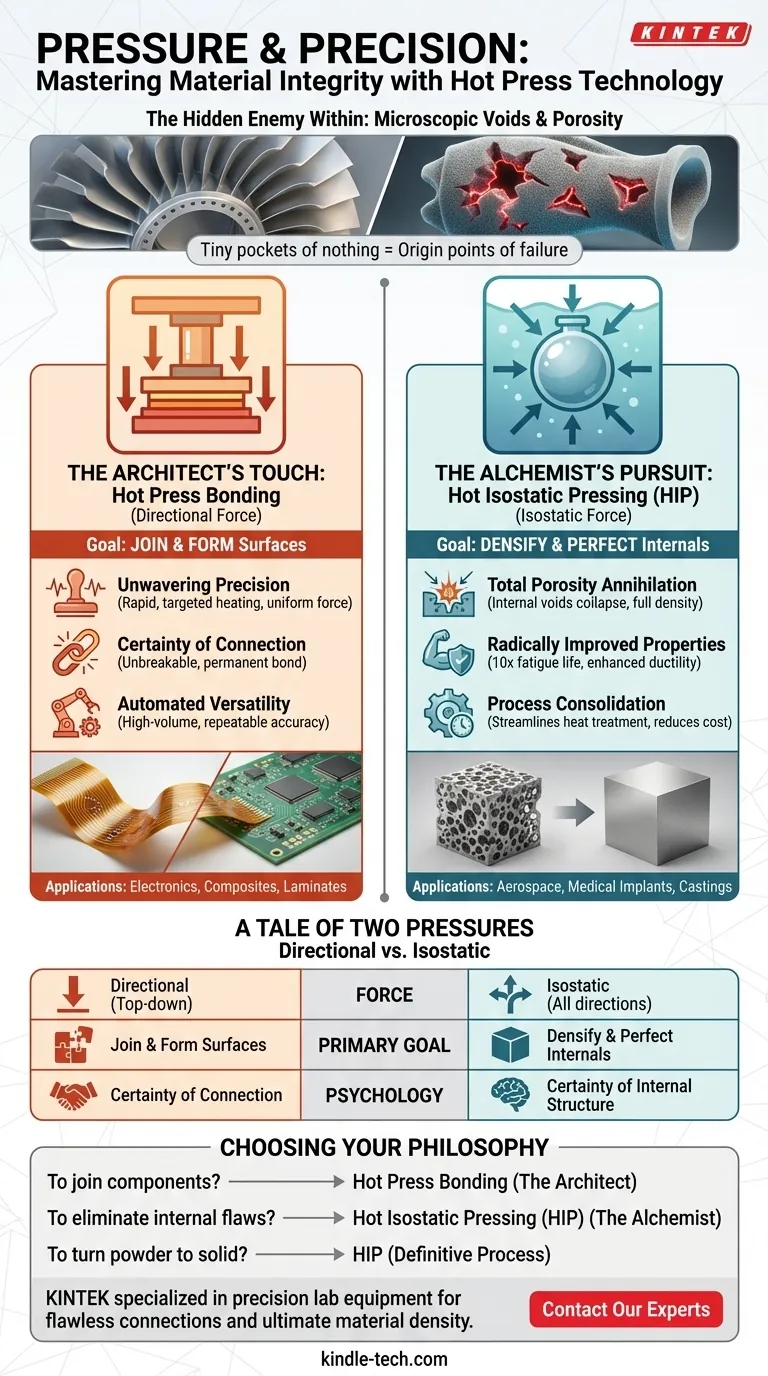
| Feature | Hot Press Bonding (The Architect) | Hot Isostatic Pressing (HIP) (The Alchemist) |
|---|---|---|
| Force | Directional (Top-down) | Isostatic (All directions) |
| Primary Goal | To Join & Form Surfaces | To Densify & Perfect Internals |
| Psychology | Certainty of Connection | Certainty of Internal Structure |
| Core Application | Electronics, Composites, Laminates | Aerospace, Medical Implants, Castings |
Choosing Your Philosophy: When to Bond, When to Perfect
Selecting the right technology depends entirely on the problem you are trying to solve.
-
To join components or laminate layers, you need the precision of a directional hot press. You are building something new from separate parts.
-
To eliminate internal flaws in a single part, you need the purifying force of Hot Isostatic Pressing. You are perfecting an existing object from within.
-
To turn metal powder into a solid block, HIP is the definitive process, creating a component with properties that can exceed even forged materials.
Navigating these two worlds of material science requires not just the right theory, but the right equipment. KINTEK specializes in providing the precision lab equipment and consumables essential for both creating flawless connections and achieving ultimate material density. To ensure your materials meet the highest standards of integrity and performance, Contact Our Experts.
Visual Guide
Related Products
- Automatic Heated Hydraulic Press Machine with Heated Plates for Laboratory Hot Press 25T 30T 50T
- Manual High Temperature Heated Hydraulic Press Machine with Heated Plates for Lab
- Touchscreen Automatic Vacuum Heat Press
- 30T 40T Split Automatic Heated Hydraulic Press Machine with Heated Plates for Laboratory Hot Press
- Vacuum Hot Press Furnace Machine Heated Vacuum Press
Related Articles
- Why Your Composite and Polymer Parts Keep Failing: The Secret Is Simultaneous Heat and Pressure
- The Physics of Flawless Materials: Deconstructing the Hydraulic Hot Press
- Precision Under Pressure: The Physics and Psychology of the Hydraulic Hot Press
- Hydraulic Hot Press: Principles, Components, Features, Advantages, and Applications
- Comprehensive Guide to Hydraulic Hot Press: Function, Features and Applications