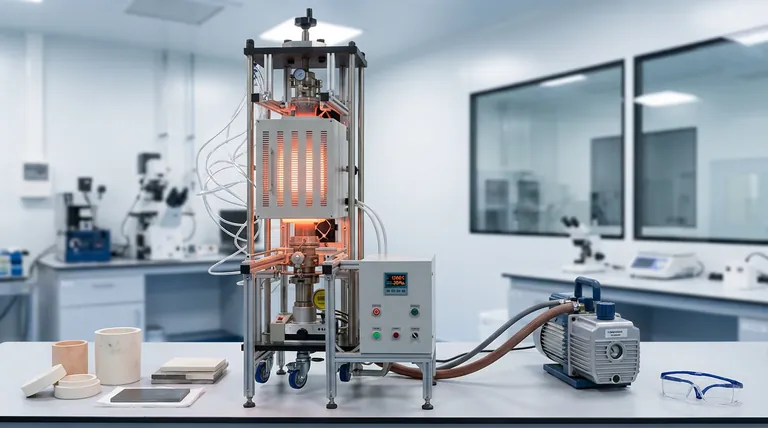
The Material Scientist's Dilemma
Imagine creating a component for a jet engine turbine or a piece of ballistic armor. Your enemy isn't just stress or heat; it's the invisible world of imperfections. A single microscopic void or an oversized crystal grain can become the epicenter of catastrophic failure.
This is the material scientist's core dilemma: the pursuit of theoretical perfection against the practical constraints of manufacturing. Most processes involve compromise. Hot pressing, however, is less a compromise and more a declaration of priorities. It is a deliberate choice to trade convenience for unparalleled material integrity.
The Illusion of Brute Force
Conventional powder metallurgy often follows a two-step logic: press, then heat. First, immense pressure compacts a powder at room temperature. Then, a furnace bakes it for hours, hoping the particles fuse together.
This approach is intuitive, but it’s a brute-force attack. It requires colossal pressure to overcome the material's cold rigidity and prolonged, intense heat to coax atoms into bonding. This often results in undesirable grain growth, which can compromise the final component's strength. You achieve a solid, but not a fundamentally optimized, structure.
The Logic of Simultaneous Action
Hot pressing rewrites the rules. By applying high temperature and pressure simultaneously, it creates an environment where the material becomes cooperative.
Think of it as the difference between shaping cold, brittle clay and warm, plastic clay. The heat in hot pressing brings the powder into a thermoplastic state, making it soft and malleable. As a result, it often requires only one-tenth of the pressure needed for cold pressing.
This synergy doesn't just make the process easier; it fundamentally activates it.
- Accelerated Diffusion: The combination of heat and pressure dramatically speeds up mass transfer, allowing atoms to bond across particle boundaries with incredible efficiency.
- Inhibited Grain Growth: The process is so fast and occurs at lower temperatures, preventing the formation of large, weakening grains.
- Near-Perfect Density: The pressure physically squeezes out voids, while the heat welds the particles together, resulting in a fine-grained structure with near-theoretical density.
A Controlled Ritual of Creation
The hot pressing process is methodical, precise, and often performed in a vacuum. Each step is a deliberate action to control the material's final state.
Step 1: The Foundation (Charging & Vacuuming)
First, the raw powder is loaded into a robust die. The entire chamber is then evacuated. Creating a vacuum is critical—it removes trapped gases and atmospheric impurities that could cause defects or unwanted chemical reactions at high temperatures. It’s about creating a pure, controlled canvas.
Step 2: The Transformation (Heating & Pressurization)
The furnace heats the powder to just below its melting point. Once at temperature, uniaxial pressure is applied. This directed force is the heart of the process, squeezing the now-pliable particles together and eliminating porosity with remarkable effectiveness.
Step 3: The Stabilization (Cooling)
Finally, the newly formed component is cooled in a controlled manner to prevent thermal shock and lock in its superior microstructure, free from internal stresses.
The Inevitable Trade-Offs: A Conscious Compromise
This pursuit of perfection comes with non-negotiable constraints. Choosing hot pressing is an acknowledgment of these trade-offs.
Geometric Simplicity
The uniaxial pressure that creates such incredible density also limits the output to relatively simple shapes like discs, blocks, and cylinders. You are choosing substance over complex form.
The Price of Patience
Hot pressing is a batch process. The cycle of loading, heating, pressing, and cooling is inherently slower than continuous methods. It is not designed for mass production, but for applications where the quality of each individual part is paramount.
The Cost of the Crucible
The dies and rams must withstand extreme conditions. Made from materials like high-purity graphite or advanced ceramics, this tooling is expensive to produce and has a finite lifespan, adding to the cost per part.
The Decision: When Perfection Is the Only Goal
So, when do you choose this demanding path? The decision framework is clear and comes down to your primary objective.
| Priority Focus | Recommended Process | Why |
|---|---|---|
| Maximum Density & Performance | Hot Pressing | Achieves superior mechanical properties, fine grain structure, and near-zero porosity. |
| Advanced or "Stubborn" Materials | Hot Pressing | Exceptionally effective for non-oxide ceramics, composites, and materials resistant to conventional sintering. |
| High-Volume, Low-Cost Production | Cold Pressing + Furnace Sintering | Faster throughput and lower tooling costs make it more economical for less demanding applications. |
Executing a process this precise requires equipment built with the same philosophy of control and reliability. For laboratories and research teams dedicated to pushing the boundaries of material science, a dependable hot press system isn't a luxury—it's foundational. KINTEK provides the specialized laboratory equipment engineered for these exact scenarios, enabling scientists to transform theoretical material perfection into tangible reality.
If your work demands the highest possible material integrity, Contact Our Experts
Visual Guide
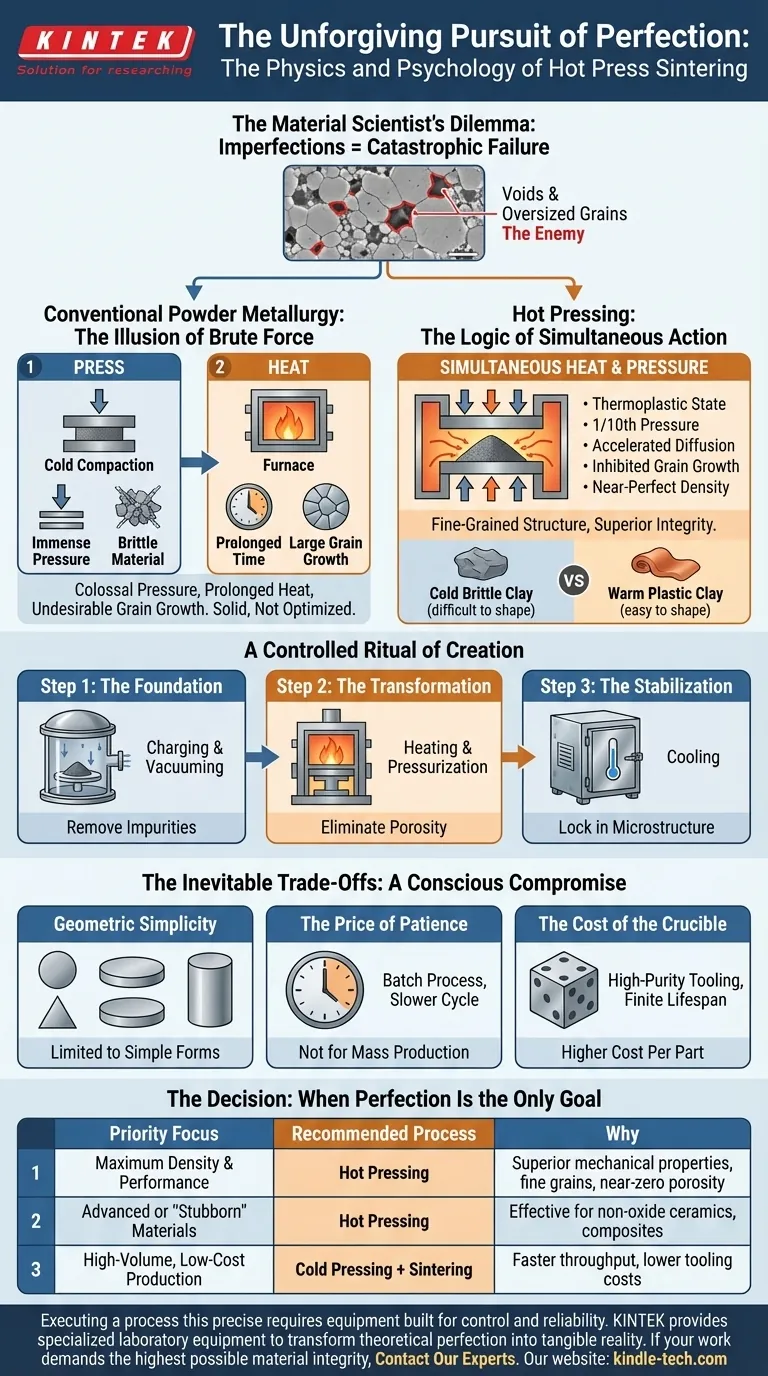
Related Products
- 600T Vacuum Induction Hot Press Furnace for Heat Treat and Sintering
- Vacuum Heat Treat and Pressure Sintering Furnace for High Temperature Applications
- Vacuum Heat Treat and Sintering Furnace with 9MPa Air Pressure
- Vacuum Hot Press Furnace Heated Vacuum Press Machine Tube Furnace
- Vacuum Hot Press Furnace Machine Heated Vacuum Press
Related Articles
- Comprehensive Guide to Vacuum Hot Press Furnace Application
- The Purity Paradox: Choosing the Heart of Your Vacuum Hot Press Furnace
- Vacuum Hot Press Furnace: A Comprehensive Guide
- Forging Perfection in a Void: The Physics of Ultra-Dense Materials
- Vacuum Hot Press Sintering Furnace Structure and Classification