The Illusion of Solidity
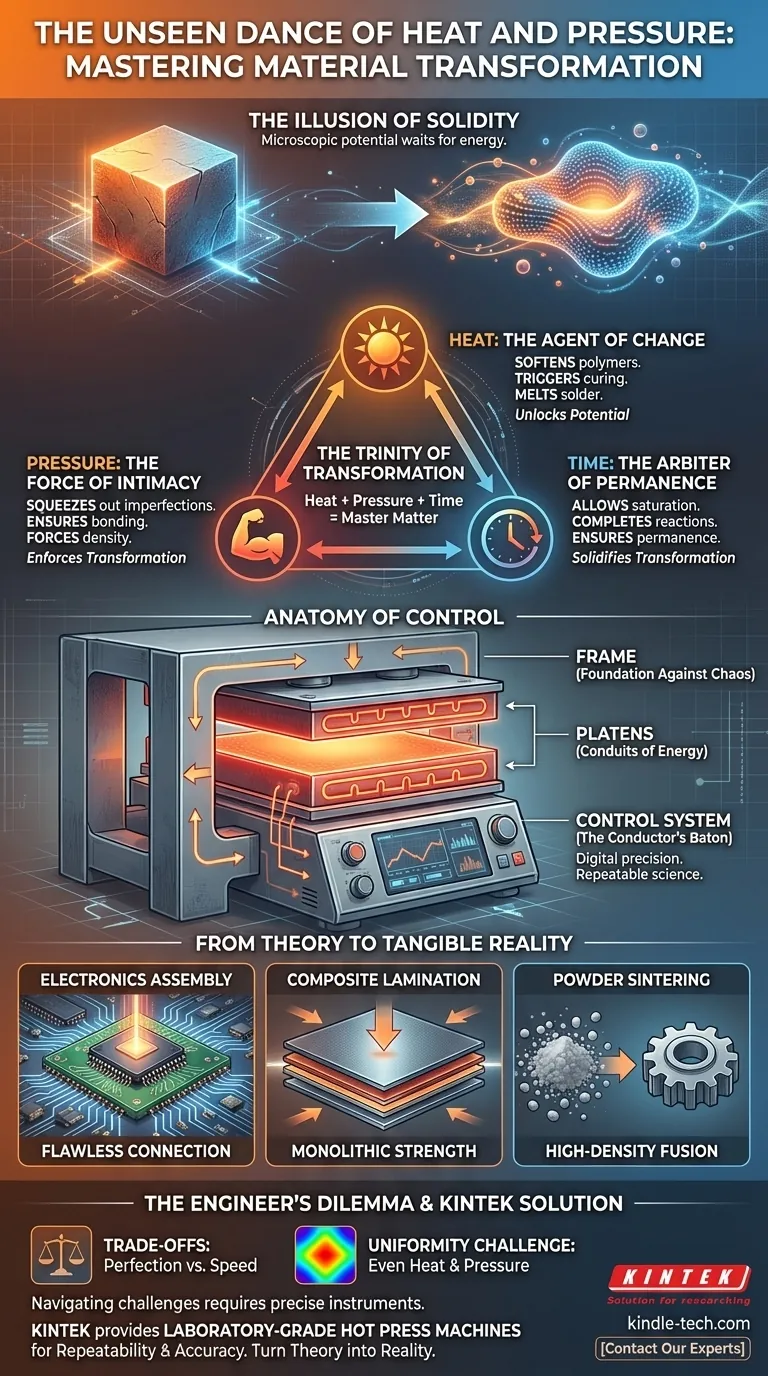
At a glance, a solid object appears permanent and unchangeable. Yet, this is an illusion. At the microscopic level, all materials are in a state of potential, waiting for the right input of energy to transform.
The human desire to bond, shape, and densify materials—to make them stronger, more useful, or more beautiful—is ancient. The modern hot press machine is the pinnacle of this ambition. It’s not just a tool of brute force; it’s an instrument for conducting a precise dance between thermodynamics and mechanics. It leverages fundamental laws to create transformations that feel like alchemy.
This process rests on a trinity of variables: heat, pressure, and time. Master them, and you can master matter.
The Trinity of Transformation
To truly control an outcome, you must understand the forces at play. In hot pressing, each element of the core trinity serves a distinct, irreplaceable purpose.
Heat: The Agent of Change
Heat is the catalyst. It provides the energy required to disrupt the stable state of a material, giving it permission to change.
In polymers, it softens molecular chains, making them pliable. In adhesives, it triggers a curing reaction, creating powerful cross-links. In electronics, it melts solder into a liquid state, ready to form a perfect connection. Heat doesn’t force the change; it unlocks the material’s potential for it.
Pressure: The Force of Intimacy
If heat grants permission, pressure enforces the transformation. Its role is to create intimacy.
By applying immense, uniform force, a press squeezes out the hidden imperfections that undermine strength—air pockets, voids, and microscopic gaps. In lamination, it ensures two surfaces become one. In powder metallurgy, it forces loose particles into a dense, unified block. Pressure is the guarantee that the intended bond, shape, or density is achieved without compromise.
Time: The Arbiter of Permanence
Time is the dimension in which the transformation solidifies. It is the patient conductor ensuring the process reaches its intended conclusion.
A press cycle's duration allows thermal energy to fully saturate the material. It gives chemical reactions, like the curing of a resin, the necessary moments to complete. A cycle cut short results in a superficial bond, prone to failure. One that runs too long can degrade the material. Time ensures the change is not temporary, but permanent.
Anatomy of Control
A hot press is an ecosystem of components designed to tame these powerful forces with scientific precision.
The Frame: A Foundation Against Chaos
The immense forces involved must be contained. The heavy, rigid frame of a press is its foundation, ensuring that every kilopascal of pressure is directed into the workpiece, not lost to structural flex.
The Platens: Conduits of Energy
The platens are the heart of the machine. These thick steel plates are the interface where heat and pressure are transferred to the material. Their design is an engineering marvel. Channels drilled within allow a heating medium to circulate, while their surfaces are ground to near-perfect flatness. Any inconsistency in temperature or pressure across the platen is a potential point of failure in the final product.
The Control System: The Conductor's Baton
This is where intent meets physics. Modern control systems, with digital pressure gauges and multi-stage temperature profiles, elevate the process from a craft to a repeatable science. They allow an operator to dictate the exact sequence of the dance, ensuring the same perfect result every single time.
From Theory to Tangible Reality
The applications of this controlled transformation are vast, each solving a unique challenge.
-
Electronics Assembly: In hot bar soldering, the challenge is creating a flawless electrical and mechanical connection on a microscopic scale. The press delivers a precise pulse of heat and force to a tiny area, forming a bond that can withstand years of thermal stress.
-
Composite Lamination: The goal is not just to glue layers together, but to create a single, monolithic panel stronger than the sum of its parts. The press eliminates voids between layers, creating a unified material for aerospace or industrial use.
-
Powder Sintering: Here, the press performs a truly remarkable feat: turning loose powder into a solid, high-density part. The simultaneous application of heat and pressure compacts the particles, fusing them into a robust component with exceptional material properties.
The Engineer's Dilemma: Navigating the Trade-offs
This power comes with inherent challenges. The primary dilemma is the battle between perfection and speed. Hot pressing is a batch process; the need to heat, press, and cool dictates a finite cycle time.
The second great challenge is uniformity. Achieving perfectly even temperature and pressure across a large surface is a significant engineering feat. These inconsistencies are the silent enemies of quality, leading to weak spots or warped parts.
Overcoming these challenges isn't about finding a bigger hammer; it's about finding a more precise instrument. For laboratory research, materials science, and high-spec production, the quality of the equipment dictates the quality of the outcome. The ability to precisely control the trinity of heat, pressure, and time is what separates success from failure.
At KINTEK, we provide the instruments for this precise control. Our range of laboratory-grade hot press machines are designed for researchers and engineers who understand that repeatability and accuracy are non-negotiable. Whether you are developing next-generation composites, perfecting electronics assembly, or pioneering new materials, our equipment provides the stable, uniform, and controllable environment you need to turn theory into reality.
If your work demands the mastery of material transformation, we can provide the tools. Contact Our Experts
Visual Guide
Related Products
- Automatic Heated Hydraulic Press Machine with Heated Plates for Laboratory Hot Press 25T 30T 50T
- Manual High Temperature Heated Hydraulic Press Machine with Heated Plates for Lab
- Touchscreen Automatic Vacuum Heat Press
- 30T 40T Split Automatic Heated Hydraulic Press Machine with Heated Plates for Laboratory Hot Press
- Vacuum Hot Press Furnace Machine Heated Vacuum Press
Related Articles
- Why Your Composite and Polymer Parts Keep Failing: The Secret Is Simultaneous Heat and Pressure
- The Physics of Flawless Materials: Deconstructing the Hydraulic Hot Press
- Precision Under Pressure: The Physics and Psychology of the Hydraulic Hot Press
- Hydraulic Hot Press: Principles, Components, Features, Advantages, and Applications
- Comprehensive Guide to Hydraulic Hot Press: Function, Features and Applications