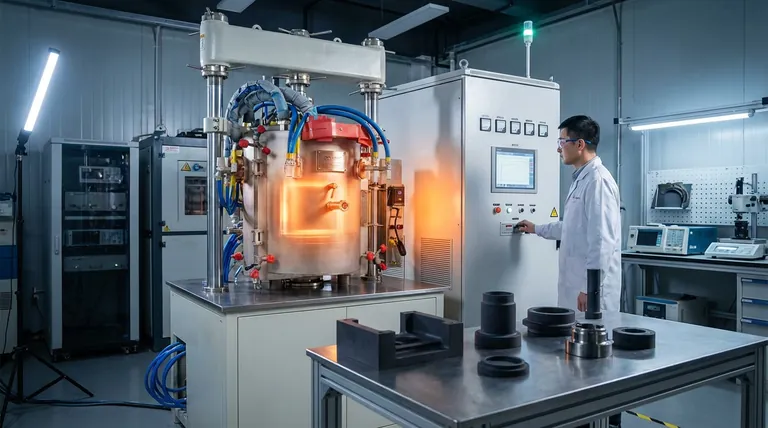
The Anatomy of a Critical Failure
Imagine a multi-million dollar industrial machine grinding to a halt. The cause? Not a complex software glitch, but the microscopic failure of a single cutting tool. Or consider an aerospace component failing under stress. The root cause is often traced back to an invisible enemy: a tiny void, an internal porosity, a weakness born during its creation.
In engineering, we often design for tolerance. But in certain high-stakes applications, tolerance is a luxury we cannot afford. The decision is not just about choosing a material, but choosing the very process that gives it integrity. This is the world where hot pressing isn't just a manufacturing method; it's a statement of intent.
The Promise of Perfection
At its core, hot pressing is deceptively simple. It combines intense heat and pressure simultaneously to fuse powdered materials into a solid form. But unlike conventional methods that press first and heat later, this simultaneous action fundamentally changes the outcome.
It is not a process built for speed or volume. It is a deliberate, methodical approach designed to create components with a density and strength that approaches the theoretical maximum of the material itself. It’s the difference between building something that is simply functional and forging something that is fundamentally sound.
The Three Pillars of Material Integrity
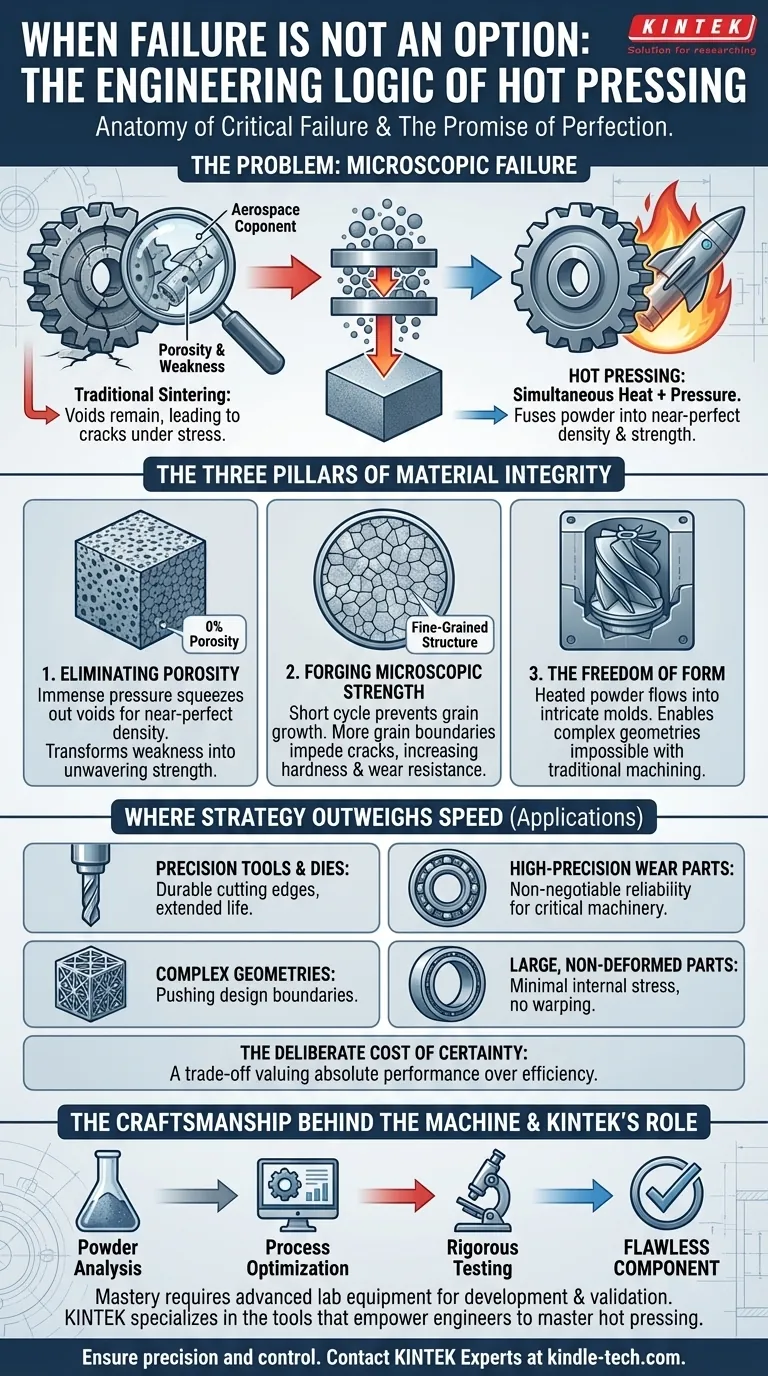
The superiority of a hot-pressed component isn’t based on a single benefit, but on a triad of interconnected properties that address the root causes of mechanical failure.
1. Eliminating the Invisible Enemy: Porosity
In traditional powder metallurgy, microscopic voids can remain trapped between particles after sintering. These voids are the starting points for cracks and failures under stress.
Hot pressing systematically eliminates this risk. The immense pressure applied while the material is heated forces the powder particles to fuse together, squeezing out virtually all porosity. The result is a near-perfectly dense component, transforming a potential weakness into unwavering strength.
2. Forging Strength at the Microscopic Level
Strength isn't just about density; it's also about structure. The relatively short cycle of hot pressing prevents the material’s microscopic grains from growing too large.
This results in a fine-grained microstructure. For materials like cemented carbide, this is critical. More grain boundaries act as roadblocks, impeding the propagation of cracks. This directly translates to exceptional hardness and wear resistance, allowing a cutting edge to last longer and a wear part to endure more friction.
3. The Freedom of Form
Heating the powder during pressing gives it a unique fluidity, allowing it to fill every intricacy of a complex mold.
This unlocks design possibilities that are difficult or prohibitively expensive to achieve through traditional machining. Intricate parts like thin-walled tubes, complex balls, or other non-standard geometries can be formed directly, preserving material integrity without the stress of subtractive manufacturing.
Where Strategy Outweighs Speed
Choosing hot pressing is a strategic decision, not a default one. It's a conscious trade-off, valuing absolute performance over production efficiency. This logic applies to a specific class of high-value components.
| Product Category | Why Hot Pressing is the Strategic Choice |
|---|---|
| Precision Tools & Dies | The fine grain structure ensures a durable, long-lasting cutting edge that justifies the higher initial cost through extended operational life. |
| High-Precision Wear Parts | For aerospace or critical industrial machinery, the exceptional wear resistance provides a level of reliability that is non-negotiable. |
| Complex Geometries | It enables the creation of intricate forms that would otherwise be impossible, pushing the boundaries of component design. |
| Large, Non-Deformed Parts | The process introduces minimal internal stress, allowing for the creation of large, stable components without the risk of warping. |
The Deliberate Cost of Certainty
Of course, this process has limitations. It is slower, more expensive, and requires a high degree of technical expertise. It's not suited for mass production or for components where "good enough" truly is.
But this is where the psychological shift occurs. You aren't paying for a faster process; you are investing in certainty. The higher cost reflects the meticulous control, advanced equipment, and skilled operation required to guarantee that the final product is as close to perfect as physically possible.
The Craftsmanship Behind the Machine
Achieving this level of perfection isn’t just about the press itself. It's about mastering the entire process, from powder analysis to final quality control. The journey to a flawless component begins long before the powder enters the mold. It starts in the lab.
Precise material characterization, process parameter optimization, and rigorous testing are the foundation upon which reliable hot pressing is built. This is where having the right laboratory equipment isn't just a convenience—it's a prerequisite for success. At KINTEK, we specialize in providing the advanced lab equipment and consumables that empower engineers to master demanding processes like hot pressing. We understand that creating superior components requires superior tools for development and validation.
If your work demands components where performance is absolute and failure is not an option, exploring the potential of hot pressing is a critical step. To ensure your process is built on a foundation of precision and control, Contact Our Experts.
Visual Guide
Related Products
- Automatic Heated Hydraulic Press Machine with Heated Plates for Laboratory Hot Press 25T 30T 50T
- Manual High Temperature Heated Hydraulic Press Machine with Heated Plates for Lab
- Touchscreen Automatic Vacuum Heat Press
- 30T 40T Split Automatic Heated Hydraulic Press Machine with Heated Plates for Laboratory Hot Press
- Vacuum Hot Press Furnace Machine Heated Vacuum Press
Related Articles
- Why Your Composite and Polymer Parts Keep Failing: The Secret Is Simultaneous Heat and Pressure
- The Physics of Flawless Materials: Deconstructing the Hydraulic Hot Press
- Precision Under Pressure: The Physics and Psychology of the Hydraulic Hot Press
- Hydraulic Hot Press: Principles, Components, Features, Advantages, and Applications
- Comprehensive Guide to Hydraulic Hot Press: Function, Features and Applications