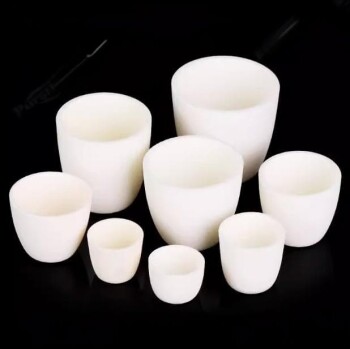
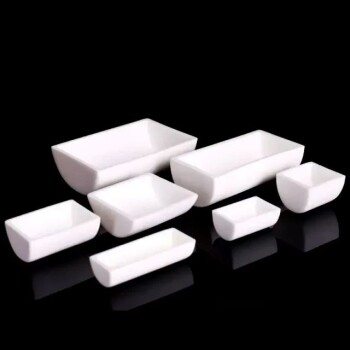
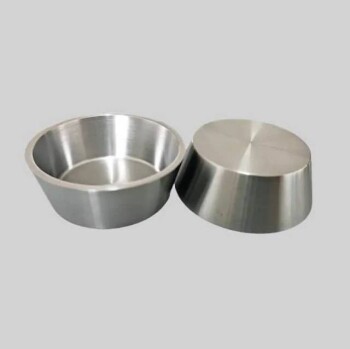
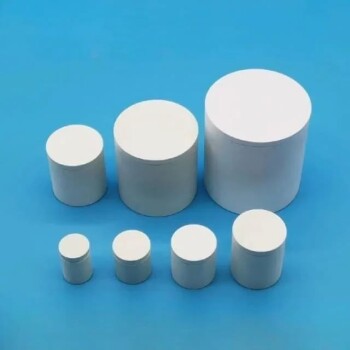
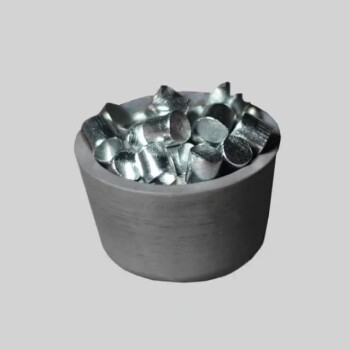
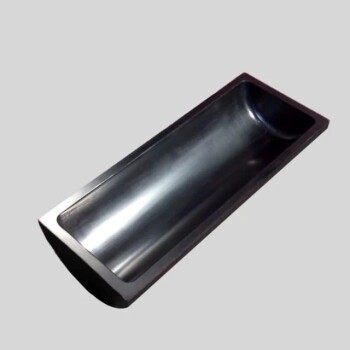
Magnesium oxide (MgO) crucibles serve as a critical component in high-temperature metallurgy by providing a physically robust and chemically neutral environment for alloy processing. Specifically for Fe2Ti alloys, these crucibles offer the distinct advantage of withstanding extreme processing temperatures without softening, while simultaneously minimizing chemical reactions that could contaminate the melt.
Core Takeaway The fundamental value of an MgO crucible lies in its ability to decouple the container from the contents. It provides the necessary thermal endurance to melt Fe2Ti while remaining chemically passive, ensuring the alloy’s composition remains pure and structurally sound.
The Mechanics of Thermal Stability
Exceptional Heat Resistance
The primary challenge in melting iron-titanium based alloys is the extreme temperature required to achieve a liquid state.
Structural Integrity at Temperature
MgO maintains its rigidity under these conditions. Unlike lesser ceramics that might soften or deform, magnesium oxide retains its shape and structural strength, preventing containment failure during the critical melting phase.
Chemical Inertness and Purity
Low Reactivity with Fe and Ti
At high temperatures, molten metals become highly aggressive solvents. Iron and titanium are particularly prone to attacking crucible walls.
MgO exhibits very low reactivity with these specific elements. It acts as an effective barrier, preventing the molten alloy from eroding the crucible surface and absorbing ceramic particles.
Preserving Alloy Composition
The integrity of an experimental sample depends on its purity. By resisting chemical breakdown, the MgO crucible minimizes the introduction of foreign impurities.
This ensures that the final structural integrity and chemical makeup of the Fe2Ti alloy are determined solely by your initial inputs, not by degradation of the containment vessel.
Understanding the Trade-offs
Cooling Rates and Microstructure
While MgO excels at stability, it behaves differently than alternative methods like water-cooled copper crucibles.
MgO is a thermal insulator. It holds heat, which results in a slower cooling process for the alloy.
If your goal requires a fine, uniform as-cast microstructure driven by a sharp cooling gradient, an MgO crucible may not provide the rapid heat extraction found in water-cooled systems, which utilize a condensation shell to force rapid solidification.
Absolute Purity vs. Practical Purity
MgO minimizes impurities, but no ceramic is perfectly inert forever.
In contrast, a water-cooled copper crucible uses a "skull" of the alloy itself to prevent any contact with the crucible wall. Therefore, while MgO offers exceptional purity for standard high-temperature applications, it represents a balance between ease of use and the absolute zero-contamination approach of skull melting.
Making the Right Choice for Your Goal
To select the correct crucible, you must define the priority of your experiment regarding cooling dynamics and contamination thresholds.
- If your primary focus is thermal stability and ease of containment: Choose the MgO crucible, as it provides a robust, low-reactivity vessel that simplifies the melting process without softening.
- If your primary focus is manipulating microstructure via rapid cooling: Consider a water-cooled copper crucible, as its active cooling system creates the steep temperature gradients necessary for fine grain formation.
Ultimately, use MgO when you need a reliable, high-temperature standard for producing pure alloy samples without the complexity of active cooling systems.
Summary Table:
| Feature | MgO Crucible Advantage | Impact on Fe2Ti Processing |
|---|---|---|
| Thermal Stability | Maintains rigidity at extreme temperatures | Prevents vessel deformation or containment failure |
| Chemical Inertness | Low reactivity with Fe and Ti | Minimizes melt contamination and ceramic inclusion |
| Cooling Profile | Thermal insulator (Slower cooling) | Supports steady solidification without active cooling |
| Purity Level | High practical purity | Ensures alloy composition matches experimental inputs |
| Operational Ease | Passive containment system | Simplifies setup compared to water-cooled skull melting |
Elevate Your Metallurgical Precision with KINTEK
Achieve uncompromising purity in your alloy development with KINTEK’s high-performance laboratory solutions. Whether you are melting complex Fe2Ti alloys or conducting advanced materials research, our specialized MgO crucibles, high-temperature furnaces, and crushing and milling systems provide the reliability your data demands.
From vacuum and atmosphere furnaces to high-pressure reactors and autoclaves, KINTEK empowers researchers with a comprehensive range of consumables including PTFE products, ceramics, and high-purity crucibles.
Ready to optimize your high-temperature processes? Contact our technical experts today to find the perfect equipment and consumables for your laboratory.
References
- W. Gąsior, A. Dębski. Enthalpy of Formation of Intermetallic Phases from Fe-Ni-Ti System. Comparative Studies / Entalpia Tworzenia Faz Międzymetalicznych Z Układu Fe-Ni-Ti. Studia Porównawcze. DOI: 10.2478/v10172-012-0122-4
This article is also based on technical information from Kintek Solution Knowledge Base .
Related Products
- Electron Beam Evaporation Coating Gold Plating Tungsten Molybdenum Crucible for Evaporation
- Electron Beam Evaporation Coating Tungsten Crucible and Molybdenum Crucible for High Temperature Applications
- High Purity Pure Graphite Crucible for Evaporation
- High Purity Pure Graphite Crucible for Electron Beam Evaporation
- Arc-Shaped Alumina Ceramic Crucible High Temperature Resistant for Engineering Advanced Fine Ceramics
People Also Ask
- What is the container that holds the metal source material called in e-beam evaporation? Ensure Purity and Quality in Your Thin-Film Deposition
- What materials are used in electron beam evaporation? Master High-Purity Thin Film Deposition
- What is the process of e-beam coating? Achieve High-Purity, Precise Thin Films for Your Lab
- What is e-beam evaporation? Achieve High-Purity Thin Film Deposition for Your Lab
- What is the voltage of e-beam evaporation? Achieve Precise Thin-Film Deposition