Knowledge pecvd machine What is plasma assisted physical vapor deposition? Enhance Your Coating Performance with Advanced PA-PVD
Author avatar

Tech Team · Kintek Solution

Updated 2 months ago

What is plasma assisted physical vapor deposition? Enhance Your Coating Performance with Advanced PA-PVD


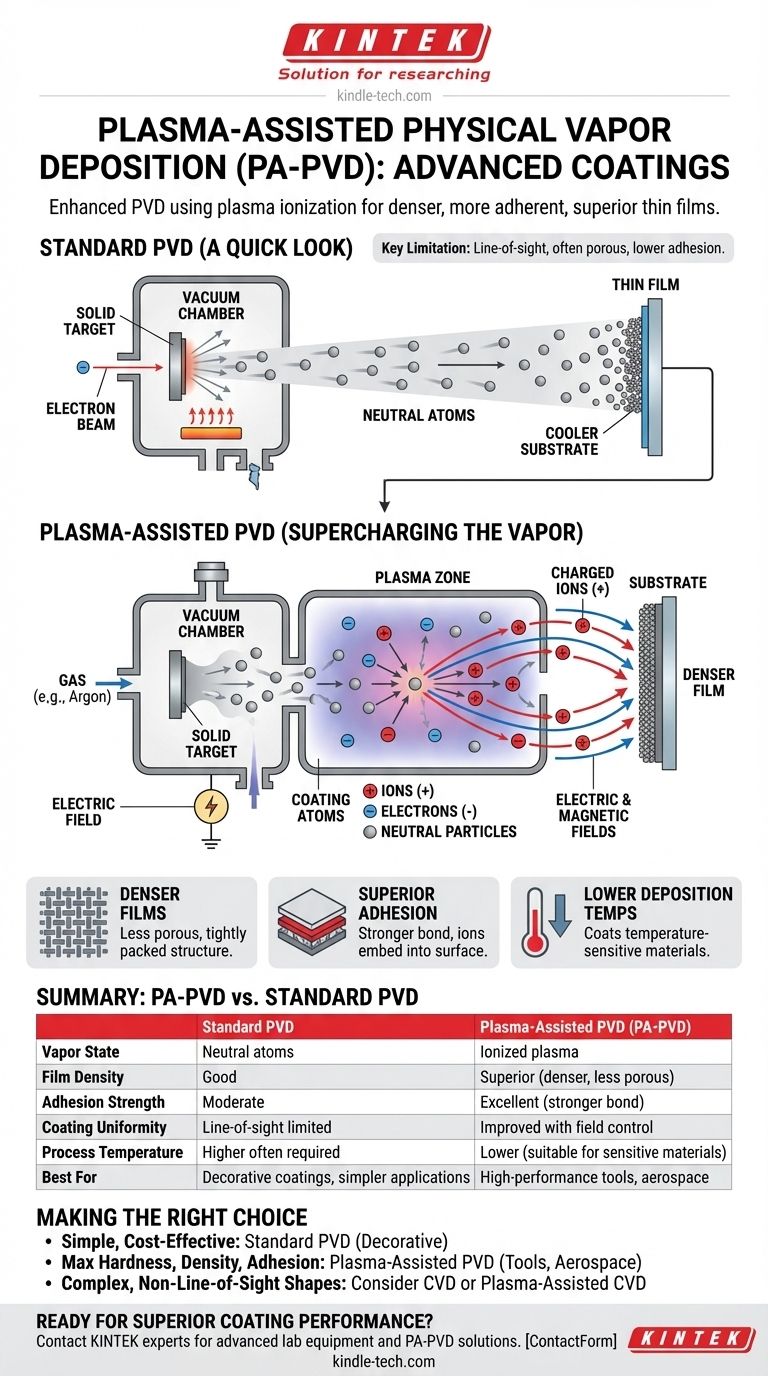
In short, Plasma-Assisted Physical Vapor Deposition (PA-PVD) is an advanced coating process that enhances traditional Physical Vapor Deposition (PVD) by using plasma to ionize the coating material. This ionization gives the vaporized atoms more energy, resulting in thin films that are denser, more adherent, and have superior properties compared to those created by standard PVD.

The critical difference is simple: standard PVD relies on neutral atoms passively condensing onto a surface. PA-PVD actively energizes these atoms by turning them into ions within a plasma, allowing for a much more controlled and forceful deposition that dramatically improves the final coating's quality.
What is plasma assisted physical vapor deposition? Enhance Your Coating Performance with Advanced PA-PVD

First, A Quick Look at Standard PVD

The Core Mechanism: From Solid to Vapor

Physical Vapor Deposition is a vacuum-based process. Inside a chamber, a high-energy source—like an electron beam or electric arc—vaporizes a solid source material, known as the "target."

These vaporized atoms travel through the vacuum and condense onto a cooler substrate (the object being coated), forming a thin, solid film.

The Key Limitation

In its most basic form, PVD is a "line-of-sight" process. The neutral vapor atoms travel in a relatively straight line from the source to the substrate.

This can make it difficult to uniformly coat complex shapes and can result in coatings with lower density or adhesion under certain conditions.

The Role of Plasma: Supercharging the Vapor

What is Plasma in this Context?

Plasma is often called the fourth state of matter. For PA-PVD, it is created by introducing a gas (like argon) into the vacuum chamber and energizing it with an electric field.

This process strips electrons from the gas atoms, creating a highly energetic environment filled with charged ions, electrons, and neutral particles.

The Power of Ionization

When the vaporized coating material passes through this plasma, it collides with these energetic particles. These collisions transfer energy and knock electrons off the coating atoms, turning them into positively charged ions.

A key example of this is Arc Vapor Deposition, a type of PA-PVD where a high percentage of the vaporized material becomes ionized.

Benefits of an Ionized Vapor Stream

Creating an ionized vapor stream fundamentally changes the deposition process. Because the coating atoms are now charged, they can be manipulated by electric and magnetic fields.

This allows us to accelerate them toward the substrate with high energy. This energetic bombardment results in several key advantages:

  • Denser Films: The high energy of the arriving ions helps to form a more tightly packed, less porous film structure.
  • Superior Adhesion: Ions can embed themselves slightly into the substrate's surface, creating a much stronger bond between the coating and the part.
  • Lower Deposition Temperatures: The energy required for a high-quality film comes from the plasma and ion acceleration, not just from heating the substrate. This makes it possible to coat temperature-sensitive materials.

Understanding the Trade-offs and Alternatives

PA-PVD vs. Standard PVD

Standard PVD is simpler and often more cost-effective. It is perfectly suitable for many applications, such as applying optical films or decorative coatings.

PA-PVD is chosen when the performance of the coating is critical. The added complexity of generating and controlling the plasma is justified by the need for exceptionally hard, dense, or corrosion-resistant films for tools or aerospace components.

A Note on Plasma-Assisted CVD (PACVD)

A related but distinct process is Plasma-Assisted Chemical Vapor Deposition (PACVD). While PVD starts with a solid target, CVD uses precursor gases that react to form the film.

Plasma serves a similar function in both: it provides the activation energy to drive the process at lower temperatures. However, the source material (solid vs. gas) is the key differentiator.

Making the Right Choice for Your Goal

  • If your primary focus is a simple, cost-effective coating: Standard PVD methods are often the most direct and economical solution.
  • If your primary focus is maximum hardness, density, and adhesion: Plasma-Assisted PVD is necessary for creating high-performance coatings for demanding applications like cutting tools or engine parts.
  • If your primary focus is coating complex, non-line-of-sight shapes: You may need to evaluate Chemical Vapor Deposition (CVD) or its plasma-assisted variants, which excel at uniform coverage.

Ultimately, integrating plasma into the PVD process is a strategic choice to transform a simple condensation into a highly controlled, energetic film growth for superior material performance.

Summary Table:

Feature Standard PVD Plasma-Assisted PVD (PA-PVD)
Vapor State Neutral atoms Ionized plasma
Film Density Good Superior (denser, less porous)
Adhesion Strength Moderate Excellent (stronger bond)
Coating Uniformity Line-of-sight limited Improved with field control
Process Temperature Higher often required Lower (suitable for sensitive materials)
Best For Decorative coatings, simpler applications High-performance tools, aerospace components

Ready to achieve superior coating performance for your laboratory applications? At KINTEK, we specialize in advanced lab equipment, including Plasma-Assisted PVD solutions that deliver denser, more adherent thin films for demanding applications. Our expertise ensures you get the right coating technology for cutting tools, aerospace components, and other high-performance needs. Contact our experts today to discuss how PA-PVD can enhance your lab's capabilities and material performance!

Visual Guide
What is plasma assisted physical vapor deposition? Enhance Your Coating Performance with Advanced PA-PVD Visual Guide

Related Products

People Also Ask

Related Products

Chemical Vapor Deposition CVD Equipment System Chamber Slide PECVD Tube Furnace with Liquid Gasifier PECVD Machine

Chemical Vapor Deposition CVD Equipment System Chamber Slide PECVD Tube Furnace with Liquid Gasifier PECVD Machine

KT-PE12 Slide PECVD System: Wide power range, programmable temp control, fast heating/cooling with sliding system, MFC mass flow control & vacuum pump.

RF PECVD System Radio Frequency Plasma-Enhanced Chemical Vapor Deposition RF PECVD

RF PECVD System Radio Frequency Plasma-Enhanced Chemical Vapor Deposition RF PECVD

RF-PECVD is an acronym for "Radio Frequency Plasma-Enhanced Chemical Vapor Deposition." It deposits DLC (Diamond-like carbon film) on germanium and silicon substrates. It is utilized in the 3-12um infrared wavelength range.

Microwave Plasma Chemical Vapor Deposition MPCVD Machine System Reactor for Lab and Diamond Growth

Microwave Plasma Chemical Vapor Deposition MPCVD Machine System Reactor for Lab and Diamond Growth

Get high-quality diamond films with our Bell-jar Resonator MPCVD machine designed for lab and diamond growth. Discover how Microwave Plasma Chemical Vapor Deposition works for growing diamonds using carbon gas and plasma.

915MHz MPCVD Diamond Machine Microwave Plasma Chemical Vapor Deposition System Reactor

915MHz MPCVD Diamond Machine Microwave Plasma Chemical Vapor Deposition System Reactor

915MHz MPCVD Diamond Machine and its multi-crystal effective growth, the maximum area can reach 8 inches, the maximum effective growth area of single crystal can reach 5 inches. This equipment is mainly used for the production of large-size polycrystalline diamond films, the growth of long single crystal diamonds, the low-temperature growth of high-quality graphene, and other materials that require energy provided by microwave plasma for growth.

Inclined Rotary Plasma Enhanced Chemical Vapor Deposition PECVD Equipment Tube Furnace Machine

Inclined Rotary Plasma Enhanced Chemical Vapor Deposition PECVD Equipment Tube Furnace Machine

Upgrade your coating process with PECVD coating equipment. Ideal for LED, power semiconductors, MEMS and more. Deposits high-quality solid films at low temps.

Inclined Rotary Plasma Enhanced Chemical Vapor Deposition PECVD Equipment Tube Furnace Machine

Inclined Rotary Plasma Enhanced Chemical Vapor Deposition PECVD Equipment Tube Furnace Machine

Introducing our inclined rotary PECVD furnace for precise thin film deposition. Enjoy automatic matching source, PID programmable temperature control, and high accuracy MFC mass flowmeter control. Built-in safety features for peace of mind.

Cylindrical Resonator MPCVD Machine System Reactor for Microwave Plasma Chemical Vapor Deposition and Lab Diamond Growth

Cylindrical Resonator MPCVD Machine System Reactor for Microwave Plasma Chemical Vapor Deposition and Lab Diamond Growth

Learn about Cylindrical Resonator MPCVD Machine, the microwave plasma chemical vapor deposition method used for growing diamond gemstones and films in the jewelry and semi-conductor industries. Discover its cost-effective advantages over traditional HPHT methods.

Spark Plasma Sintering Furnace SPS Furnace

Spark Plasma Sintering Furnace SPS Furnace

Discover the benefits of Spark Plasma Sintering Furnaces for rapid, low-temperature material preparation. Uniform heating, low cost & eco-friendly.

Round Bidirectional Press Mold for Lab

Round Bidirectional Press Mold for Lab

The round bidirectional press mold is a specialized tool used in high-pressure molding processes, particularly for creating intricate shapes from metal powders.

Multi Heating Zones CVD Tube Furnace Machine Chemical Vapor Deposition Chamber System Equipment

Multi Heating Zones CVD Tube Furnace Machine Chemical Vapor Deposition Chamber System Equipment

KT-CTF14 Multi Heating Zones CVD Furnace - Precise Temperature Control and Gas Flow for Advanced Applications. Max temp up to 1200℃, 4 channels MFC mass flow meter, and 7" TFT touch screen controller.

Vacuum Hot Press Furnace Machine for Lamination and Heating

Vacuum Hot Press Furnace Machine for Lamination and Heating

Experience clean and precise lamination with Vacuum Lamination Press. Perfect for wafer bonding, thin-film transformations, and LCP lamination. Order now!

Custom CVD Diamond Coating for Lab Applications

Custom CVD Diamond Coating for Lab Applications

CVD Diamond Coating: Superior Thermal Conductivity, Crystal Quality, and Adhesion for Cutting Tools, Friction, and Acoustic Applications

Vacuum Heat Treat and Pressure Sintering Furnace for High Temperature Applications

Vacuum Heat Treat and Pressure Sintering Furnace for High Temperature Applications

Vacuum pressure sintering furnaces are designed for high temperature hot pressing applications in metal and ceramic sintering. Its advanced features ensure precise temperature control, reliable pressure maintenance, and a robust design for seamless operation.

Laboratory CVD Boron Doped Diamond Materials

Laboratory CVD Boron Doped Diamond Materials

CVD boron-doped diamond: A versatile material enabling tailored electrical conductivity, optical transparency, and exceptional thermal properties for applications in electronics, optics, sensing, and quantum technologies.

Vacuum Hot Press Furnace Machine Heated Vacuum Press

Vacuum Hot Press Furnace Machine Heated Vacuum Press

Discover the advantages of Vacuum Hot Press Furnace! Manufacture dense refractory metals & compounds, ceramics, and composites under high temp and pressure.

Vacuum Induction Melting Spinning System Arc Melting Furnace

Vacuum Induction Melting Spinning System Arc Melting Furnace

Develop metastable materials with ease using our Vacuum Melt Spinning System. Ideal for research and experimental work with amorphous and microcrystalline materials. Order now for effective results.

Customer Made Versatile CVD Tube Furnace Chemical Vapor Deposition Chamber System Equipment

Customer Made Versatile CVD Tube Furnace Chemical Vapor Deposition Chamber System Equipment

Get your exclusive CVD furnace with KT-CTF16 Customer Made Versatile Furnace. Customizable sliding, rotating, and tilting functions for precise reactions. Order now!

Vacuum Cold Mounting Machine for Sample Preparation

Vacuum Cold Mounting Machine for Sample Preparation

Vacuum Cold Mounting Machine for precise sample prep. Handles porous, fragile materials with -0.08MPa vacuum. Ideal for electronics, metallurgy, and failure analysis.

Vacuum Hot Press Furnace Heated Vacuum Press Machine Tube Furnace

Vacuum Hot Press Furnace Heated Vacuum Press Machine Tube Furnace

Reduce forming pressure & shorten sintering time with Vacuum Tube Hot Press Furnace for high-density, fine-grain materials. Ideal for refractory metals.

Molybdenum Tungsten Tantalum Evaporation Boat for High Temperature Applications

Molybdenum Tungsten Tantalum Evaporation Boat for High Temperature Applications

Evaporation boat sources are used in thermal evaporation systems and are suitable for depositing various metals, alloys and materials. Evaporation boat sources are available in different thicknesses of tungsten, tantalum and molybdenum to ensure compatibility with a variety of power sources. As a container, it is used for vacuum evaporation of materials. They can be used for thin film deposition of various materials, or designed to be compatible with techniques such as electron beam fabrication.


Leave Your Message