Knowledge What is sintering of clay? The Process of Transforming Powder into Durable Ceramics
Author avatar

Tech Team · Kintek Solution

Updated 1 week ago

What is sintering of clay? The Process of Transforming Powder into Durable Ceramics


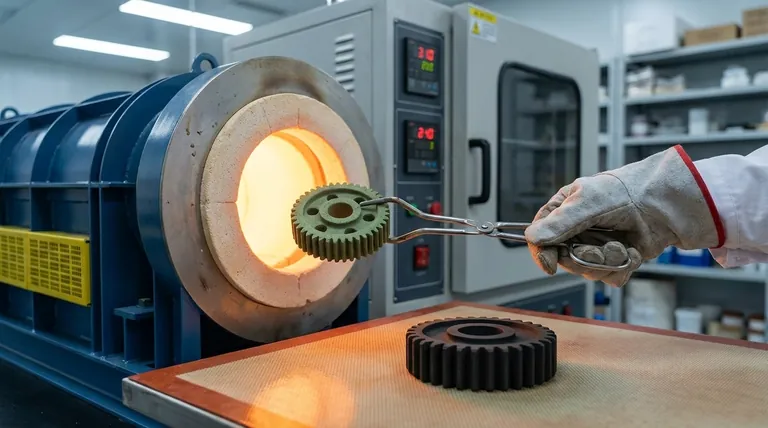
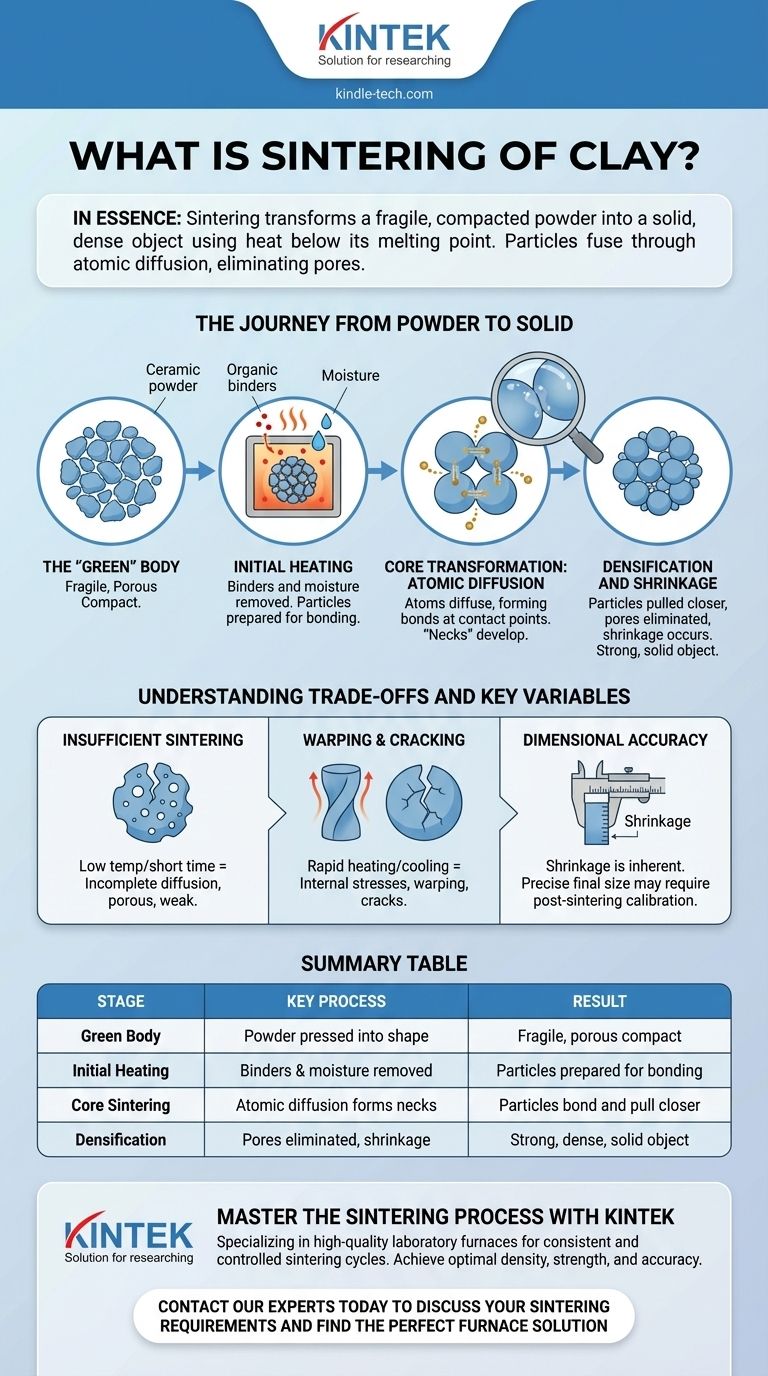
In essence, sintering is the process of transforming a fragile, compacted powder into a solid, dense object using heat. This is achieved by heating the material to a high temperature, but crucially, below its melting point. At this temperature, the individual particles fuse together through atomic diffusion, eliminating the pores between them and creating a strong, coherent mass.

Sintering is not a melting process. Instead, it is a solid-state transformation where heat and pressure compel individual particles to bond, systematically removing porosity and converting a delicate "green" body into a durable, dense ceramic piece.
What is sintering of clay? The Process of Transforming Powder into Durable Ceramics

The Journey from Powder to Solid

To truly understand sintering, it's best to view it as a multi-stage journey where a shaped powder undergoes a fundamental structural transformation.

The "Green" Body: The Starting Point

The process begins with a ceramic powder, which is often pressed into a desired shape using molds and high pressure.

This initial object is called a "green" body or a compact. While it holds its shape, it is mechanically weak, porous, and fragile.

Initial Heating: Clearing the Way

As the green body is heated in a furnace, the first phase occurs at lower temperatures.

During this stage, any residual moisture or organic binders—additives used to help shape the powder—are burned off, preparing the particles for direct contact.

The Core Transformation: Atomic Diffusion

As the temperature rises, the core of the sintering process begins. The atoms on the surfaces of the adjacent particles become more mobile.

These atoms start to move, or diffuse, across the boundaries between particles. This creates small "necks" or bonds at every point of contact.

Think of it like a collection of soap bubbles. Where two bubbles touch, their walls merge, and they begin to pull closer together, reducing the total empty space.

The Result: Densification and Shrinkage

As these bonds grow, the particle centers are pulled closer together. This systematically eliminates the tiny pores and gaps that existed in the green body.

This elimination of void space causes the entire object to become denser and stronger. It also results in a predictable amount of shrinkage, a critical factor in manufacturing.

Understanding the Trade-offs and Key Variables

Successful sintering depends on the precise control of several factors. Mismanaging them can lead to flawed or failed pieces.

Insufficient Sintering

If the temperature is too low or the time in the furnace is too short, the diffusion process will be incomplete.

The result is a piece that remains porous, weak, and unsuitable for its intended function.

Warping and Cracking

The heating and cooling cycles must be carefully managed. If a piece is heated or cooled too quickly, internal stresses can build up.

These stresses can cause the object to warp out of shape or, in more severe cases, develop cracks.

The Challenge of Dimensional Accuracy

Because sintering inherently involves shrinkage, achieving exact final dimensions is a significant challenge.

For applications requiring very tight tolerances, a post-sintering calibration step is often necessary, where the piece may be re-pressed or machined to its final, precise size.

Making the Right Choice for Your Goal

Understanding the principles of sintering allows you to control the outcome of your ceramic or powder-based project.

  • If your primary focus is maximum strength and density: You must ensure the piece reaches the optimal sintering temperature and is held there long enough for pore elimination to complete.
  • If your primary focus is precise dimensional accuracy: You must carefully calculate the material's shrinkage rate and plan for post-sintering calibration or machining.
  • If you are troubleshooting a failed piece: First, examine it for signs of incomplete sintering (porosity and low strength) or for stress fractures caused by improper heating and cooling cycles.

Ultimately, mastering sintering is about precisely controlling heat and time to guide a simple powder through its transformation into a durable, functional object.

Summary Table:

Stage Key Process Result
Green Body Powder is pressed into shape Fragile, porous compact
Initial Heating Binders and moisture are removed Particles prepared for bonding
Core Sintering Atomic diffusion forms necks between particles Particles bond and pull closer
Densification Pores are eliminated, shrinkage occurs Strong, dense, solid object

Master the sintering process for your laboratory ceramics with KINTEK.

Whether you are developing new ceramic materials, troubleshooting sintering defects like warping or porosity, or require precise dimensional control, the right equipment is critical. KINTEK specializes in high-quality laboratory furnaces designed for consistent and controlled sintering cycles.

We provide the reliable tools you need to achieve optimal density, strength, and accuracy in your ceramic projects.

Contact our experts today to discuss your specific sintering requirements and find the perfect furnace solution for your lab.

Visual Guide
What is sintering of clay? The Process of Transforming Powder into Durable Ceramics Visual Guide

Related Products

People Also Ask

Related Products

Electric Rotary Kiln Pyrolysis Furnace Plant Machine Calciner Small Rotary Kiln Rotating Furnace

Electric Rotary Kiln Pyrolysis Furnace Plant Machine Calciner Small Rotary Kiln Rotating Furnace

Electric rotary kiln - precisely controlled, it's ideal for calcination and drying of materials like lithium cobalate, rare earths, and non-ferrous metals.

Electric Rotary Kiln Continuous Working Small Rotary Furnace Heating Pyrolysis Plant

Electric Rotary Kiln Continuous Working Small Rotary Furnace Heating Pyrolysis Plant

Efficiently calcine and dry bulk powder and lump fluid materials with an electric heating rotary furnace. Ideal for processing lithium ion battery materials and more.

Electric Rotary Kiln Small Rotary Furnace for Activated Carbon Regeneration

Electric Rotary Kiln Small Rotary Furnace for Activated Carbon Regeneration

Revitalize your activated carbon with KinTek's Electric Regeneration Furnace. Achieve efficient and cost-effective regeneration with our highly automated rotary kiln and intelligent thermal controller.

Vacuum Sealed Continuous Working Rotary Tube Furnace Rotating Tube Furnace

Vacuum Sealed Continuous Working Rotary Tube Furnace Rotating Tube Furnace

Experience efficient material processing with our vacuum-sealed rotary tube furnace. Perfect for experiments or industrial production, equipped with optional features for controlled feeding and optimized results. Order now.

1700℃ Muffle Oven Furnace for Laboratory

1700℃ Muffle Oven Furnace for Laboratory

Get superior heat control with our 1700℃ Muffle Furnace. Equipped with intelligent temperature microprocessor, TFT touch screen controller & advanced insulation materials for precise heating up to 1700C. Order now!

Laboratory Muffle Oven Furnace Bottom Lifting Muffle Furnace

Laboratory Muffle Oven Furnace Bottom Lifting Muffle Furnace

Efficiently produce batches with excellent temperature uniformity using our Bottom Lifting Furnace. Features two electric lifting stages and advanced temperature control up to 1600℃.

Mesh belt controlled atmosphere furnace

Mesh belt controlled atmosphere furnace

Discover our KT-MB mesh belt sintering furnace - perfect for high-temperature sintering of electronic components & glass insulators. Available for open air or controlled atmosphere environments.

High Temperature Muffle Oven Furnace for Laboratory Debinding and Pre Sintering

High Temperature Muffle Oven Furnace for Laboratory Debinding and Pre Sintering

KT-MD High temperature debinding and pre-sintering furnace for ceramic materials with various molding processes. Ideal for electronic components such as MLCC and NFC.

Small Vacuum Heat Treat and Tungsten Wire Sintering Furnace

Small Vacuum Heat Treat and Tungsten Wire Sintering Furnace

The small vacuum tungsten wire sintering furnace is a compact experimental vacuum furnace specially designed for universities and scientific research institutes. The furnace features a CNC welded shell and vacuum piping to ensure leak-free operation. Quick-connect electrical connections facilitate relocation and debugging, and the standard electrical control cabinet is safe and convenient to operate.

1200℃ Split Tube Furnace with Quartz Tube Laboratory Tubular Furnace

1200℃ Split Tube Furnace with Quartz Tube Laboratory Tubular Furnace

KT-TF12 split tube furnace: high-purity insulation, embedded heating wire coils, and max. 1200C. Widely used for new materials and chemical vapour deposition.

Laboratory Disc Rotary Mixer for Efficient Sample Mixing and Homogenization

Laboratory Disc Rotary Mixer for Efficient Sample Mixing and Homogenization

Efficient Laboratory Disc Rotary Mixer for Precise Sample Mixing, Versatile for Various Applications, DC Motor and Microcomputer Control, Adjustable Speed and Angle.

Vacuum Dental Porcelain Sintering Furnace

Vacuum Dental Porcelain Sintering Furnace

Get precise and reliable results with KinTek's Vacuum Porcelain Furnace. Suitable for all porcelain powders, it features hyperbolic ceramic furnace function, voice prompt, and automatic temperature calibration.

Manual High Temperature Heated Hydraulic Press Machine with Heated Plates for Lab

Manual High Temperature Heated Hydraulic Press Machine with Heated Plates for Lab

The High Temperature Hot Press is a machine specifically designed for pressing, sintering and processing materials in a high temperature environment. It is capable of operating in the range of hundreds of degrees Celsius to thousands of degrees Celsius for a variety of high temperature process requirements.

600T Vacuum Induction Hot Press Furnace for Heat Treat and Sintering

600T Vacuum Induction Hot Press Furnace for Heat Treat and Sintering

Discover the 600T Vacuum Induction Hot Press Furnace, designed for high-temperature sintering experiments in vacuum or protected atmospheres. Its precise temperature and pressure control, adjustable working pressure, and advanced safety features make it ideal for nonmetal materials, carbon composites, ceramics, and metal powders.

1400℃ Controlled Atmosphere Furnace with Nitrogen and Inert Atmosphere

1400℃ Controlled Atmosphere Furnace with Nitrogen and Inert Atmosphere

Achieve precise heat treatment with KT-14A controlled atmosphere furnace. Vacuum sealed with a smart controller, it's ideal for lab and industrial use up to 1400℃.

1700℃ Controlled Atmosphere Furnace Nitrogen Inert Atmosphere Furnace

1700℃ Controlled Atmosphere Furnace Nitrogen Inert Atmosphere Furnace

KT-17A Controlled atmosphere furnace: 1700℃ heating, vacuum sealing technology, PID temperature control, and versatile TFT smart touch screen controller for laboratory and industrial use.

Graphite Vacuum Furnace IGBT Experimental Graphitization Furnace

Graphite Vacuum Furnace IGBT Experimental Graphitization Furnace

IGBT experimental graphitization furnace, a tailored solution for universities and research institutions, with high heating efficiency, user-friendliness, and precise temperature control.

Graphite Vacuum Continuous Graphitization Furnace

Graphite Vacuum Continuous Graphitization Furnace

High-temperature graphitization furnace is a professional equipment for graphitization treatment of carbon materials. It is a key equipment for the production of high-quality graphite products. It has high temperature, high efficiency and uniform heating. It is suitable for various high-temperature treatments and graphitization treatments. It is widely used in metallurgy, electronics, aerospace, etc. industry.

Manual Heated Hydraulic Press Machine with Heated Plates for Laboratory Hot Press

Manual Heated Hydraulic Press Machine with Heated Plates for Laboratory Hot Press

The Manual Heat Press is a versatile piece of equipment suitable for a variety of applications, operated by a manual hydraulic system that applies controlled pressure and heat to the material placed on the piston.

Automatic Laboratory Heat Press Machine

Automatic Laboratory Heat Press Machine

Precision automatic heat press machines for labs—ideal for material testing, composites, and R&D. Customizable, safe, and efficient. Contact KINTEK today!


Leave Your Message