Knowledge What is the brazing process in short note? Master the Key Parameters for Strong Metal Joints
Author avatar

Tech Team · Kintek Solution

Updated 6 days ago

What is the brazing process in short note? Master the Key Parameters for Strong Metal Joints


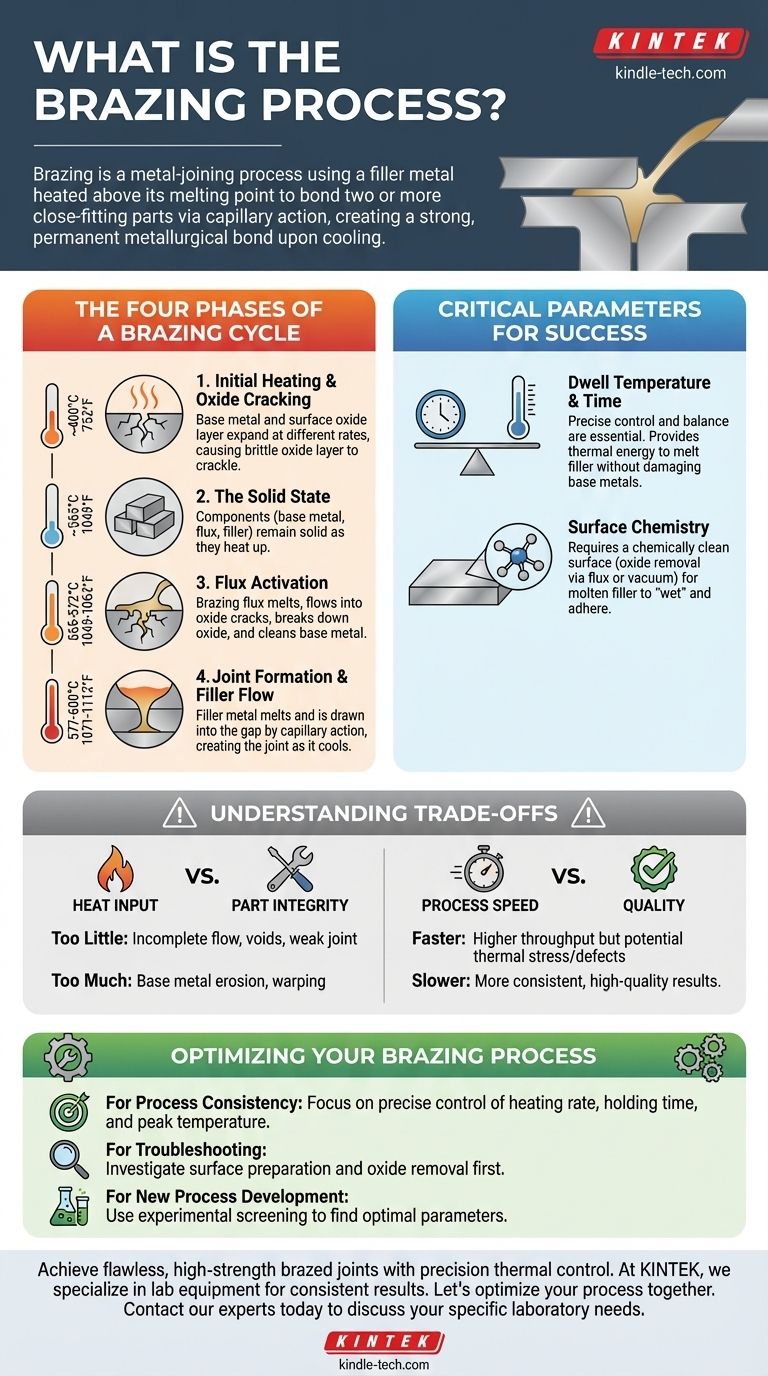
Brazing is a metal-joining process where a filler metal is heated above its melting point and distributed between two or more close-fitting parts by capillary action. The filler metal, which has a lower melting point than the base metals, melts and flows into the gap, creating a strong, permanent metallurgical bond upon cooling.

The success of any brazing operation hinges on the precise control and balance of its two most essential parameters: dwell temperature and time. Achieving the correct combination for your specific materials is the fundamental principle for creating a sound joint.
What is the brazing process in short note? Master the Key Parameters for Strong Metal Joints

The Four Phases of a Brazing Cycle

For many common materials like aluminum, the brazing process follows a distinct, four-phase thermal cycle. Understanding each phase is key to controlling the outcome.

Phase 1: Initial Heating and Oxide Cracking

As the assembly is heated, it starts to expand. Around 400°C (752°F), the base metal and its surface oxide layer expand at different rates, causing the brittle oxide layer to crackle.

Phase 2: The Solid State

Below approximately 565°C (1049°F), all components of the assembly—the base metal, the flux, and the filler metal—remain in their solid forms. The parts are simply getting hotter.

Phase 3: Flux Activation

Between 565-572°C (1049-1062°F), the brazing flux melts. This liquid flux is chemically active and flows into the cracks in the oxide layer, breaking it down and cleaning the underlying base metal to prepare it for bonding.

Phase 4: Filler Metal Flow and Joint Formation

Once the temperature reaches 577-600°C (1071-1112°F), the filler metal melts. Because the surface has been cleaned by the flux, the molten filler metal is drawn into the gap between the parts by capillary action, creating the brazed joint as it solidifies during cooling.

The Critical Parameters for Success

While the thermal cycle provides the framework, several variables must be managed to ensure a high-quality joint.

The Core Relationship: Time and Temperature

These two parameters are inextricably linked. A process might call for a dwell time of more than 5 minutes at 577°C or a shorter cycle of 1 to 8 minutes at a higher temperature like 585°C. The goal is to provide enough thermal energy to melt the filler metal completely without damaging the base metals.

The Importance of Surface Chemistry

A successful braze is impossible without a chemically clean surface. The process relies on removing the surface oxide film, often with a chemical flux or by using a vacuum atmosphere, so the molten filler metal can "wet" and adhere to the base metals.

Material and Design Considerations

The specific type of metal alloy, the shape and size of the parts, and the required quality of the final joint all influence the ideal process parameters. A large, thick part will require a different heating rate and holding time than a small, thin one.

Understanding the Trade-offs

Optimizing a brazing process involves balancing competing factors to minimize defects and maximize strength.

Heat Input vs. Part Integrity

The primary trade-off is between applying enough heat for a sufficient time versus causing damage to the base metals.

Too little heat or time results in an incomplete flow of the filler metal, leading to voids and a weak joint.

Too much heat or time can cause the base metal to erode or warp. However, in some cases, longer dwell times at the highest allowed temperatures can improve filler flow and ultimately reduce the amount of scrap.

Process Speed vs. Quality

Faster heating rates and shorter cycle times increase throughput but can also introduce thermal stress or incomplete joint formation if not carefully controlled. Slower, more controlled cycles often yield more consistent, high-quality results.

Optimizing Your Brazing Process

Because so many factors are at play, the ideal parameters for one application will not be a perfect fit for another. The best approach is to establish a baseline and refine it through careful testing.

  • If your primary focus is process consistency: Concentrate on precisely controlling the heating rate, holding time, and peak temperature within a very narrow window.
  • If you are troubleshooting failed joints: Always investigate surface preparation first; improper cleaning and oxide removal are the most common causes of failure.
  • If you are developing a new process: Use experimental screening to determine the optimal combination of parameters for your specific alloys, part geometry, and furnace capabilities.

Ultimately, mastering the brazing process is about understanding and controlling these fundamental principles to create strong, reliable, and repeatable joints.

Summary Table:

Brazing Phase Key Temperature Range Primary Action
Phase 1: Initial Heating ~400°C (752°F) Base metal expands, causing oxide layer to crack.
Phase 2: Solid State Below ~565°C (1049°F) Components heat up but remain solid.
Phase 3: Flux Activation 565-572°C (1049-1062°F) Flux melts, cleans the base metal surface.
Phase 4: Joint Formation 577-600°C (1071-1112°F) Filler metal melts, flows via capillary action to form the bond.

Achieve flawless, high-strength brazed joints with precision thermal control.

The success of your brazing operation depends on the precise balance of dwell temperature and time. At KINTEK, we specialize in the lab equipment and consumables that laboratories rely on for consistent, high-quality results. Whether you are developing a new process or troubleshooting joint failures, our expertise can help you optimize your parameters for maximum strength and minimal scrap.

Let's optimize your brazing process together. Contact our experts today to discuss your specific laboratory needs.

Visual Guide
What is the brazing process in short note? Master the Key Parameters for Strong Metal Joints Visual Guide

Related Products

People Also Ask

Related Products

Vacuum Heat Treat Sintering Brazing Furnace

Vacuum Heat Treat Sintering Brazing Furnace

A vacuum brazing furnace is a type of industrial furnace used for brazing, a metalworking process that joins two pieces of metal using a filler metal that melts at a lower temperature than the base metals. Vacuum brazing furnaces are typically used for high-quality applications where a strong, clean joint is required.

Molybdenum Vacuum Heat Treat Furnace

Molybdenum Vacuum Heat Treat Furnace

Discover the benefits of a high-configuration molybdenum vacuum furnace with heat shield insulation. Ideal for high-purity, vacuum environments like sapphire crystal growth and heat treatment.

2200 ℃ Tungsten Vacuum Heat Treat and Sintering Furnace

2200 ℃ Tungsten Vacuum Heat Treat and Sintering Furnace

Experience the ultimate refractory metal furnace with our Tungsten vacuum furnace. Capable of reaching 2200℃, perfect for sintering advanced ceramics and refractory metals. Order now for high-quality results.

2200 ℃ Graphite Vacuum Heat Treat Furnace

2200 ℃ Graphite Vacuum Heat Treat Furnace

Discover the power of the KT-VG Graphite Vacuum Furnace - with a maximum working temperature of 2200℃, it's perfect for vacuum sintering of various materials. Learn more now.

Vacuum Heat Treat Furnace with Ceramic Fiber Liner

Vacuum Heat Treat Furnace with Ceramic Fiber Liner

Vacuum furnace with polycrystalline ceramic fiber insulation liner for excellent heat insulation and uniform temperature field. Choose from 1200℃ or 1700℃ max. working temperature with high vacuum performance and precise temperature control.

High Pressure Laboratory Vacuum Tube Furnace Quartz Tubular Furnace

High Pressure Laboratory Vacuum Tube Furnace Quartz Tubular Furnace

KT-PTF High Pressure Tube Furnace: Compact split tube furnace with strong positive pressure resistance. Working temp up to 1100°C and pressure up to 15Mpa. Also works under controller atmosphere or high vacuum.

1700℃ Controlled Atmosphere Furnace Nitrogen Inert Atmosphere Furnace

1700℃ Controlled Atmosphere Furnace Nitrogen Inert Atmosphere Furnace

KT-17A Controlled atmosphere furnace: 1700℃ heating, vacuum sealing technology, PID temperature control, and versatile TFT smart touch screen controller for laboratory and industrial use.

Laboratory Muffle Oven Furnace Bottom Lifting Muffle Furnace

Laboratory Muffle Oven Furnace Bottom Lifting Muffle Furnace

Efficiently produce batches with excellent temperature uniformity using our Bottom Lifting Furnace. Features two electric lifting stages and advanced temperature control up to 1600℃.

Ultra-High Temperature Graphite Vacuum Graphitization Furnace

Ultra-High Temperature Graphite Vacuum Graphitization Furnace

The ultra-high temperature graphitization furnace utilizes medium frequency induction heating in a vacuum or inert gas environment. The induction coil generates an alternating magnetic field, inducing eddy currents in the graphite crucible, which heats up and radiates heat to the workpiece, bringing it to the desired temperature. This furnace is primarily used for graphitization and sintering of carbon materials, carbon fiber materials, and other composite materials.

Vertical High Temperature Graphite Vacuum Graphitization Furnace

Vertical High Temperature Graphite Vacuum Graphitization Furnace

Vertical high temperature graphitization furnace for carbonization and graphitization of carbon materials up to 3100℃.Suitable for shaped graphitization of carbon fiber filaments and other materials sintered in a carbon environment.Applications in metallurgy, electronics, and aerospace for producing high-quality graphite products like electrodes and crucibles.

Vacuum Hot Press Furnace Heated Vacuum Press Machine Tube Furnace

Vacuum Hot Press Furnace Heated Vacuum Press Machine Tube Furnace

Reduce forming pressure & shorten sintering time with Vacuum Tube Hot Press Furnace for high-density, fine-grain materials. Ideal for refractory metals.

High Temperature Muffle Oven Furnace for Laboratory Debinding and Pre Sintering

High Temperature Muffle Oven Furnace for Laboratory Debinding and Pre Sintering

KT-MD High temperature debinding and pre-sintering furnace for ceramic materials with various molding processes. Ideal for electronic components such as MLCC and NFC.

1800℃ Muffle Oven Furnace for Laboratory

1800℃ Muffle Oven Furnace for Laboratory

KT-18 muffle furnace with Japan Al2O3 polycrystalline fibe and Silicon Molybdenum heating element, up to 1900℃, PID temperature control and 7" smart touch screen. Compact design, low heat loss, and high energy efficiency. Safety interlock system and versatile functions.

Vacuum Heat Treat Furnace and Levitation Induction Melting Furnace

Vacuum Heat Treat Furnace and Levitation Induction Melting Furnace

Experience precise melting with our Vacuum Levitation Melting Furnace. Ideal for high melting point metals or alloys, with advanced technology for effective smelting. Order now for high-quality results.

Vacuum Heat Treat and Sintering Furnace with 9MPa Air Pressure

Vacuum Heat Treat and Sintering Furnace with 9MPa Air Pressure

The air pressure sintering furnace is a high-tech equipment commonly used for the sintering of advanced ceramic materials. It combines vacuum sintering and pressure sintering techniques to achieve high-density and high-strength ceramics.

600T Vacuum Induction Hot Press Furnace for Heat Treat and Sintering

600T Vacuum Induction Hot Press Furnace for Heat Treat and Sintering

Discover the 600T Vacuum Induction Hot Press Furnace, designed for high-temperature sintering experiments in vacuum or protected atmospheres. Its precise temperature and pressure control, adjustable working pressure, and advanced safety features make it ideal for nonmetal materials, carbon composites, ceramics, and metal powders.

Vacuum Heat Treat and Molybdenum Wire Sintering Furnace for Vacuum Sintering

Vacuum Heat Treat and Molybdenum Wire Sintering Furnace for Vacuum Sintering

A vacuum molybdenum wire sintering furnace is a vertical or bedroom structure, which is suitable for withdrawal, brazing, sintering and degassing of metal materials under high vacuum and high temperature conditions. It is also suitable for dehydroxylation treatment of quartz materials.

Vacuum Dental Porcelain Sintering Furnace

Vacuum Dental Porcelain Sintering Furnace

Get precise and reliable results with KinTek's Vacuum Porcelain Furnace. Suitable for all porcelain powders, it features hyperbolic ceramic furnace function, voice prompt, and automatic temperature calibration.

1200℃ Split Tube Furnace with Quartz Tube Laboratory Tubular Furnace

1200℃ Split Tube Furnace with Quartz Tube Laboratory Tubular Furnace

KT-TF12 split tube furnace: high-purity insulation, embedded heating wire coils, and max. 1200C. Widely used for new materials and chemical vapour deposition.

1700℃ Muffle Oven Furnace for Laboratory

1700℃ Muffle Oven Furnace for Laboratory

Get superior heat control with our 1700℃ Muffle Furnace. Equipped with intelligent temperature microprocessor, TFT touch screen controller & advanced insulation materials for precise heating up to 1700C. Order now!


Leave Your Message