Knowledge What is the chemical vapor deposition of parylene? A Guide to Conformal Coating
Author avatar

Tech Team · Kintek Solution

Updated 2 weeks ago

What is the chemical vapor deposition of parylene? A Guide to Conformal Coating


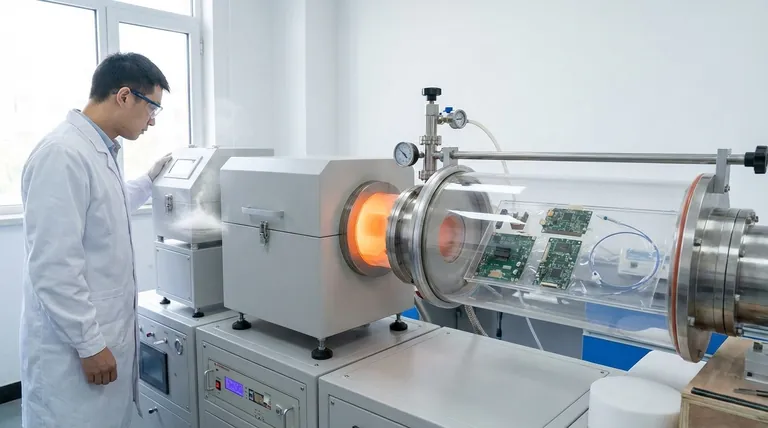
Parylene chemical vapor deposition is a unique vacuum-based process used to apply an ultra-thin, perfectly uniform polymer coating onto a substrate. Unlike liquid coatings, this method involves converting a solid raw material, called a dimer, into a gas. In a vacuum, this gas polymerizes directly onto all exposed surfaces of an object at room temperature, forming a protective film.

The core principle is that parylene isn't applied as a liquid but "grows" on the component's surface. This gas-phase polymerization allows it to create a completely conformal and pinhole-free plastic coating without the thermal or mechanical stress of other methods.
What is the chemical vapor deposition of parylene? A Guide to Conformal Coating

The Three-Stage Deposition Process

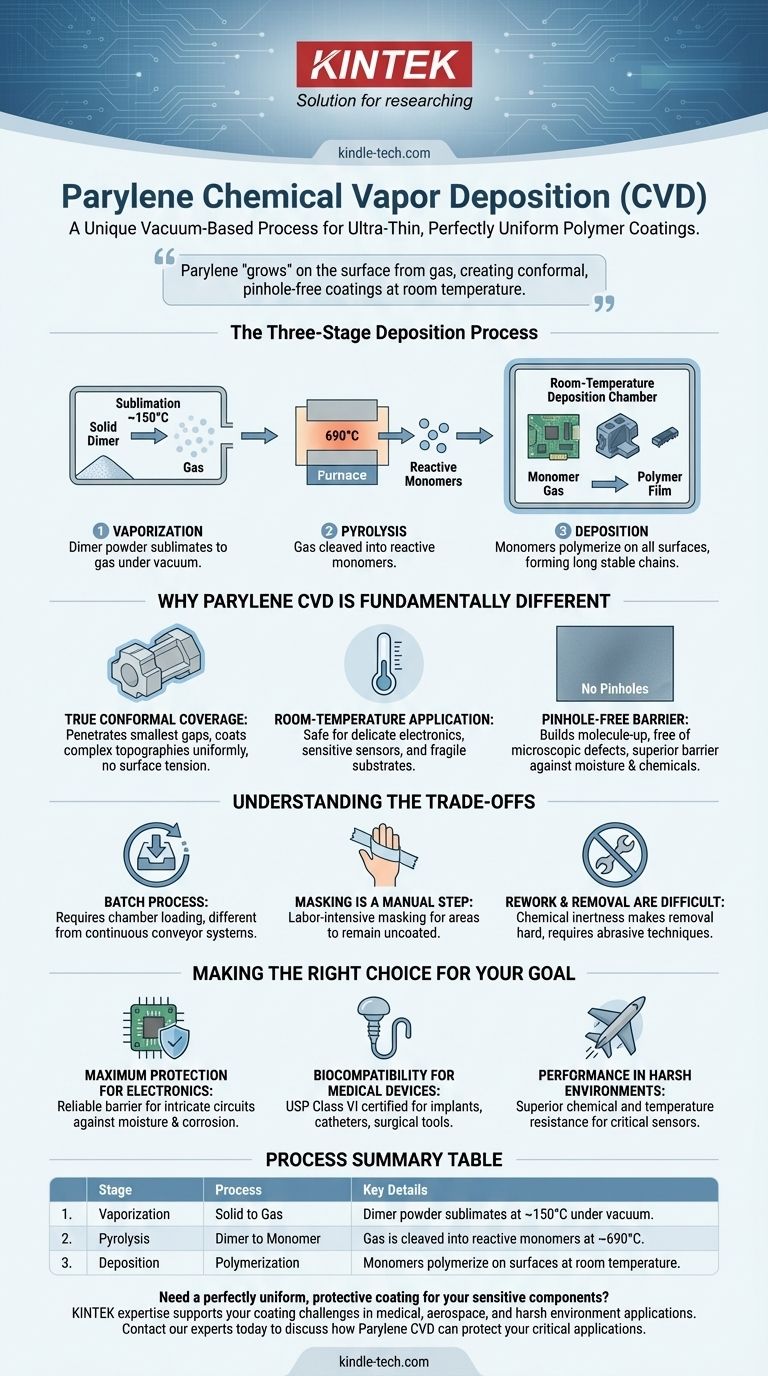
Parylene CVD is a highly controlled process that occurs entirely within a connected vacuum system. It consists of three distinct stages that transform a solid powder into a final polymer film.

Stage 1: Vaporization

The process begins with the raw material, a crystalline solid known as di-p-xylylene (or simply "dimer"), placed in a vaporizer chamber. The chamber is heated to approximately 150 °C under a vacuum. This causes the solid dimer to sublimate, turning directly into a gas.

Stage 2: Pyrolysis

This dimer gas then flows into a second, much hotter furnace heated to around 690 °C. This intense heat cleaves the dimer molecule into two highly reactive "monomer" molecules. This step is the critical chemical transformation that prepares the material for polymerization.

Stage 3: Deposition

The reactive monomer gas enters the final room-temperature deposition chamber, which contains the parts to be coated. As the gas molecules land on any surface inside the chamber, they spontaneously link together, or polymerize, forming a long, stable polymer chain. This film grows one molecule at a time, resulting in a coating that is exceptionally uniform across all surfaces, including sharp edges, crevices, and even inside small bores.

Why This Process is Fundamentally Different

The CVD method gives parylene properties that are unattainable with conventional liquid coatings like acrylic, epoxy, or urethane.

True Conformal Coverage

Because the coating is formed from a gas, it has no surface tension. It can penetrate the smallest gaps and coat complex 3D topographies without thinning on sharp corners or pooling in low spots, a common failure point for sprayed or dipped coatings.

Room-Temperature Application

The actual coating deposition occurs at ambient temperature. This means delicate electronic components, sensitive sensors, and fragile substrates can be coated without any risk of thermal damage or stress.

Pinhole-Free Barrier

The polymerization process builds the coating from the molecule up. This method results in a plastic film with supreme barrier properties, free of the microscopic pinholes that can plague liquid coatings and allow moisture or chemicals to attack the underlying component.

Understanding the Trade-offs

While powerful, the parylene CVD process has specific operational characteristics that must be considered.

It Is a Batch Process

Parts must be loaded into a vacuum chamber for each coating run. This is different from a continuous conveyor-based process like spraying, which can impact throughput and cost for very high-volume manufacturing.

Masking is a Manual Step

Since the parylene gas will coat everything it touches, any areas that must remain uncoated (like connector pins or contact pads) need to be manually masked before being placed in the chamber. This adds labor and time to the overall process.

Rework and Removal are Difficult

The same chemical inertness that makes parylene an excellent protective barrier also makes it very difficult to remove. Reworking a coated board typically requires specialized abrasive techniques, as chemical stripping is often ineffective.

Making the Right Choice for Your Goal

Selecting parylene is a decision based on performance requirements. Its unique application method makes it an ideal solution for specific, high-stakes challenges.

  • If your primary focus is maximum protection for complex electronics: The perfectly conformal and pinhole-free nature of parylene provides the most reliable barrier against moisture and corrosion for intricate circuit boards.
  • If your primary focus is biocompatibility for medical devices: Parylene is USP Class VI certified and has a long history of use for implants, catheters, and surgical tools due to its inert and protective qualities.
  • If your primary focus is performance in harsh environments: The chemical and temperature resistance of parylene makes it a superior choice for aerospace, defense, and industrial sensors that must function without fail.

By understanding the fundamentals of the parylene CVD process, you can leverage its distinct advantages for your most critical applications.

Summary Table:

Stage Process Key Details
1. Vaporization Solid to Gas Dimer powder sublimates at ~150°C under vacuum.
2. Pyrolysis Dimer to Monomer Gas is cleaved into reactive monomers at ~690°C.
3. Deposition Polymerization Monomers polymerize on surfaces at room temperature.

Need a perfectly uniform, protective coating for your sensitive components?
The Parylene CVD process offers unparalleled conformal coverage and pinhole-free barrier properties that liquid coatings cannot match. If you are developing medical devices, aerospace electronics, or any product requiring maximum reliability in harsh environments, KINTEK's expertise in lab equipment and consumables can support your coating challenges.
Contact our experts today to discuss how Parylene CVD can protect your critical applications.

Visual Guide
What is the chemical vapor deposition of parylene? A Guide to Conformal Coating Visual Guide

Related Products

People Also Ask

Related Products

Chemical Vapor Deposition CVD Equipment System Chamber Slide PECVD Tube Furnace with Liquid Gasifier PECVD Machine

Chemical Vapor Deposition CVD Equipment System Chamber Slide PECVD Tube Furnace with Liquid Gasifier PECVD Machine

KT-PE12 Slide PECVD System: Wide power range, programmable temp control, fast heating/cooling with sliding system, MFC mass flow control & vacuum pump.

Customer Made Versatile CVD Tube Furnace Chemical Vapor Deposition Chamber System Equipment

Customer Made Versatile CVD Tube Furnace Chemical Vapor Deposition Chamber System Equipment

Get your exclusive CVD furnace with KT-CTF16 Customer Made Versatile Furnace. Customizable sliding, rotating, and tilting functions for precise reactions. Order now!

Inclined Rotary Plasma Enhanced Chemical Vapor Deposition PECVD Equipment Tube Furnace Machine

Inclined Rotary Plasma Enhanced Chemical Vapor Deposition PECVD Equipment Tube Furnace Machine

Upgrade your coating process with PECVD coating equipment. Ideal for LED, power semiconductors, MEMS and more. Deposits high-quality solid films at low temps.

RF PECVD System Radio Frequency Plasma-Enhanced Chemical Vapor Deposition RF PECVD

RF PECVD System Radio Frequency Plasma-Enhanced Chemical Vapor Deposition RF PECVD

RF-PECVD is an acronym for "Radio Frequency Plasma-Enhanced Chemical Vapor Deposition." It deposits DLC (Diamond-like carbon film) on germanium and silicon substrates. It is utilized in the 3-12um infrared wavelength range.

915MHz MPCVD Diamond Machine Microwave Plasma Chemical Vapor Deposition System Reactor

915MHz MPCVD Diamond Machine Microwave Plasma Chemical Vapor Deposition System Reactor

915MHz MPCVD Diamond Machine and its multi-crystal effective growth, the maximum area can reach 8 inches, the maximum effective growth area of single crystal can reach 5 inches. This equipment is mainly used for the production of large-size polycrystalline diamond films, the growth of long single crystal diamonds, the low-temperature growth of high-quality graphene, and other materials that require energy provided by microwave plasma for growth.

Split Chamber CVD Tube Furnace with Vacuum Station Chemical Vapor Deposition System Equipment Machine

Split Chamber CVD Tube Furnace with Vacuum Station Chemical Vapor Deposition System Equipment Machine

Efficient split chamber CVD furnace with vacuum station for intuitive sample checking and quick cooling. Up to 1200℃ max temperature with accurate MFC mass flowmeter control.

Microwave Plasma Chemical Vapor Deposition MPCVD Machine System Reactor for Lab and Diamond Growth

Microwave Plasma Chemical Vapor Deposition MPCVD Machine System Reactor for Lab and Diamond Growth

Get high-quality diamond films with our Bell-jar Resonator MPCVD machine designed for lab and diamond growth. Discover how Microwave Plasma Chemical Vapor Deposition works for growing diamonds using carbon gas and plasma.

Cylindrical Resonator MPCVD Machine System Reactor for Microwave Plasma Chemical Vapor Deposition and Lab Diamond Growth

Cylindrical Resonator MPCVD Machine System Reactor for Microwave Plasma Chemical Vapor Deposition and Lab Diamond Growth

Learn about Cylindrical Resonator MPCVD Machine, the microwave plasma chemical vapor deposition method used for growing diamond gemstones and films in the jewelry and semi-conductor industries. Discover its cost-effective advantages over traditional HPHT methods.

VHP Sterilization Equipment Hydrogen Peroxide H2O2 Space Sterilizer

VHP Sterilization Equipment Hydrogen Peroxide H2O2 Space Sterilizer

A hydrogen peroxide space sterilizer is a device that uses vaporized hydrogen peroxide to decontaminate enclosed spaces. It kills microorganisms by damaging their cellular components and genetic material.

1200℃ Split Tube Furnace with Quartz Tube Laboratory Tubular Furnace

1200℃ Split Tube Furnace with Quartz Tube Laboratory Tubular Furnace

KT-TF12 split tube furnace: high-purity insulation, embedded heating wire coils, and max. 1200C. Widely used for new materials and chemical vapour deposition.

Platinum Sheet Electrode for Laboratory and Industrial Applications

Platinum Sheet Electrode for Laboratory and Industrial Applications

Elevate your experiments with our Platinum Sheet Electrode. Crafted with quality materials, our safe and durable models can be tailored to fit your needs.

Polygon Press Mold for Lab

Polygon Press Mold for Lab

Discover precision polygon press molds for sintering. Ideal for pentagon-shaped parts, our molds ensure uniform pressure and stability. Perfect for repeatable, high-quality production.

High Performance Laboratory Freeze Dryer

High Performance Laboratory Freeze Dryer

Advanced lab freeze dryer for lyophilization, preserving biological & chemical samples efficiently. Ideal for biopharma, food, and research.

Electrolytic Electrochemical Cell for Coating Evaluation

Electrolytic Electrochemical Cell for Coating Evaluation

Looking for corrosion-resistant coating evaluation electrolytic cells for electrochemical experiments? Our cells boast complete specifications, good sealing, high-quality materials, safety, and durability. Plus, they're easily customizable to meet your needs.

High Pressure Laboratory Autoclave Reactor for Hydrothermal Synthesis

High Pressure Laboratory Autoclave Reactor for Hydrothermal Synthesis

Discover the applications of Hydrothermal Synthesis Reactor - a small, corrosion-resistant reactor for chemical labs. Achieve rapid digestion of insoluble substances in a safe and reliable way. Learn more now.

Customizable High Pressure Reactors for Advanced Scientific and Industrial Applications

Customizable High Pressure Reactors for Advanced Scientific and Industrial Applications

This laboratory-scale high-pressure reactor is a high-performance autoclave engineered for precision and safety in demanding research and development environments.

Non Consumable Vacuum Arc Induction Melting Furnace

Non Consumable Vacuum Arc Induction Melting Furnace

Explore the benefits of Non-Consumable Vacuum Arc Furnace with high melting point electrodes. Small, easy to operate & eco-friendly. Ideal for laboratory research on refractory metals & carbides.

Small Vacuum Heat Treat and Tungsten Wire Sintering Furnace

Small Vacuum Heat Treat and Tungsten Wire Sintering Furnace

The small vacuum tungsten wire sintering furnace is a compact experimental vacuum furnace specially designed for universities and scientific research institutes. The furnace features a CNC welded shell and vacuum piping to ensure leak-free operation. Quick-connect electrical connections facilitate relocation and debugging, and the standard electrical control cabinet is safe and convenient to operate.

Variable Speed Peristaltic Pump

Variable Speed Peristaltic Pump

KT-VSP Series Smart Variable Speed Peristaltic Pumps offer precise flow control for labs, medical, and industrial applications. Reliable, contamination-free liquid transfer.

Rotating Platinum Disk Electrode for Electrochemical Applications

Rotating Platinum Disk Electrode for Electrochemical Applications

Upgrade your electrochemical experiments with our Platinum Disc Electrode. High-quality and reliable for accurate results.


Leave Your Message