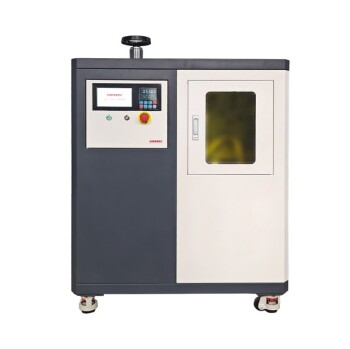
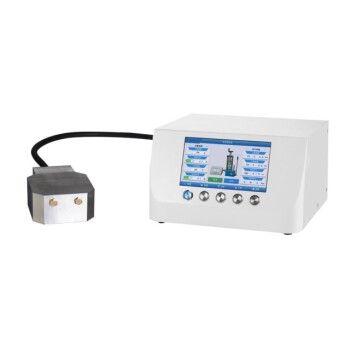
The primary function of a hot press in bilayer garnet electrolyte lamination is to achieve a molecular-level bond between the dense-layer and porous-layer green tapes. By applying synchronized heat and stable pressure, the press eliminates interfacial gaps and ensures the bilayer structure remains intact during the subsequent high-temperature co-sintering process.
The hot press serves as the critical bridge between individual material layers and a unified electrolyte structure. It ensures structural integrity and electrochemical continuity by preventing delamination and maintaining a seamless interface between the dense and porous components.
Achieving Molecular-Level Adhesion
Eliminating Interfacial Gaps
The application of mechanical pressure forces the surfaces of the dried dense-layer and porous-layer green tapes into intimate contact. This physical compression removes microscopic air pockets and voids at the interface that would otherwise act as defects.
Inducing Material Flow and Entanglement
Appropriate temperatures soften the binders and polymer components within the green tapes, allowing for molecular flow. This softening enables the material chains from both layers to intermingle and bond, creating a robust, unified transition zone rather than a weak physical stack.
Ensuring Uniform Thickness
The precision of a hot press allows for the creation of structurally consistent films with a specified thickness. By controlling the dwell time and heat, the press eliminates internal stresses within the layers, resulting in a flat substrate that is essential for reliable battery assembly.
Preparing for High-Temperature Co-Sintering
Preventing Delamination
If layers are merely stacked, they will likely peel apart or "delaminate" during the intense heat of co-sintering due to mismatched thermal expansion. The molecular bonding established by the hot press ensures that the bilayer remains a single entity throughout the entire thermal profile.
Maintaining Electrochemical Continuity
A seamless interface is vital for the movement of ions across the electrolyte. By ensuring there is no physical separation between the dense and porous layers, the hot press facilitates uninterrupted ionic transport, which is fundamental to the battery's power density.
Enhancing Mechanical Strength
The lamination process densifies the green tapes before they ever reach the furnace. This initial densification improves the mechanical handling strength of the films, making them less susceptible to cracking during the transition to the sintering phase.
Understanding the Trade-offs
Pressure and Porosity Balance
While high pressure is required to eliminate gaps, excessive force can inadvertently collapse the structure of the porous-layer green tape. Maintaining the specific architecture of the porous layer is necessary for later stages, requiring a delicate balance of force.
Temperature Sensitivity and Degradation
Applying too much heat during lamination can cause the polymer binders to degrade prematurely or become too fluid. This can lead to dimensional instability, where the electrolyte film thins out unevenly or loses its intended geometric shape.
Dwell Time and Production Throughput
Longer dwell times ensure a more complete molecular bond but reduce industrial throughput. Manufacturers must optimize the thermal-pressure cycle to achieve maximum bond strength without creating a bottleneck in the production line.
Making the Right Choice for Your Goal
How to Apply This to Your Process
- If your primary focus is maximizing ionic conductivity: Prioritize eliminating all interfacial gaps during hot pressing to ensure a seamless path for lithium ions.
- If your primary focus is structural durability: Focus on the molecular-level bonding of the green tapes to prevent delamination during the high-stress co-sintering stage.
- If your primary focus is high-volume manufacturing: Optimize the dwell time and temperature to achieve "just enough" adhesion to survive sintering without extending the cycle time.
The hot press is the definitive tool for transforming separate electrolyte layers into a high-performance, integrated bilayer system ready for solid-state battery integration.
Summary Table:
| Key Function | Mechanism | Benefit for Electrolyte |
|---|---|---|
| Gap Elimination | Mechanical pressure forces layers into intimate contact | Removes voids and air pockets at the interface |
| Molecular Bonding | Synchronized heat softens binders for polymer flow | Prevents delamination during high-temp co-sintering |
| Thickness Control | Precise force and dwell time management | Ensures uniform thickness and internal stress relief |
| Ionic Continuity | Creation of a seamless bilayer interface | Facilitates uninterrupted lithium-ion transport |
Optimize Your Solid-State Battery Research with KINTEK
Achieving the perfect molecular bond in bilayer garnet electrolytes requires precision and reliability. KINTEK specializes in advanced laboratory solutions, offering a comprehensive range of hydraulic presses (hot, pellet, and isostatic) and high-temperature furnaces (muffle, vacuum, and tube) designed specifically for rigorous material research.
Whether you are scaling production or refining your lamination process, our high-performance tools ensure structural integrity and electrochemical continuity for your battery components. From PTFE consumables to high-pressure reactors, KINTEK provides the end-to-end equipment needed to drive innovation.
Ready to enhance your lab's efficiency and film quality? Contact KINTEK today for expert guidance and tailored equipment solutions.
References
- Changmin Shi, Eric D. Wachsman. High Sulfur Loading and Capacity Retention in Bilayer Garnet Sulfurized‐Polyacrylonitrile/Lithium‐Metal Batteries with Gel Polymer Electrolytes. DOI: 10.1002/aenm.202301656
This article is also based on technical information from Kintek Solution Knowledge Base .
Related Products
- Automatic Heated Hydraulic Press Machine with Heated Plates for Laboratory Hot Press 25T 30T 50T
- Manual High Temperature Heated Hydraulic Press Machine with Heated Plates for Lab
- Touchscreen Automatic Vacuum Heat Press
- 30T 40T Split Automatic Heated Hydraulic Press Machine with Heated Plates for Laboratory Hot Press
- Vacuum Hot Press Furnace Machine Heated Vacuum Press
People Also Ask
- Why is the heating function of a laboratory hydraulic press essential for MEA assembly in DEFC? Optimize Cell Bonding
- What technical conditions does a heated hydraulic press provide for PEO batteries? Optimize Solid-State Interfaces
- How is a heated hydraulic press used for Li-LLZO batteries? Optimize Interfacial Bonding with Thermal-Pressure
- What role does a heated hydraulic press play in Cold Sintering (CSP)? Enhancing LATP-Halide Densification
- What are heated hydraulic presses used for? Molding Composites, Vulcanizing Rubber, and More