Knowledge What is the major disadvantage of thermal evaporation system? High Contamination Risk Explained
Author avatar

Tech Team · Kintek Solution

Updated 5 days ago

What is the major disadvantage of thermal evaporation system? High Contamination Risk Explained


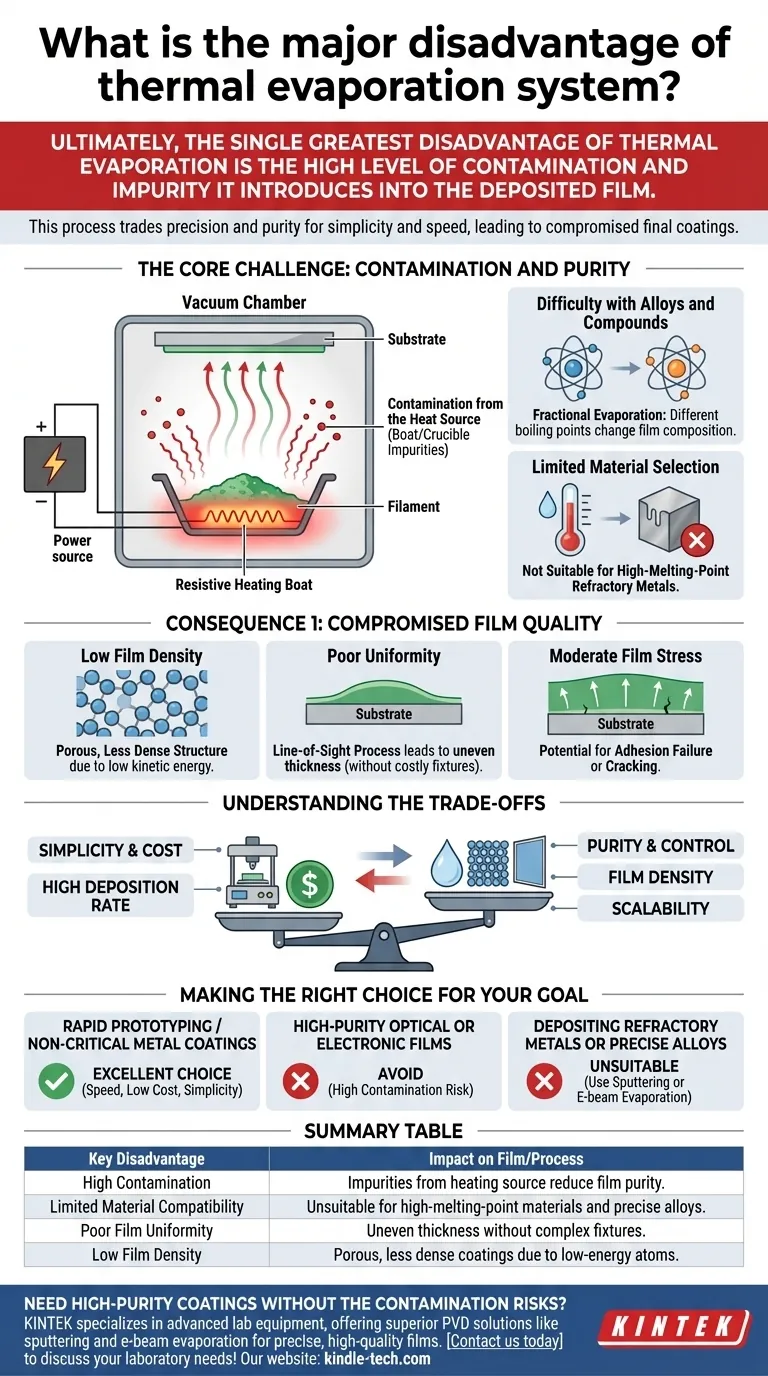
Ultimately, the single greatest disadvantage of thermal evaporation is the high level of contamination and impurity it introduces into the deposited film. While valued for its simplicity and low cost, the process itself creates an environment where elements from the heating source can mix with the desired material, compromising the purity and quality of the final coating.

Thermal evaporation trades precision and purity for simplicity and speed. Its fundamental drawback is the inability to heat a source material without also heating—and potentially evaporating—the crucible or boat holding it, leading to contaminated films and limited material compatibility.
What is the major disadvantage of thermal evaporation system? High Contamination Risk Explained

The Core Challenge: Contamination and Purity

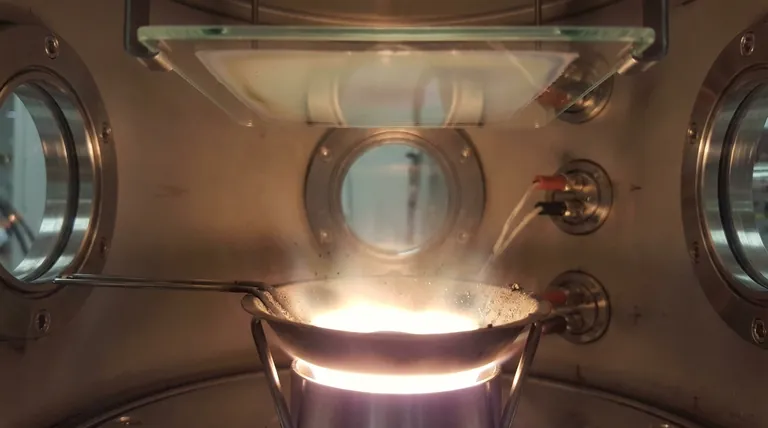
Thermal evaporation is a physical vapor deposition (PVD) process that uses resistive heating—running a current through a boat or filament—to heat a source material until it evaporates. While simple, this direct heating method is the root cause of its primary disadvantages.

Contamination from the Heat Source

The boat or crucible holding the source material is heated to extreme temperatures. This can cause the boat material itself (often a refractory metal like tungsten or molybdenum) to evaporate or react with the source, releasing impurities that co-deposit onto your substrate. This makes it the least pure of all PVD methods.

Difficulty with Alloys and Compounds

Heating an alloy often results in fractional evaporation, where the element with the lower boiling point evaporates at a much higher rate. The resulting film will have a different stoichiometry (elemental ratio) than the source material, making it difficult to deposit complex materials with precise composition.

Limited Material Selection

The process is not suitable for materials with very high melting points, such as refractory metals like tungsten or tantalum. Achieving the necessary temperatures would require so much power that it would risk destroying the heating element and cause extreme contamination, rendering the process ineffective.

Consequence 1: Compromised Film Quality

The impurities and the low-energy nature of the process directly impact the physical characteristics of the deposited film.

Low Film Density

Atoms leave the source material with relatively low kinetic energy. When they arrive at the substrate, they have little energy to move around and settle into a dense, tightly packed structure. This typically results in a film that is porous and has lower density compared to films made with other PVD techniques.

Poor Uniformity

Thermal evaporation is a "line-of-sight" process, where atoms travel in straight lines from the source. Without sophisticated and costly additions like planetary substrate rotation and uniformity masks, the film will be significantly thicker directly above the source and thinner toward the edges of the substrate.

Moderate Film Stress

The way atoms arrange and cool on the substrate can create internal stress within the film. While often less severe than in some other processes, this stress can still be a concern for sensitive applications, potentially causing adhesion failure or cracking.

Understanding the Trade-offs

Choosing a deposition method is about balancing competing priorities. Thermal evaporation's disadvantages are the direct trade-off for its primary advantages.

Simplicity and Cost vs. Purity

Thermal evaporation systems are mechanically simple, relatively inexpensive to build and operate, and do not require complex power supplies. This accessibility is its main selling point, but it comes at the direct cost of film purity and control.

Deposition Rate vs. Control

The process can achieve very high deposition rates, making it fast for applying thick coatings. However, this speed offers less granular control over film growth and properties compared to slower, more energetic methods like sputtering.

Limited Scalability

While simple for a lab-scale coater, achieving uniform coatings over large areas is a significant engineering challenge. It requires complex rotating fixtures that increase the system's cost and complexity, eroding its main advantage of simplicity.

Making the Right Choice for Your Goal

Select your deposition method based on the non-negotiable requirements of your project.

  • If your primary focus is rapid prototyping or non-critical metal coatings: Thermal evaporation is an excellent choice for its speed, low cost, and simplicity.
  • If your primary focus is high-purity optical or electronic films: Avoid thermal evaporation, as the inherent risk of contamination is too high for performance-critical applications.
  • If your primary focus is depositing refractory metals or precise alloys: This method is unsuitable; you must use a technique like e-beam evaporation or sputtering.

Understanding these core limitations allows you to leverage thermal evaporation for its strengths in simplicity and speed, while avoiding it where purity and structural quality are paramount.

Summary Table:

Key Disadvantage Impact on Film/Process
High Contamination Impurities from the heating source (crucible/boat) co-deposit, reducing film purity.
Limited Material Compatibility Unsuitable for high-melting-point materials and precise alloy deposition.
Poor Film Uniformity Line-of-sight deposition leads to uneven thickness without complex fixtures.
Low Film Density Low-energy atoms result in porous, less dense coatings.

Need high-purity coatings without the contamination risks of thermal evaporation? KINTEK specializes in advanced lab equipment and consumables, offering superior PVD solutions like sputtering and e-beam evaporation for precise, high-quality films. Let our experts help you select the right deposition method for your critical applications. Contact us today to discuss your laboratory needs!

Visual Guide
What is the major disadvantage of thermal evaporation system? High Contamination Risk Explained Visual Guide

Related Products

People Also Ask

Related Products

HFCVD Machine System Equipment for Drawing Die Nano-Diamond Coating

HFCVD Machine System Equipment for Drawing Die Nano-Diamond Coating

The nano-diamond composite coating drawing die uses cemented carbide (WC-Co) as the substrate, and uses the chemical vapor phase method ( CVD method for short ) to coat the conventional diamond and nano-diamond composite coating on the surface of the inner hole of the mold.

915MHz MPCVD Diamond Machine Microwave Plasma Chemical Vapor Deposition System Reactor

915MHz MPCVD Diamond Machine Microwave Plasma Chemical Vapor Deposition System Reactor

915MHz MPCVD Diamond Machine and its multi-crystal effective growth, the maximum area can reach 8 inches, the maximum effective growth area of single crystal can reach 5 inches. This equipment is mainly used for the production of large-size polycrystalline diamond films, the growth of long single crystal diamonds, the low-temperature growth of high-quality graphene, and other materials that require energy provided by microwave plasma for growth.

Vacuum Hot Press Furnace Machine for Lamination and Heating

Vacuum Hot Press Furnace Machine for Lamination and Heating

Experience clean and precise lamination with Vacuum Lamination Press. Perfect for wafer bonding, thin-film transformations, and LCP lamination. Order now!

CVD Diamond Cutting Tool Blanks for Precision Machining

CVD Diamond Cutting Tool Blanks for Precision Machining

CVD Diamond Cutting Tools: Superior Wear Resistance, Low Friction, High Thermal Conductivity for Non-Ferrous Materials, Ceramics, Composites Machining

Anti-Cracking Press Mold for Lab Use

Anti-Cracking Press Mold for Lab Use

The anti-cracking press mold is a specialized equipment designed for molding various shapes and sizes of film using high pressure and electric heating.

Laboratory Sterilizer Lab Autoclave Pulse Vacuum Lifting Sterilizer

Laboratory Sterilizer Lab Autoclave Pulse Vacuum Lifting Sterilizer

The pulse vacuum lifting sterilizer is a state-of-the-art equipment for efficient and precise sterilization. It uses pulsating vacuum technology, customizable cycles, and a user-friendly design for easy operation and safety.

Benchtop Laboratory Vacuum Freeze Dryer

Benchtop Laboratory Vacuum Freeze Dryer

Benchtop laboratory freeze dryer for efficient lyophilization of biological, pharmaceutical, and food samples. Features intuitive touchscreen, high-performance refrigeration, and durable design. Preserve sample integrity—consult now!

Laboratory Sterilizer Lab Autoclave Vertical Pressure Steam Sterilizer for Liquid Crystal Display Automatic Type

Laboratory Sterilizer Lab Autoclave Vertical Pressure Steam Sterilizer for Liquid Crystal Display Automatic Type

Liquid crystal display automatic vertical sterilizer is a safe, reliable and automatic control sterilization equipment, which is composed of heating system, microcomputer control system and overheating and overvoltage protection system.

Graphite Vacuum Furnace High Thermal Conductivity Film Graphitization Furnace

Graphite Vacuum Furnace High Thermal Conductivity Film Graphitization Furnace

The high thermal conductivity film graphitization furnace has uniform temperature, low energy consumption and can operate continuously.

Laboratory Test Sieves and Sieving Machines

Laboratory Test Sieves and Sieving Machines

Precision lab test sieves & sieving machines for accurate particle analysis. Stainless steel, ISO-compliant, 20μm-125mm range. Request specs now!

Engineering Advanced Fine Ceramics Aluminum Oxide Al2O3 Heat Sink for Insulation

Engineering Advanced Fine Ceramics Aluminum Oxide Al2O3 Heat Sink for Insulation

The hole structure of the ceramic heat sink increases the heat dissipation area in contact with the air, which greatly enhances the heat dissipation effect, and the heat dissipation effect is better than that of super copper and aluminum.

Benchtop Laboratory Freeze Dryer for Lab Use

Benchtop Laboratory Freeze Dryer for Lab Use

Premium benchtop laboratory freeze dryer for lyophilization, preserving samples with ≤ -60°C cooling. Ideal for pharmaceuticals & research.

Vacuum Heat Treat and Molybdenum Wire Sintering Furnace for Vacuum Sintering

Vacuum Heat Treat and Molybdenum Wire Sintering Furnace for Vacuum Sintering

A vacuum molybdenum wire sintering furnace is a vertical or bedroom structure, which is suitable for withdrawal, brazing, sintering and degassing of metal materials under high vacuum and high temperature conditions. It is also suitable for dehydroxylation treatment of quartz materials.

Small Vacuum Heat Treat and Tungsten Wire Sintering Furnace

Small Vacuum Heat Treat and Tungsten Wire Sintering Furnace

The small vacuum tungsten wire sintering furnace is a compact experimental vacuum furnace specially designed for universities and scientific research institutes. The furnace features a CNC welded shell and vacuum piping to ensure leak-free operation. Quick-connect electrical connections facilitate relocation and debugging, and the standard electrical control cabinet is safe and convenient to operate.

1200℃ Split Tube Furnace with Quartz Tube Laboratory Tubular Furnace

1200℃ Split Tube Furnace with Quartz Tube Laboratory Tubular Furnace

KT-TF12 split tube furnace: high-purity insulation, embedded heating wire coils, and max. 1200C. Widely used for new materials and chemical vapour deposition.

Ultra-High Temperature Graphite Vacuum Graphitization Furnace

Ultra-High Temperature Graphite Vacuum Graphitization Furnace

The ultra-high temperature graphitization furnace utilizes medium frequency induction heating in a vacuum or inert gas environment. The induction coil generates an alternating magnetic field, inducing eddy currents in the graphite crucible, which heats up and radiates heat to the workpiece, bringing it to the desired temperature. This furnace is primarily used for graphitization and sintering of carbon materials, carbon fiber materials, and other composite materials.

Vacuum Sealed Continuous Working Rotary Tube Furnace Rotating Tube Furnace

Vacuum Sealed Continuous Working Rotary Tube Furnace Rotating Tube Furnace

Experience efficient material processing with our vacuum-sealed rotary tube furnace. Perfect for experiments or industrial production, equipped with optional features for controlled feeding and optimized results. Order now.

Molybdenum Vacuum Heat Treat Furnace

Molybdenum Vacuum Heat Treat Furnace

Discover the benefits of a high-configuration molybdenum vacuum furnace with heat shield insulation. Ideal for high-purity, vacuum environments like sapphire crystal growth and heat treatment.

Vacuum Dental Porcelain Sintering Furnace

Vacuum Dental Porcelain Sintering Furnace

Get precise and reliable results with KinTek's Vacuum Porcelain Furnace. Suitable for all porcelain powders, it features hyperbolic ceramic furnace function, voice prompt, and automatic temperature calibration.

Graphite Vacuum Furnace IGBT Experimental Graphitization Furnace

Graphite Vacuum Furnace IGBT Experimental Graphitization Furnace

IGBT experimental graphitization furnace, a tailored solution for universities and research institutions, with high heating efficiency, user-friendliness, and precise temperature control.


Leave Your Message