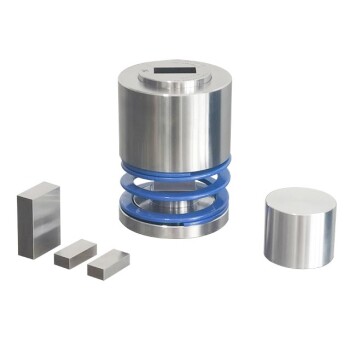
The primary constraint is the mechanical integrity of the mold. The pressure generally remains limited to 30 MPa during W-Si alloy hot-pressing to accommodate the material properties of the graphite containment. Because standard graphite molds typically possess a compressive strength below 60 MPa, exceeding this 30 MPa threshold creates a significant risk of mold fracture or severe deformation under high-temperature conditions.
While higher pressures could theoretically enhance densification, the process is strictly bound by the containment material. The 30 MPa limit serves as a critical safety factor to prevent catastrophic failure of the graphite mold during the sintering cycle.
The Mechanics of Graphite Limitations
Compressive Strength Thresholds
Standard graphite used in hot-pressing applications has a distinct physical limit. Its compressive strength is often less than 60 MPa.
Operating at pressures approaching this limit eliminates the necessary safety margin. Therefore, engineers cap the process pressure at 30 MPa—roughly half the theoretical failure point—to ensure reliability.
Thermal and Mechanical Stress
Hot-pressing subjects the mold to simultaneous thermal expansion and mechanical loading.
At elevated temperatures, the material dynamics change, making the mold more susceptible to failure. The 30 MPa limit accounts for the complex stress state induced by the combination of heat and applied force.
Consequences of Excessive Pressure
Risk of Fracture
The most immediate danger of exceeding the pressure limit is mold fracture.
If the graphite cracks during the cycle, the W-Si alloy containment is breached. This not only ruins the sample but can cause significant damage to the heating elements and the hot-press furnace itself.
Dimensional Deformation
Even if the mold does not shatter, excessive pressure causes plastic deformation.
Graphite that warps under load will result in a sintered billet with incorrect dimensions. This compromises the manufacturing tolerances and results in wasted material.
Understanding the Trade-offs
Process Safety vs. Densification Force
Adhering to the 30 MPa limit prioritizes process security and mold survival.
The trade-off is that the system cannot rely solely on high mechanical force to achieve full density in the W-Si alloy. Consequently, the process must rely more heavily on temperature and dwell time to drive the sintering kinetics, rather than brute mechanical force.
Mold Longevity
Operating near the material's failure point drastically reduces the lifespan of the tooling.
By restricting pressure to 30 MPa, manufacturers protect the structural integrity of the graphite. This ensures the mold survives the full sintering cycle without degrading, which is essential for consistent production runs.
Optimizing the Sintering Strategy
To balance the limitations of graphite with the requirements of the W-Si alloy, consider your primary operational goals:
- If your primary focus is Process Safety: Adhere strictly to the 30 MPa cap to mitigate the high risk of mold explosion or furnace damage.
- If your primary focus is Dimensional Accuracy: Maintain pressure well within limits to prevent mold warping, ensuring the final alloy billet meets strict geometric tolerances.
Respecting the mechanical limits of your tooling is the first step toward a reproducible and safe sintering process.
Summary Table:
| Feature | Graphite Mold Limitation | Impact on Sintering |
|---|---|---|
| Compressive Strength | Typically < 60 MPa | Limits maximum applied pressure to 30 MPa |
| Safety Factor | ~2:1 Ratio | Prevents catastrophic mold failure under load |
| Thermal Stress | High-temperature degradation | Increases susceptibility to fracture or warping |
| Structural Integrity | Brittleness | High risk of furnace damage if containment is breached |
| Dimensional Stability | Low deformation resistance | Excess pressure causes warping and inaccurate tolerances |
Maximize Your Sintering Precision with KINTEK
Don't let equipment limitations compromise your material research or production quality. KINTEK specializes in high-performance laboratory solutions, providing everything from durable graphite molds and crucibles to advanced hot-pressing systems and high-temperature furnaces.
Whether you are working with W-Si alloys or developing next-generation ceramics, our comprehensive portfolio—including hydraulic presses, vacuum furnaces, and specialized sintering consumables—is designed to meet the most rigorous mechanical and thermal requirements.
Ready to optimize your lab's performance? Contact our technical experts today to find the perfect equipment for your high-pressure and high-temperature applications.
Related Products
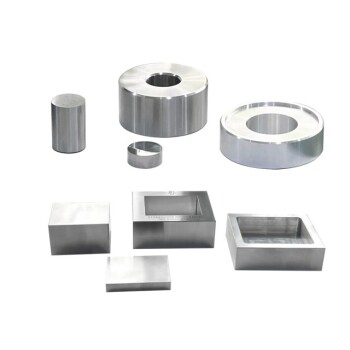
- Special Heat Press Mold for Lab Use
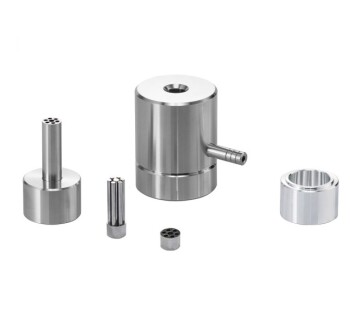
- Double Plate Heating Press Mold for Lab
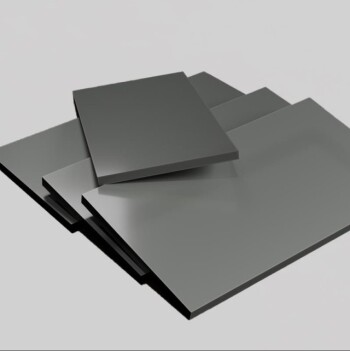
- Carbon Graphite Plate Manufactured by Isostatic Pressing Method
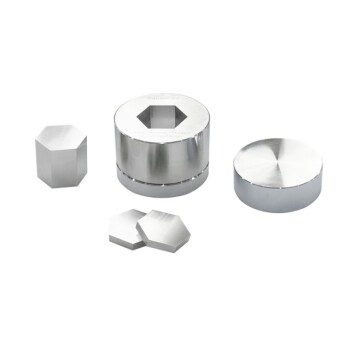
- Polygon Press Mold for Lab
- 2200 ℃ Graphite Vacuum Heat Treat Furnace
People Also Ask
- How to use a press mold? Master the Art of Creating Consistent Ceramic Forms
- What is the press mould method? A Guide to Consistent, Detailed Ceramic Forms
- What is a press mold used for? Achieve Repeatable Precision and Efficiency
- What is the function of press molds during the preparation of SiCf/Ti-43Al-9V composites? Achieve Structural Precision
- What is the purpose of specialized pressure devices in sulfide solid-state batteries? Ensure Chemo-Mechanical Stability