Knowledge How is heat transfer in liquids different from that in a vacuum? Mastering Thermal Management for Your Lab
Author avatar

Tech Team · Kintek Solution

Updated 1 week ago

How is heat transfer in liquids different from that in a vacuum? Mastering Thermal Management for Your Lab


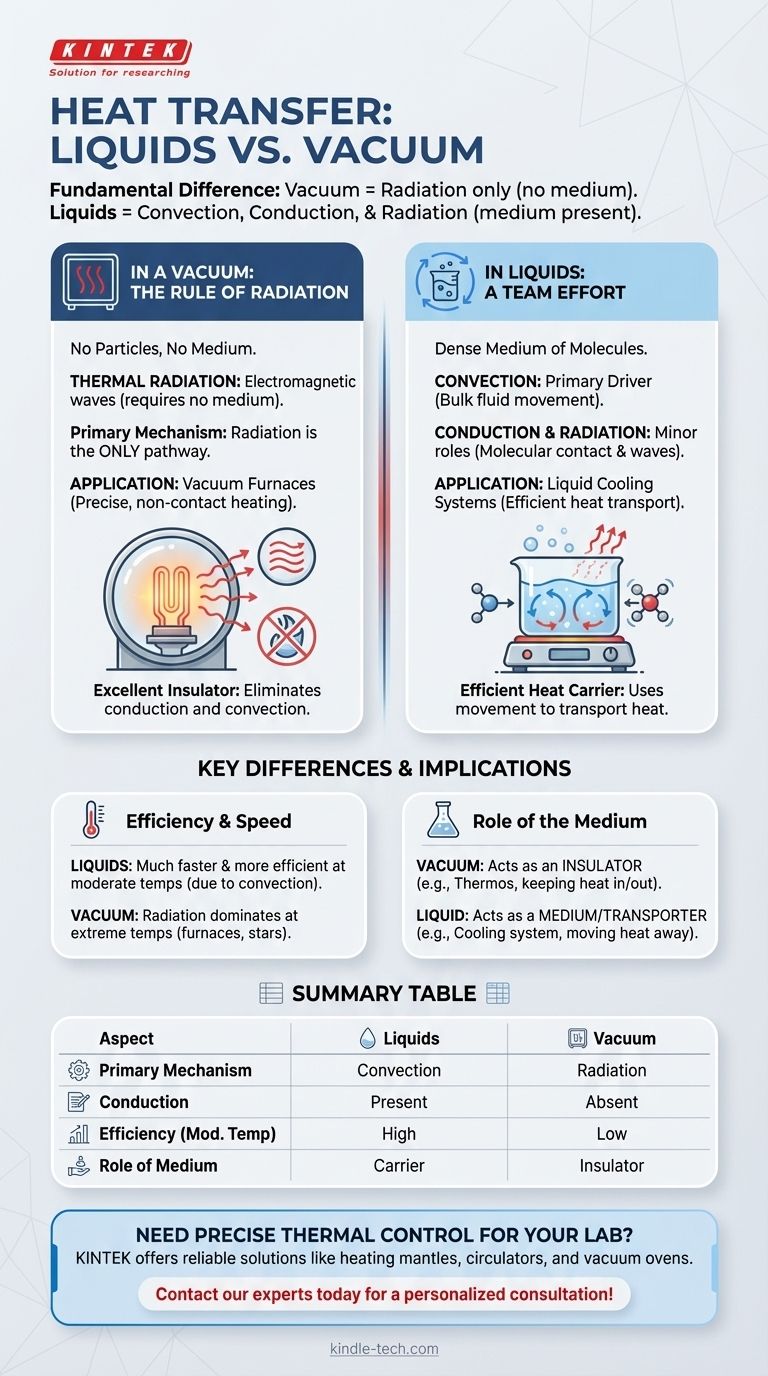
In essence, the fundamental difference between heat transfer in liquids and a vacuum lies in the mechanisms available for energy to travel. A vacuum, being devoid of matter, permits heat transfer exclusively through radiation. Liquids, on the other hand, utilize a combination of convection, conduction, and radiation, with convection typically being the most dominant mechanism.

The presence or absence of a physical medium is the single most important factor. A vacuum eliminates conduction and convection, making it an excellent insulator, while a liquid acts as a carrier, using its own movement to efficiently transport heat.
How is heat transfer in liquids different from that in a vacuum? Mastering Thermal Management for Your Lab

Heat Transfer in a Vacuum: The Rule of Radiation

In the emptiness of a vacuum, there are no particles to collide or flow. This leaves only one pathway for thermal energy to move from one place to another.

What is Thermal Radiation?

Thermal radiation is energy transferred in the form of electromagnetic waves, similar to light or radio waves. It does not require any medium to propagate.

Any object with a temperature above absolute zero emits this radiation. The hotter the object, the more energy it radiates. This is how the sun's heat travels through the vacuum of space to reach Earth.

No Medium Required

This is the defining characteristic of radiative heat transfer. It can move through a perfect vacuum unimpeded, which is impossible for other forms of heat transfer.

Application: Vacuum Furnaces

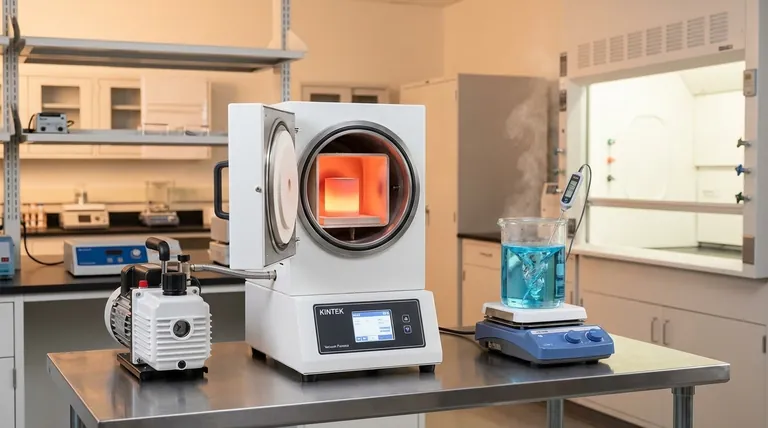
In industrial processes like vacuum induction sintering, this principle is used for precise heating. By removing air, heat transfer by convection is minimized, forcing radiation from a heating element to be the primary method. This allows for uniform, non-contact heating of a material's surface.

Heat Transfer in Liquids: A Team Effort

Unlike a vacuum, a liquid is a dense medium of molecules. This allows for two additional, and often far more effective, methods of heat transfer.

Convection: The Primary Driver

Convection is heat transfer through the bulk movement of a fluid. When a part of a liquid is heated, it expands, becomes less dense, and rises.

Cooler, denser liquid then moves in to take its place, gets heated, and also rises. This creates a continuous circulation, called a convection current, that efficiently distributes heat throughout the liquid. This is the main principle behind boiling a pot of water.

Conduction: The Molecular Hand-off

Conduction is the transfer of heat through direct molecular contact. Vibrating (hot) molecules bump into their neighbors, transferring kinetic energy to them.

While conduction occurs in liquids, its effect is often overshadowed by the much faster and large-scale energy transport provided by convection.

The Minor Role of Radiation

Radiation still occurs in liquids. Heat can be radiated from the surface of the liquid, and some radiation can travel through the liquid itself, though it is often absorbed quickly. In most common scenarios, however, its contribution is small compared to convection.

Understanding the Key Differences

The practical implications of these distinct mechanisms are significant, defining their use in engineering and science.

Efficiency and Speed

At everyday temperatures, convection in liquids is a much faster and more efficient way to transfer heat than radiation alone. This is why liquid cooling systems are so effective.

Radiation's effectiveness, however, increases dramatically with temperature. In the extreme heat of a furnace or a star, radiation becomes the dominant mode of heat transfer.

The Role of the Medium

A vacuum is an excellent insulator against conduction and convection. This is the principle behind vacuum flasks (like a Thermos), which use a vacuum layer to keep liquids hot or cold.

A liquid, conversely, is a medium for heat transfer. Its purpose in a cooling system is to absorb heat in one place and physically transport it somewhere else.

Making the Right Choice for Your Goal

Understanding these mechanisms allows you to control thermal energy for a specific purpose.

  • If your primary focus is insulation or high-temperature processing: A vacuum is your tool. It eliminates conduction and convection, allowing you to either trap heat or control it precisely using radiation.
  • If your primary focus is rapid cooling or heat distribution: A liquid is your solution. You must engineer a system that promotes strong convection currents to carry heat away quickly and efficiently.

Ultimately, mastering thermal management begins with understanding how the chosen medium—or the lack thereof—dictates the rules of energy transfer.

Summary Table:

Aspect Heat Transfer in Liquids Heat Transfer in a Vacuum
Primary Mechanism Convection (bulk fluid movement) Radiation (electromagnetic waves)
Conduction Present (molecular contact) Absent (no medium)
Efficiency at Moderate Temperatures High (due to convection) Low
Role of Medium Acts as a heat carrier Acts as an insulator
Common Applications Liquid cooling systems, heating baths Vacuum furnaces, thermal insulation

Need precise thermal control for your laboratory processes?

Whether your application requires the rapid, uniform heating of a liquid bath or the contamination-free, high-temperature environment of a vacuum furnace, KINTEK has the expertise and equipment to meet your needs. Our range of lab equipment, including heating mantles, circulators, and vacuum ovens, is designed to deliver reliable performance and exact temperature control.

Let us help you select the right solution for your specific thermal management challenges. Contact our experts today for a personalized consultation!

Visual Guide
How is heat transfer in liquids different from that in a vacuum? Mastering Thermal Management for Your Lab Visual Guide

Related Products

People Also Ask

Related Products

Heated Hydraulic Press Machine with Heated Plates for Vacuum Box Laboratory Hot Press

Heated Hydraulic Press Machine with Heated Plates for Vacuum Box Laboratory Hot Press

The lab press for vacuum box is a specialized piece of equipment designed for laboratory use. Its main purpose is to press pills and powders according to specific requirements.

Molybdenum Vacuum Heat Treat Furnace

Molybdenum Vacuum Heat Treat Furnace

Discover the benefits of a high-configuration molybdenum vacuum furnace with heat shield insulation. Ideal for high-purity, vacuum environments like sapphire crystal growth and heat treatment.

Vacuum Heat Treat Furnace with Ceramic Fiber Liner

Vacuum Heat Treat Furnace with Ceramic Fiber Liner

Vacuum furnace with polycrystalline ceramic fiber insulation liner for excellent heat insulation and uniform temperature field. Choose from 1200℃ or 1700℃ max. working temperature with high vacuum performance and precise temperature control.

Electric Heated Hydraulic Vacuum Heat Press for Lab

Electric Heated Hydraulic Vacuum Heat Press for Lab

The Electric Vacuum Heat Press is a specialized heat press equipment that operates in a vacuum environment, utilizing advanced infrared heating and precise temperature control for high quality, rugged and reliable performance.

Heated Hydraulic Press Machine with Heated Plates for Vacuum Box Laboratory Hot Press

Heated Hydraulic Press Machine with Heated Plates for Vacuum Box Laboratory Hot Press

Enhance your lab's precision with our lab press for vacuum box. Press pills and powders with ease and precision in a vacuum environment, reducing oxidation and improving consistency. Compact and easy to use with a digital pressure gauge.

Manual High Temperature Heated Hydraulic Press Machine with Heated Plates for Lab

Manual High Temperature Heated Hydraulic Press Machine with Heated Plates for Lab

The High Temperature Hot Press is a machine specifically designed for pressing, sintering and processing materials in a high temperature environment. It is capable of operating in the range of hundreds of degrees Celsius to thousands of degrees Celsius for a variety of high temperature process requirements.

Vacuum Hot Press Furnace Heated Vacuum Press Machine Tube Furnace

Vacuum Hot Press Furnace Heated Vacuum Press Machine Tube Furnace

Reduce forming pressure & shorten sintering time with Vacuum Tube Hot Press Furnace for high-density, fine-grain materials. Ideal for refractory metals.

600T Vacuum Induction Hot Press Furnace for Heat Treat and Sintering

600T Vacuum Induction Hot Press Furnace for Heat Treat and Sintering

Discover the 600T Vacuum Induction Hot Press Furnace, designed for high-temperature sintering experiments in vacuum or protected atmospheres. Its precise temperature and pressure control, adjustable working pressure, and advanced safety features make it ideal for nonmetal materials, carbon composites, ceramics, and metal powders.

Warm Isostatic Press WIP Workstation 300Mpa for High Pressure Applications

Warm Isostatic Press WIP Workstation 300Mpa for High Pressure Applications

Discover Warm Isostatic Pressing (WIP) - A cutting-edge technology that enables uniform pressure to shape and press powdered products at a precise temperature. Ideal for complex parts and components in manufacturing.

Double Plate Heating Press Mold for Lab

Double Plate Heating Press Mold for Lab

Discover precision in heating with our Double Plate Heating Mold, featuring high-quality steel and uniform temperature control for efficient lab processes. Ideal for various thermal applications.

Warm Isostatic Press for Solid State Battery Research

Warm Isostatic Press for Solid State Battery Research

Discover the advanced Warm Isostatic Press (WIP) for semiconductor lamination. Ideal for MLCC, hybrid chips, and medical electronics. Enhance strength and stability with precision.

Vacuum Hot Press Furnace Machine for Lamination and Heating

Vacuum Hot Press Furnace Machine for Lamination and Heating

Experience clean and precise lamination with Vacuum Lamination Press. Perfect for wafer bonding, thin-film transformations, and LCP lamination. Order now!

Automatic Heated Hydraulic Press Machine with Heated Plates for Laboratory Hot Press

Automatic Heated Hydraulic Press Machine with Heated Plates for Laboratory Hot Press

The Automatic High Temperature Heat Press is a sophisticated hydraulic hot press designed for efficient temperature control and product quality processing.

Laboratory Hydraulic Press Split Electric Lab Pellet Press

Laboratory Hydraulic Press Split Electric Lab Pellet Press

Efficiently prepare samples with a split electric lab press - available in various sizes and ideal for material research, pharmacy, and ceramics. Enjoy greater versatility and higher pressure with this portable and programmable option.

Vacuum Hot Press Furnace Machine Heated Vacuum Press

Vacuum Hot Press Furnace Machine Heated Vacuum Press

Discover the advantages of Vacuum Hot Press Furnace! Manufacture dense refractory metals & compounds, ceramics, and composites under high temp and pressure.

Vacuum Heat Treat and Molybdenum Wire Sintering Furnace for Vacuum Sintering

Vacuum Heat Treat and Molybdenum Wire Sintering Furnace for Vacuum Sintering

A vacuum molybdenum wire sintering furnace is a vertical or bedroom structure, which is suitable for withdrawal, brazing, sintering and degassing of metal materials under high vacuum and high temperature conditions. It is also suitable for dehydroxylation treatment of quartz materials.

Heated Hydraulic Press Machine with Heated Plates Split Manual Laboratory Hot Press

Heated Hydraulic Press Machine with Heated Plates Split Manual Laboratory Hot Press

Efficiently prepare your samples with our Split Manual Heated Lab Press. With a pressure range up to 40T and heating plates up to 300°C, it's perfect for various industries.

2200 ℃ Graphite Vacuum Heat Treat Furnace

2200 ℃ Graphite Vacuum Heat Treat Furnace

Discover the power of the KT-VG Graphite Vacuum Furnace - with a maximum working temperature of 2200℃, it's perfect for vacuum sintering of various materials. Learn more now.

Automatic High Temperature Heated Hydraulic Press Machine with Heated Plates for Lab

Automatic High Temperature Heated Hydraulic Press Machine with Heated Plates for Lab

The High Temperature Hot Press is a machine specifically designed for pressing, sintering and processing materials in a high temperature environment. It is capable of operating in the range of hundreds of degrees Celsius to thousands of degrees Celsius for a variety of high temperature process requirements.

30T 40T Split Automatic Heated Hydraulic Press Machine with Heated Plates for Laboratory Hot Press

30T 40T Split Automatic Heated Hydraulic Press Machine with Heated Plates for Laboratory Hot Press

Discover our split automatic heated lab press 30T/40T for precise sample preparation in material research, pharmacy, ceramics, and electronics industries. With a small footprint and heating up to 300°C, it's perfect for processing under vacuum environment.


Leave Your Message