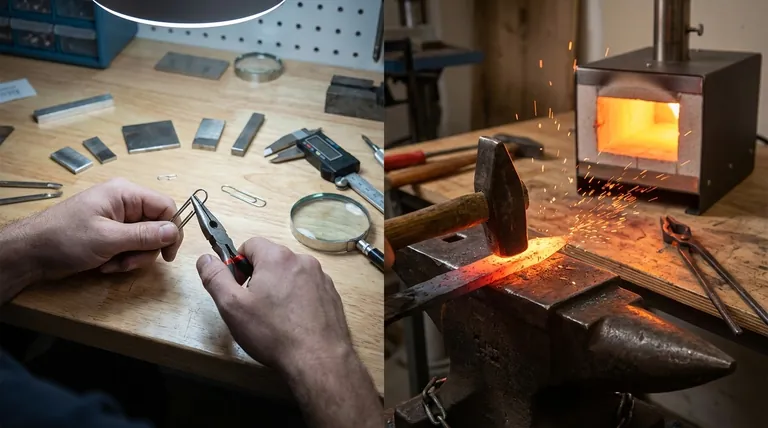
A classic example of cold working is bending a paperclip until it becomes stiff and eventually snaps. An equally classic example of hot working is a blacksmith heating steel in a forge until it glows red, then hammering it into the shape of a sword. While one is done at room temperature and the other in a furnace, the true difference lies in the metal's internal structure during the process.
The critical distinction between hot and cold working is not the absolute temperature, but whether the process occurs above or below the metal's specific recrystallization temperature. This single factor dictates the material's final strength, ductility, and internal stress.
What Defines "Hot" vs. "Cold" Working?
The concepts of "hot" and "cold" in metallurgy are relative. A process like hot rolling steel occurs at over 1700°F (930°C), while "hot" working lead can happen at temperatures just slightly above room temperature. It all depends on the material's unique properties.
The Critical Role of Recrystallization Temperature
Every metal has a recrystallization temperature, the point at which new, strain-free grains can form within its crystal structure.
Cold working is any metal forming process performed below this temperature.
Hot working is any process performed above this temperature. This is the fundamental, defining principle.
How Grains Behave Below Recrystallization (Cold Working)
During cold working, the metal's existing crystal grains are deformed, elongated, and distorted in the direction of the work being done.
This process introduces defects called dislocations, which tangle up and impede further grain movement. This phenomenon is known as strain hardening or work hardening.
The result is a metal that is significantly stronger and harder, but also less ductile and more brittle.
How Grains Behave Above Recrystallization (Hot Working)
When a metal is worked above its recrystallization temperature, something remarkable happens. The deformation process is immediately followed by the formation of new, unstressed grains.
This "healing" process, known as dynamic recrystallization, happens concurrently with the shaping.
Because the grain structure is constantly renewing itself, the metal does not strain harden. It remains soft and highly ductile, allowing for enormous changes in shape with relatively little force.
A Practical Comparison: The Impact on Material Properties
The choice between hot and cold working is a deliberate engineering decision made to achieve specific material properties in the final product.
Strength and Hardness
Cold working increases strength and hardness. This is the primary reason for choosing it when the final part needs to be strong and wear-resistant, like in the manufacturing of high-strength bolts and wires.
Hot working does not significantly increase strength. The material's properties remain relatively uniform and isotropic (the same in all directions).
Ductility and Brittleness
Cold working decreases ductility, making the metal more brittle. Bending a paperclip back and forth makes it harder to bend again but also brings it closer to snapping.
Hot working maintains or even improves ductility. This makes it ideal for processes that require massive shape changes, like forging an engine crankshaft from a single billet.
Surface Finish and Dimensional Accuracy
Cold working produces a smooth, scale-free surface finish and allows for very tight dimensional tolerances. No heat means no oxidation and no shrinkage upon cooling.
Hot working often results in a rough, oxidized surface layer called mill scale, which may need to be removed. The high temperatures and subsequent cooling also make precise dimensional control more challenging.
Understanding the Trade-offs
Neither process is universally superior; each comes with its own set of advantages and disadvantages that must be balanced for a given application.
The Cost of Energy
Hot working is energy-intensive. A significant amount of energy is required to heat large billets of metal in a furnace and maintain their temperature during the forming process.
Cold working requires minimal energy for heating, lowering operational costs in that regard. However, the forces required to shape the hardened metal are much higher, demanding more powerful machinery.
The Need for Annealing
After significant cold work, a part may become too brittle for its intended use or for subsequent forming operations.
It often requires an intermediate heating step called annealing to relieve internal stresses and restore some ductility, adding complexity and cost to the manufacturing cycle.
Tooling and Equipment
The extreme temperatures of hot working cause more rapid wear and degradation of dies, rolls, and presses. Tooling must be made from specialized, expensive, heat-resistant materials.
Cold working tooling, while needing to be very robust to handle high pressures, does not face the challenge of thermal fatigue.
Making the Right Choice for Your Goal
Selecting the correct process requires a clear understanding of the desired outcome for the finished component.
- If your primary focus is maximum strength and a precise, smooth finish: Cold working is the correct path, as seen in the production of precision tubing, fasteners, and sheet metal for car bodies.
- If your primary focus is making very large changes to a metal's shape with minimal force: Hot working is the necessary choice, used for creating foundational shapes like I-beams, railroad tracks, and large forgings.
Ultimately, understanding this temperature threshold empowers you to select the right process to intentionally control a metal's final properties.
Summary Table:
| Aspect | Cold Working | Hot Working |
|---|---|---|
| Temperature | Below recrystallization temperature | Above recrystallization temperature |
| Strength & Hardness | Increases | No significant increase |
| Ductility | Decreases | Maintains or improves |
| Surface Finish | Smooth, precise | Rough, may have scale |
| Primary Use | High-strength parts, precise tolerances | Large shape changes, massive forgings |
Need to choose the right metalworking process for your lab or production needs? KINTEK specializes in providing high-quality lab equipment and consumables, including furnaces for heat treatment and tools for material testing. Whether you're researching material properties or scaling up production, our expertise ensures you get the precise results you need. Contact us today to discuss how we can support your project with reliable, performance-driven solutions.
Visual Guide

Related Products
- Vacuum Hot Press Furnace Heated Vacuum Press Machine Tube Furnace
- Vacuum Hot Press Furnace Machine Heated Vacuum Press
- Electric Heated Hydraulic Vacuum Heat Press for Lab
- Vacuum Hot Press Furnace Machine for Lamination and Heating
- Heated Hydraulic Press Machine with Heated Plates for Vacuum Box Laboratory Hot Press
People Also Ask
- What is pressure-assisted sintering? Achieve Denser, Stronger Materials Faster
- What are the advantages and disadvantages of hot pressing? Choose the Right Powder Metallurgy Process
- What is the sintering process of hot pressing? Achieve Maximum Density and Complex Shapes
- What is the hot pressing method of sintering? A Guide to High-Density Material Fabrication
- What is vacuum hot pressing? Achieve Maximum Density & Purity in Advanced Materials