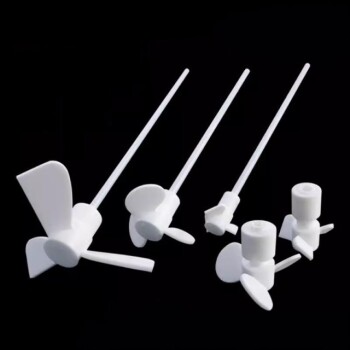
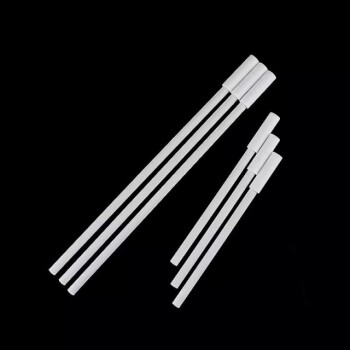
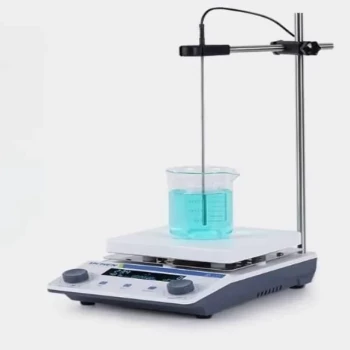
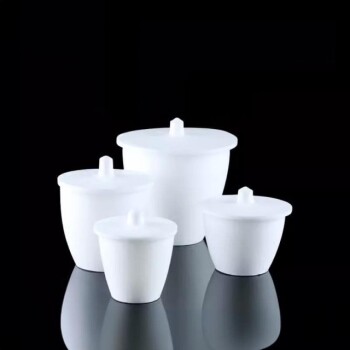
The primary role of a PTFE magnetic stirrer in polyester degradation is to act as the central mechanism for achieving homogeneity within a heterogeneous system. Through high-speed rotation, these stirrers generate intense shear forces and convection, ensuring that solid powders are ideally dispersed into liquid-phase ionic liquids and methanol solvents.
The specific value of Polytetrafluoroethylene (PTFE) lies in its ability to withstand harsh reaction environments without compromising the sample. Its chemical inertness and temperature resistance prevent the stirrer itself from degrading, ensuring the final product is free from leached metals or polymer contaminants.
Achieving Homogeneity in Heterogeneous Systems
Generating Shear and Convection
In a polyester degradation vessel, simple stirring is often insufficient. The system requires high-strength stirrers capable of high-speed rotation to create powerful shear forces. This mechanical action drives convection currents throughout the vessel, ensuring kinetic uniformity.
Mixing Solids with Solvents
These reactions typically involve a heterogeneous mix of solid powders and liquid solvents, such as ionic liquids and methanol. The stirrer serves to suspend the solid particles continuously. This prevents sedimentation and maximizes the surface area contact between the solid reactants and the liquid phase.
Preserving Product Purity Under Stress
Resistance to Chemical Attack
The degradation environment typically utilizes potent solvents and catalysts. PTFE is selected for its exceptional chemical inertness. Unlike metal or lower-grade plastic alternatives, it resists chemical attack, preventing the stirrer material from leaching into the reaction mixture.
Withstanding Thermal Stress
Degradation reactions frequently occur at elevated temperatures. PTFE maintains its structural integrity under these thermal loads. This durability prevents wear or physical degradation of the stirrer bar during prolonged catalytic reactions.
The Critical Trade-off: Durability vs. Purity
The Risk of Contamination
In high-pressure and high-temperature contexts, the wrong stirrer material is a liability. Metal stirrers can introduce metallic ions, while non-reinforced polymers may melt or shed micro-particles.
Eliminating Impurities
The use of PTFE eliminates these specific contamination vectors. By resisting both physical wear and chemical breakdown, it ensures that the recovered degradation products remain pure. This is vital for downstream analysis or repolymerization, where even trace impurities can ruin the result.
Making the Right Choice for Your Goal
To maximize the efficacy of your polyester degradation process, consider the following operational priorities:
- If your primary focus is reaction kinetics: Prioritize high rotational speeds to generate sufficient shear, ensuring the solid powders remain fully suspended in the ionic liquid solvent.
- If your primary focus is product purity: Rely on the high-grade inertness of PTFE to prevent material leaching, ensuring your recovered products are free of metal or polymer cross-contamination.
By selecting high-strength PTFE magnetic stirrers, you secure both the mechanical efficiency required for the reaction and the chemical integrity required for the result.
Summary Table:
| Feature | Benefit in Polyester Degradation |
|---|---|
| Chemical Inertness | Prevents leaching and ensures zero contamination of degradation products. |
| High-Shear Rotation | Creates intense convection to disperse solid powders into liquid solvents. |
| Thermal Resistance | Maintains structural integrity under high-temperature and high-pressure stress. |
| Kinetic Uniformity | Prevents sedimentation and maximizes surface area contact for catalysts. |
Optimize Your Chemical Reactions with KINTEK Precision
Achieving pure results in high-temperature and high-pressure environments requires equipment that never compromises. KINTEK specializes in high-performance laboratory solutions, providing the durability and inertness necessary for advanced material research.
Whether you are conducting polyester degradation or complex synthesis, our extensive range of high-temperature high-pressure reactors, autoclaves, and premium PTFE consumables ensures your samples remain contaminant-free. From precision crushing and milling systems to specialized electrolytic cells, we provide the tools to drive your innovation forward.
Ready to elevate your lab's efficiency and product purity? Contact our technical experts today to find the perfect match for your research needs!
References
- Emma McCrea, Małgorzata Swadźba‐Kwaśny. Methanolysis of polyethylene terephthalate (PET) using non-stoichiometric protic ionic liquids. DOI: 10.1039/d5su00316d
This article is also based on technical information from Kintek Solution Knowledge Base .
Related Products
- Custom PTFE Teflon Parts Manufacturer for Magnetic Stirring Bar
- Custom PTFE Teflon Parts Manufacturer Laboratory High Temperature Mixing Paddle Mixer
- Custom PTFE Teflon Parts Manufacturer for Reagent Wide Mouth Fine Mouth Sample High Temperature Bottles
- Custom PTFE Teflon Parts Manufacturer for PTFE Stirring Bar Recovery Rod
- Laboratory Small Constant Temperature Heated Magnetic Stirrer Heater and Stirrer
People Also Ask
- What is the function of a magnetic stirrer during the alkaline etching of nano-silicon carbide? Essential Mixing Guide
- Why is a powerful magnetic stirrer essential during photocatalytic degradation? Ensure Accurate Catalyst Performance
- What is the function of a magnetic stirrer in simulating industrial sulfolane environments? Master Fluid Dynamics
- What is the function of a magnetic stirrer in MgAl-LDH coprecipitation? Ensure Uniformity and Precision
- What is the function of a magnetic stirrer in co-precipitation? Ensure Homogeneity in Doped ZnO Synthesis