Knowledge Does PVD change color? Discover the Durable, Fade-Resistant Finish for Your Products
Author avatar

Tech Team · Kintek Solution

Updated 6 days ago

Does PVD change color? Discover the Durable, Fade-Resistant Finish for Your Products


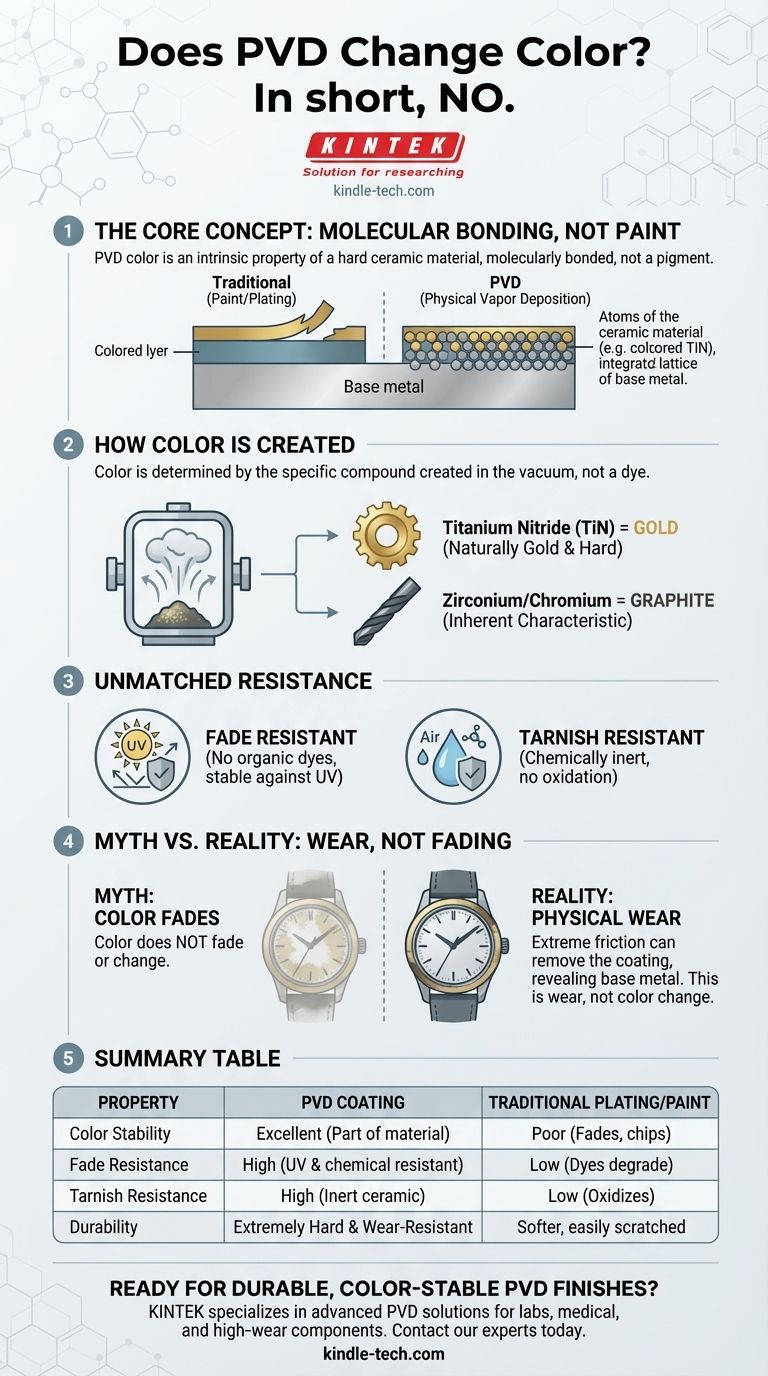
In short, no. Under normal circumstances, a PVD coating does not change color, fade, or tarnish. The color you see is an intrinsic property of an extremely hard ceramic material that is molecularly bonded to the base metal, making it exceptionally stable over time.

The core reason people worry about colored metal is their experience with paints that fade or plating that wears off. PVD is fundamentally different. Its color comes from the very structure of the durable, wear-resistant layer itself, not from pigments or dyes that can degrade.
Does PVD change color? Discover the Durable, Fade-Resistant Finish for Your Products

What Exactly is a PVD Coating?

To understand why the color is so stable, you must understand that PVD is not a liquid coating. It is a highly technical vacuum deposition process that creates a thin film with superior properties.

It's Not Paint or Plating

Traditional methods like painting apply a layer of pigment on top of a surface. Electroplating deposits a thin layer of metal, like gold or chrome, which can wear away or flake off.

PVD (Physical Vapor Deposition) is a process where a solid material is vaporized in a vacuum and deposited onto the surface of a part. This creates a metal-ceramic layer that is molecularly bonded to the substrate.

How the Color is Created

The color of a PVD finish is not a dye. It is determined by the specific compound created during the process.

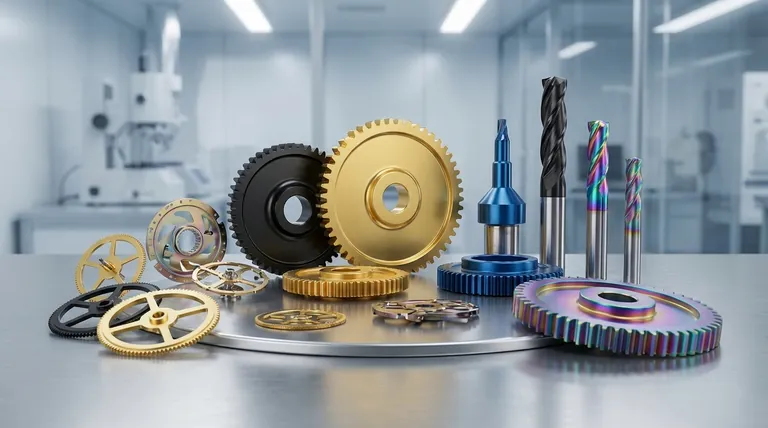
For example, a "gold" PVD finish is often Titanium Nitride, a ceramic that is naturally gold in color and incredibly hard. A "graphite" finish might be created using Zirconium or Chromium. The color is an inherent characteristic of this new, ultra-hard surface.

How PVD Color Holds Up Over Time

Because the color is integral to the ceramic layer, it resists the most common causes of discoloration that affect other finishes.

Unmatched Resistance to Fading

Since there are no organic dyes or pigments, a PVD coating is highly resistant to fading from UV light or sun exposure. Its color will remain consistent for years.

Superior Resistance to Tarnishing

The ceramic layer created by the PVD process is chemically inert and non-reactive. This means it will not oxidize or tarnish when exposed to air, moisture, or common chemicals, which is why it's a favored finish for watches, jewelry, and bathroom fixtures.

Understanding the Trade-offs: When PVD Can "Change"

While PVD is incredibly durable, it is not indestructible. It's critical to distinguish between color fading and physical wear.

The Myth of Fading vs. The Reality of Wear

A PVD coating will not fade, but with extreme and persistent friction or abrasion, the coating itself can eventually be worn away. If this happens, you are not seeing a color change—you are seeing the base metal underneath as the coating has been physically removed in that area.

This level of wear requires significant abuse, far beyond what would be seen in typical daily use for products like watches or faucets.

The Need for Special Removal

The durability of a PVD coating is proven by the fact that it cannot be removed easily.

As the references note, specialized industrial "de-coating" processes are required to strip the PVD layer without damaging the underlying product. This underscores its permanence under any normal condition.

Making the Right Choice for Your Goal

PVD is a premium finish chosen for its exceptional durability and color stability. Deciding if it's right for you depends entirely on your priority.

  • If your primary focus is long-term color stability for a daily-use item (like a watch, ring, or faucet): PVD is one of the most reliable and colorfast finishing options you can choose.
  • If your primary focus is protecting a component from extreme industrial abrasion (like a drill bit): The PVD coating provides a sacrificial layer of hardness that will eventually wear away, but its purpose is to dramatically extend the tool's life.

By choosing a PVD-coated product, you are investing in a finish engineered for superior durability and lasting color.

Summary Table:

Property PVD Coating Traditional Plating/Paint
Color Stability Excellent (color is part of the material) Poor (can fade, chip, or wear)
Fade Resistance High (resistant to UV light and chemicals) Low (dyes and pigments can degrade)
Tarnish Resistance High (chemically inert ceramic layer) Low (can oxidize and tarnish)
Durability Extremely hard and wear-resistant Softer, can be easily scratched or worn away

Ready to integrate durable, color-stable PVD finishes into your products?

At KINTEK, we specialize in advanced PVD coating solutions for laboratory equipment, medical devices, and high-wear components. Our expertise ensures your products benefit from a finish that combines lasting beauty with superior protection.

Contact our experts today to discuss how PVD coating can enhance your product's performance and longevity.

Visual Guide
Does PVD change color? Discover the Durable, Fade-Resistant Finish for Your Products Visual Guide

Related Products

People Also Ask

Related Products

Custom CVD Diamond Coating for Lab Applications

Custom CVD Diamond Coating for Lab Applications

CVD Diamond Coating: Superior Thermal Conductivity, Crystal Quality, and Adhesion for Cutting Tools, Friction, and Acoustic Applications

RF PECVD System Radio Frequency Plasma-Enhanced Chemical Vapor Deposition RF PECVD

RF PECVD System Radio Frequency Plasma-Enhanced Chemical Vapor Deposition RF PECVD

RF-PECVD is an acronym for "Radio Frequency Plasma-Enhanced Chemical Vapor Deposition." It deposits DLC (Diamond-like carbon film) on germanium and silicon substrates. It is utilized in the 3-12um infrared wavelength range.

Vacuum Hot Press Furnace Machine for Lamination and Heating

Vacuum Hot Press Furnace Machine for Lamination and Heating

Experience clean and precise lamination with Vacuum Lamination Press. Perfect for wafer bonding, thin-film transformations, and LCP lamination. Order now!

Vacuum Dental Porcelain Sintering Furnace

Vacuum Dental Porcelain Sintering Furnace

Get precise and reliable results with KinTek's Vacuum Porcelain Furnace. Suitable for all porcelain powders, it features hyperbolic ceramic furnace function, voice prompt, and automatic temperature calibration.

Molybdenum Disilicide (MoSi2) Thermal Elements Electric Furnace Heating Element

Molybdenum Disilicide (MoSi2) Thermal Elements Electric Furnace Heating Element

Discover the power of Molybdenum Disilicide (MoSi2) Heating Element for high-temperature resistance. Unique oxidation resistance with stable resistance value. Learn more about its benefits now!

Silicon Carbide (SIC) Ceramic Sheet Wear-Resistant Engineering Advanced Fine Ceramics

Silicon Carbide (SIC) Ceramic Sheet Wear-Resistant Engineering Advanced Fine Ceramics

Silicon carbide (sic) ceramic sheet is composed of high-purity silicon carbide and ultra-fine powder, which is formed by vibration molding and high-temperature sintering.

Rotating Platinum Disk Electrode for Electrochemical Applications

Rotating Platinum Disk Electrode for Electrochemical Applications

Upgrade your electrochemical experiments with our Platinum Disc Electrode. High-quality and reliable for accurate results.

Electrolytic Electrochemical Cell for Coating Evaluation

Electrolytic Electrochemical Cell for Coating Evaluation

Looking for corrosion-resistant coating evaluation electrolytic cells for electrochemical experiments? Our cells boast complete specifications, good sealing, high-quality materials, safety, and durability. Plus, they're easily customizable to meet your needs.

Platinum Sheet Electrode for Laboratory and Industrial Applications

Platinum Sheet Electrode for Laboratory and Industrial Applications

Elevate your experiments with our Platinum Sheet Electrode. Crafted with quality materials, our safe and durable models can be tailored to fit your needs.

Cylindrical Resonator MPCVD Machine System Reactor for Microwave Plasma Chemical Vapor Deposition and Lab Diamond Growth

Cylindrical Resonator MPCVD Machine System Reactor for Microwave Plasma Chemical Vapor Deposition and Lab Diamond Growth

Learn about Cylindrical Resonator MPCVD Machine, the microwave plasma chemical vapor deposition method used for growing diamond gemstones and films in the jewelry and semi-conductor industries. Discover its cost-effective advantages over traditional HPHT methods.

Graphite Vacuum Continuous Graphitization Furnace

Graphite Vacuum Continuous Graphitization Furnace

High-temperature graphitization furnace is a professional equipment for graphitization treatment of carbon materials. It is a key equipment for the production of high-quality graphite products. It has high temperature, high efficiency and uniform heating. It is suitable for various high-temperature treatments and graphitization treatments. It is widely used in metallurgy, electronics, aerospace, etc. industry.

Precision Machined Zirconia Ceramic Ball for Engineering Advanced Fine Ceramics

Precision Machined Zirconia Ceramic Ball for Engineering Advanced Fine Ceramics

zirconia ceramic ball have the characteristics of high strength, high hardness, PPM wear level, high fracture toughness, good wear resistance, and high specific gravity.

1400℃ Controlled Atmosphere Furnace with Nitrogen and Inert Atmosphere

1400℃ Controlled Atmosphere Furnace with Nitrogen and Inert Atmosphere

Achieve precise heat treatment with KT-14A controlled atmosphere furnace. Vacuum sealed with a smart controller, it's ideal for lab and industrial use up to 1400℃.

1200℃ Split Tube Furnace with Quartz Tube Laboratory Tubular Furnace

1200℃ Split Tube Furnace with Quartz Tube Laboratory Tubular Furnace

KT-TF12 split tube furnace: high-purity insulation, embedded heating wire coils, and max. 1200C. Widely used for new materials and chemical vapour deposition.

Vertical Laboratory Quartz Tube Furnace Tubular Furnace

Vertical Laboratory Quartz Tube Furnace Tubular Furnace

Elevate your experiments with our Vertical Tube Furnace. Versatile design allows for operation under various environments and heat treatment applications. Order now for precise results!

Hexagonal Boron Nitride HBN Thermocouple Protection Tube

Hexagonal Boron Nitride HBN Thermocouple Protection Tube

Hexagonal boron nitride ceramics is an emerging industrial material. Because of its similar structure to graphite and many similarities in performance, it is also called "white graphite".

Laboratory Vibratory Sieve Shaker Machine Slap Vibrating Sieve

Laboratory Vibratory Sieve Shaker Machine Slap Vibrating Sieve

KT-T200TAP is a slapping and oscillating sieving instrument for laboratory desktop use, with 300 rpm horizontal circular motion and 300 vertical slapping motions to simulate manual sieving to help sample particles pass through better.

Silicon Carbide SiC Thermal Heating Elements for Electric Furnace

Silicon Carbide SiC Thermal Heating Elements for Electric Furnace

Experience the advantages of Silicon Carbide (SiC) Heating Element: Long service life, high corrosion and oxidation resistance, fast heating speed, and easy maintenance. Learn more now!

Platinum Auxiliary Electrode for Laboratory Use

Platinum Auxiliary Electrode for Laboratory Use

Optimize your electrochemical experiments with our Platinum Auxiliary Electrode. Our high-quality, customizable models are safe and durable. Upgrade today!

Graphite Vacuum Furnace IGBT Experimental Graphitization Furnace

Graphite Vacuum Furnace IGBT Experimental Graphitization Furnace

IGBT experimental graphitization furnace, a tailored solution for universities and research institutions, with high heating efficiency, user-friendliness, and precise temperature control.


Leave Your Message